


Cardboard Shockwave: Japan’s $2,500 Drones Shatter Billion-Dollar Military Logic, Redefining Global Conflict
POLICY WIRE — Tokyo, Japan — The quiet rustle of corrugated fiberboard, not the thrum of jet engines or the hum of sophisticated radar, is what’s unsettling defense ministries across the globe....

POLICY WIRE — Tokyo, Japan — The quiet rustle of corrugated fiberboard, not the thrum of jet engines or the hum of sophisticated radar, is what’s unsettling defense ministries across the globe. Forget the multi-million-dollar stealth aircraft, the advanced missile defense systems – the future of asymmetric warfare might just be found in a Japanese factory, crafted from humble cardboard, and priced like a mid-range laptop.
It’s an audacious reversal, isn’t it? For decades, military strategists and defense contractors alike have operated under a singular, escalating logic: more advanced, more expensive, more impenetrable. Yet, here we’re, watching a ~$2,500 drone, designed by the Australian subsidiary of Japan’s SYPAQ Systems, perform tasks previously reserved for far costlier, more complex machinery. It’s a bitter pill to swallow for those who’ve staked careers (and national budgets) on the premise that technological supremacy equates to unassailable dominance.
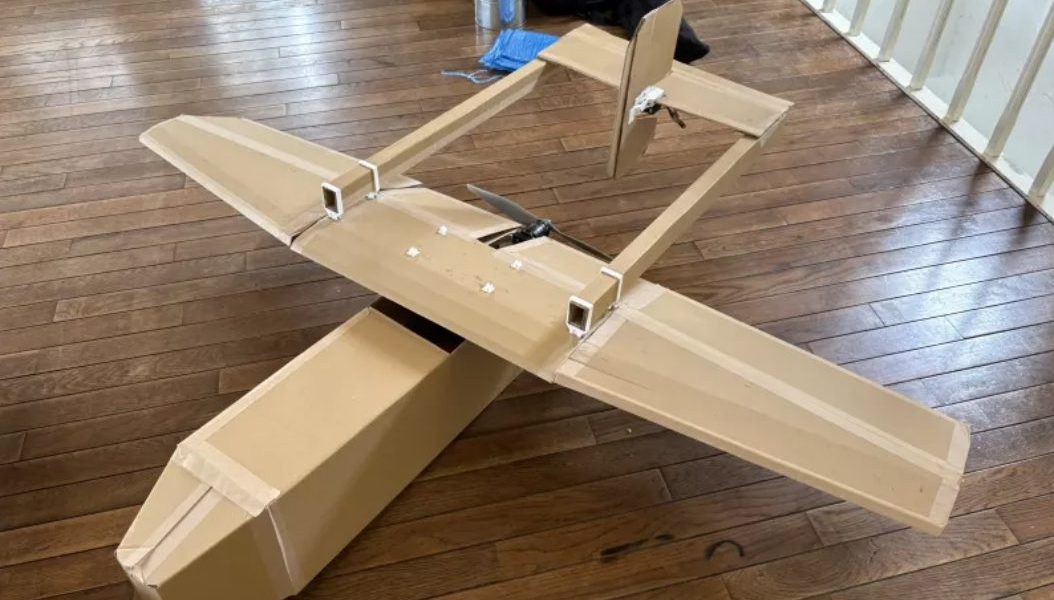
And these aren’t toy planes. Dubbed the ‘Corvo PPDS’ (Precision Payload Delivery System), these paper marvels aren’t just for delivering supplies to remote frontlines. They’ve been deployed in Ukraine, reportedly with considerable success, as reconnaissance platforms and even, in some audacious instances, as rudimentary attack drones. They’re light, easily assembled, and crucially, their low radar signature—owing to their non-metallic composition—makes them a nightmare for sophisticated air defense systems built to detect high-speed, metallic threats. They don’t register, or if they do, they’re often dismissed as anomalous clutter, not genuine threats.
“Frankly, it’s a humbling development. We’ve poured billions into systems designed to counter advanced threats, only to find our adversaries embracing ingenuity born of scarcity. It’s a strategic re-evaluation, a painful one,” observed General Keiichi Tanaka, a seasoned official within Japan’s Ministry of Defense, his tone betraying a mix of admiration and consternation. His sentiments echo quietly through corridors of power, from Washington to Riyadh, as defense planners grapple with this unexpected disruption.
Still, the implications extend far beyond the immediate battlefield. At its core, this cardboard revolution presents a stark challenge to the entrenched military-industrial complex. What happens to the bottom line of defense contractors when a drone that costs less than a week’s rent can confound a missile system valued at millions of dollars per intercept? That’s the real, unsettling question. The U.S. Congressional Budget Office, for instance, estimated in 2023 that a single Patriot missile interceptor costs approximately $3 million. This colossal disparity in cost-exchange ratio makes swarm tactics — deploying dozens or even hundreds of these cheap drones — an economically devastating proposition for any modern military.
The beauty (or terror, depending on your perspective) of these drones lies in their democratizing effect. Nations with modest defense budgets, or even well-resourced non-state actors, can now project a degree of air power previously unimaginable. Imagine the operational headaches for forces tasked with securing vast, permeable borders in regions like South Asia, where asymmetric threats are a constant. Pakistan, for example, shares complex borders where such low-cost, adaptable technology could easily be replicated or acquired, potentially shifting local power dynamics and complicating counter-insurgency efforts significantly. It’s a game-changer for those who can’t afford top-tier weaponry but possess a healthy dose of resourcefulness.
📄 POLICY WIRE WHITEPAPER PUBLISHED: PAKISTAN'S NATIONAL SECURITY POLICY PRIORITIES
👉 READ BY CLICKING HERE“This isn’t about cardboard being inherently superior; it’s about the weaponization of economic asymmetry. When a $2,500 platform can tie up a multi-million-dollar air defense system, you’ve fundamentally altered the cost-benefit analysis of warfare,” shot back Dr. Fatima Zahra, a prominent Geopolitical Strategist at the Al-Azhar Center for Strategic Studies. Her point is cutting: this isn’t about advanced metallurgy, it’s about shrewd tactical exploitation of a financial vulnerability inherent in high-tech defense.
Behind the headlines, this development forces a reckoning. Is the relentless pursuit of hyper-expensive, exquisitely engineered weaponry actually creating vulnerabilities, not strengths? Are we so focused on countering the ‘next-gen’ threat that we’re overlooking the incredibly effective ‘no-tech’ solutions?
What This Means
The advent of effective, low-cost platforms like the Corvo PPDS portends a significant recalibration of global defense strategies and procurement. Economically, we could see a downturn in demand for certain segments of the traditional air defense market, alongside a surge in investment in countermeasures specifically designed for swarm attacks and non-metallic threats. Politically, this levels the playing field, empowering smaller states and non-state actors, potentially leading to increased instability in contested regions. For countries like Pakistan or Bangladesh (where ingenuity often thrives amidst resource constraints, just look at the ‘rail ballet’ phenomenon), such technology offers a compelling, albeit dangerous, path to enhance defensive or offensive capabilities without crippling national budgets. Don’t be surprised if the next generation of military thought embraces simplicity over sophistication, because sometimes, the cheapest solution proves the most strategically devastating.