

Beyond the Pitch: Madrid Forum Unveils Football’s Lucrative, Polished Future
POLICY WIRE — Madrid, Spain — The real game, it seems, isn’t played on the verdant turf anymore. It’s a high-stakes, meticulously choreographed parley held in glass-walled conference rooms, where...

POLICY WIRE — Madrid, Spain — The real game, it seems, isn’t played on the verdant turf anymore. It’s a high-stakes, meticulously choreographed parley held in glass-walled conference rooms, where suits outnumber jerseys and the discourse revolves less around tactics and more around diversified revenue streams. Such was the prevailing atmosphere last week as Madrid, specifically the Riyadh Air Metropolitano stadium, momentarily consecrated itself as the global epicenter for sport’s true orchestrators.
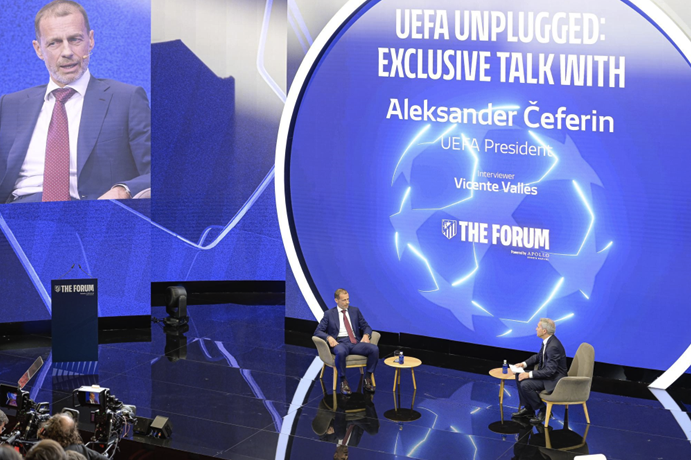
It wasn’t merely a gathering; it was a veritable conclave. Atlético de Madrid, together with Apollo Sports Capital, convened “THE FORUM,” ostensibly to debate football’s future as a global industry. Yet, the subtext shimmered with something far more profound: the wholesale recalibration of what football actually is — transforming from a simple athletic endeavor into an omnivorous entertainment behemoth. Four hundred powerbrokers attended, an elite cadre dissecting strategies to monetize every conceivable fan interaction, every fleeting moment of a club’s existence (and what a lucrative existence it’s, for some).
Enrique Cerezo, Atlético de Madrid’s president, articulated this shift with disarming candor. “The world of football is experiencing significant growth not only as a sport but also as an industry,” he posited, his words echoing through the polished halls. He sounded less like a football club chairman — and more like a CEO describing a blue-chip stock. And why not? Atlético’s CEO, Miguel Ángel Gil, laid bare the stark commercial reality: in 2025 alone, their stadium hosted over 250 corporate events, 23 music concerts for 60,000 patrons each, and merely 24 football matches. That’s a staggering 3.5 million visitors, by his club’s own accounting, drawn by everything but the ninety minutes of play. It’s a business model that treats the beautiful game as just one component of a sprawling, profitable ecosystem.
This evolving paradigm isn’t confined to Spain’s capital. Nasser Al-Khelaïfi, the formidable president of both Paris Saint-Germain and the European Club Association (ECA), painted a grander picture. He spoke of UC3, the joint venture with UEFA, as an entity building “something bigger for the clubs,” a testament to the surging collective power of elite teams vying for greater influence and a larger slice of the financial pie. But it’s not just about European clubs; it’s about global capital. Riyadh Air, the event’s co-sponsor, isn’t just an airline; it’s a statement. Its prominent placement underscores the deep, deepening ties between Gulf investment and European football — a trend visible from Manchester to Marbella. And it’s not simply sponsorship; it’s a strategic move, integrating Gulf states into the very fabric of global sports governance and commerce.
For nations like Pakistan, football’s burgeoning commercialization might seem a distant concern, far removed from the everyday struggles. But the global flow of capital, the increasing influence of Gulf states in sports and entertainment, and the deliberate cultivation of massive, transnational fan bases are currents that impact everyone. Pakistan’s own football landscape, though nascent on the global stage, benefits from — or is influenced by — these broader economic shifts, especially through migrant remittances and cultural exchange with Gulf countries that are now heavily invested in the sport. These forums, in their understated way, define the future markets and cultural touchpoints that will invariably ripple across South Asia, dictating everything from media rights to player development.
Still, even amidst the boardroom rhetoric, some voices offered a more grounded perspective. Javier Tebas, the outspoken president of LaLiga, stressed a critical counterpoint to the globalist aspirations: “The balance between domestic competitions is where the brand is built, and all clubs contribute to that.” He understands that for all the international glamour, a strong, competitive domestic league remains the bedrock, the perennial feeder system for the global spectacle. And for all the talk of new industries and experiences, the visceral connection fans feel to their local club — that shared passion and tribal loyalty — it’s still what makes the entire enterprise viable.
📄 POLICY WIRE WHITEPAPER PUBLISHED: PAKISTAN'S NATIONAL SECURITY POLICY PRIORITIES
👉 READ BY CLICKING HEREFormer luminaries like David Villa and Fernando Torres, now coaches or ambassadors, were present too, offering the perspective of those who actually played the game. Villa opined on the ephemeral nature of a player’s career — and the critical importance of a supportive environment. Torres, the erstwhile striker, underscored the value of allowing young players to “make mistakes, to express themselves, and to experiment.” It’s a stark contrast, isn’t it, between the purity of development and the hyper-commercial machinery being erected around it (a fascinating juxtaposition, wouldn’t you agree?). They’re talking about nurturing souls, while the executives are counting EBITDA.
What This Means
This Madrid summit wasn’t just a discussion; it was a snapshot of football’s accelerating metamorphosis into a global entertainment conglomerate, a phenomenon with potent political and economic implications. Economically, the sport is shedding its traditional revenue models, aggressively diversifying into events, hospitality, media, and digital experiences. The stadium, once a shrine to athleticism, has become a multi-purpose event space, its profitability decoupled from mere match days. This signals a future where only clubs capable of such expansive commercial operations — often backed by significant private equity or state wealth — can compete at the pinnacle.
Politically, the forum’s sponsor, Riyadh Air, exemplifies the growing intersection of Gulf state soft power and European football. This isn’t altruism; it’s a calculated long-term investment in global branding and influence, a form of cultural diplomacy that sidesteps traditional diplomatic channels. Such investments often come with an implicit understanding of geopolitical alignment, subtly shifting the game’s power dynamics away from traditional European footballing bodies towards new financial stakeholders. It also highlights the intensifying global competition for sporting hegemony, as seen in Miami’s own crucible of sporting giants. The delicate balance between domestic leagues and super-clubs, meanwhile, will continue to be a flashpoint, as national identities clash with the aspirations of globally-minded enterprises. But, ultimately, the relentless pursuit of profit and global reach is reshaping not just the game, but the very cultural fabric it once represented.