


Israel’s Skyward Gambit: A Trillion-Shekel Bet on Air Superiority and Geopolitical Heft
POLICY WIRE — Tel Aviv, Israel — It’s a sum that could build cities, launch social programs, or simply vanish into the ether of sovereign debt. Instead, Israel’s war cabinet has just ratified a...

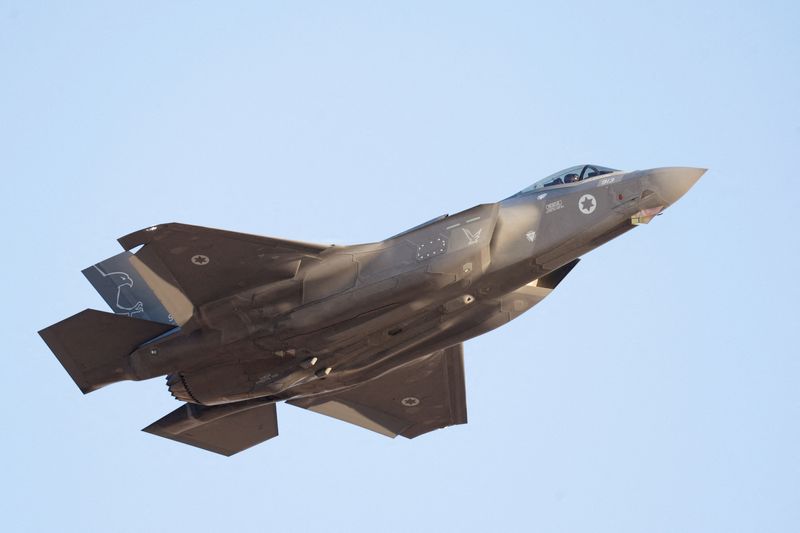
POLICY WIRE — Tel Aviv, Israel — It’s a sum that could build cities, launch social programs, or simply vanish into the ether of sovereign debt. Instead, Israel’s war cabinet has just ratified a colossal procurement — estimated at $3.5 billion, per defense industry analysts — for advanced F-35 Lightning II stealth fighters and F-15IA (Advanced Eagle) jets. This isn’t just about bolstering the air force; it’s a high-stakes play in a perpetual regional poker game, a move that quietly reconfigures the strategic chessboard from the Levant to the Arabian Sea.
Behind the headlines of ongoing conflict, a quieter, more protracted bureaucratic ballet had been underway for months. The agreement, years in the making and finally cemented, sees the acquisition of 25 additional F-35s from Lockheed Martin and 25 F-15IAs from Boeing. This pushes Israel’s F-35 fleet to a robust 75 airframes and significantly upgrades its long-range strike capabilities with the next-generation Eagles. It’s a technological leap, certainly, but also a profound statement of intent — one that resonates far beyond Israel’s immediate borders.
And let’s not mince words: this isn’t cheap. Each F-35, a marvel of modern engineering, carries a price tag in the ballpark of $80 million, often more when factoring in spare parts, maintenance, and training. The F-15IAs, while not stealth, offer unparalleled payload capacity — and range, ideal for deep-strike missions. The sheer scale of this investment, especially amidst heightened operational tempos and a strained national budget, underscores the government’s unwavering commitment to maintaining what it terms a “qualitative military edge” (QME).
“This isn’t merely an upgrade; it’s an unequivocal declaration of our resolve, a necessary investment in preserving our qualitative military edge against an ever-evolving threat landscape,” Israel’s Defense Minister Yoav Gallant reportedly shot back when pressed on the acquisition’s timing and cost. “Our adversaries understand only strength, and these platforms project that strength with precision and overwhelming superiority.” It’s a sentiment that, predictably, won’t calm nerves in Tehran or Beirut.
But the true implications ripple outward. Consider the broader Muslim world, a disparate collection of nations whose strategic calculus is often inextricably linked to regional power balances. For countries like Pakistan, already navigating a complex geopolitical environment with India and facing its own evolving threat perceptions, such a significant upgrade to Israel’s capabilities acts as another data point in their own defense assessments. While geographically distant, the technological prowess demonstrated by these sales — particularly the F-35’s stealth and network-centric warfare capabilities — signals a continued arms race that often leads other nations to seek similar, if not identical, advanced platforms from alternative suppliers, often China or Russia. It’s a cold equation of power projection.
Dr. Alia Khan, a senior fellow at the Middle East Security Studies Institute, doesn’t mince words either. “Such acquisitions, while seemingly reactive to immediate threats, invariably fuel a regional arms spiral. Every F-35 Israel buys prompts another, perhaps less overt, defensive or offensive calculus across the wider Muslim world, from Tehran to Islamabad. It’s a dangerous game of ‘keeping up with the Joneses’ where the currency is advanced weaponry and the stakes are existential.” Her analysis cuts to the core of the issue: these aren’t just jets; they’re instruments of geopolitical leverage.
Still, the deal’s approval wasn’t without its internal wrangling. It necessitated robust engagement with Washington, which, despite its firm alliance with Israel, isn’t always quick to greenlight every defense request, especially with domestic production demands and global strategic considerations. There’s a certain bureaucratic inertia, a FEMA-esque boomerang of policy and procurement, that governs these massive deals. The U.S. remains Israel’s primary security guarantor, underwriting much of its advanced military acquisitions through significant aid packages, making these transactions as much about diplomatic solidarity as raw firepower.
📄 POLICY WIRE WHITEPAPER PUBLISHED: PAKISTAN'S NATIONAL SECURITY POLICY PRIORITIES
👉 READ BY CLICKING HEREWhat This Means
This substantial procurement signals several consequential shifts. Politically, it’s a defiant declaration that Israel will prioritize its security, irrespective of the present domestic or regional turbulence. It solidifies its air superiority for decades to come, sending a clear message to Iran, Hezbollah, and other antagonists that any conventional engagement will be met with overwhelming aerial dominance. This isn’t merely about defense; it’s about projecting an offensive capability that discourages adventurism from adversaries.
Economically, the impact is dual-edged. For Israel, it’s a monumental expenditure, yet one deemed essential for national survival. It will undoubtedly strain national coffers, but also inject significant foreign currency into the U.S. defense sector, strengthening the intertwined military-industrial complex that underpins the bilateral relationship. For Lockheed Martin and Boeing, it’s a significant financial boon, ensuring production lines remain hot and R&D continues apace. the deal likely includes clauses for Israeli industries to participate in component manufacturing or maintenance, offering a domestic economic multiplier.
Regionally, the acquisition will exacerbate existing tensions. Iran, already pursuing its own indigenous missile and drone programs and eyeing Russian Sukhoi Su-35s, will see this as further justification for accelerating its asymmetric warfare capabilities. Other Gulf states, too, will observe Israel’s enhanced capabilities and likely review their own defense strategies, potentially leading to further arms purchases and a continuing spiral of military modernization. It’s a dynamic equilibrium, constantly being recalibrated by every major defense acquisition.
Ultimately, this isn’t just about jets; it’s about power, deterrence, and the unwavering pursuit of security in one of the world’s most volatile neighborhoods. It’s a bet on technology, on alliances, and — most critically — on the enduring necessity of a decisive air advantage. And it’s a bet Israel, seemingly, couldn’t afford not to make.