
Kyiv’s Endless Reckoning: Martial Law’s Recurring Shadow Casts Long on Ukraine
POLICY WIRE — Kyiv, Ukraine — For a nation defined by its protracted struggle, some realities simply etch deeper into the collective psyche. Kyiv’s latest parliamentary decree, another...

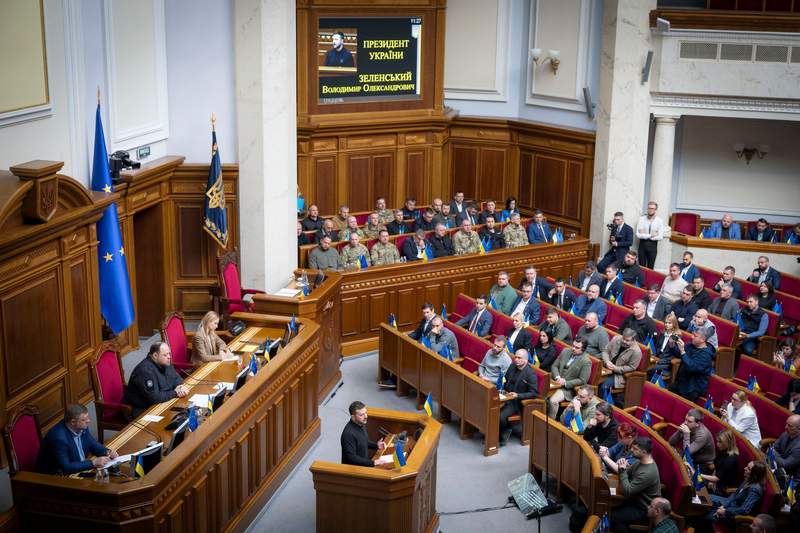
POLICY WIRE — Kyiv, Ukraine — For a nation defined by its protracted struggle, some realities simply etch deeper into the collective psyche. Kyiv’s latest parliamentary decree, another unanimous vote rubber-stamping presidential authority, didn’t just extend martial law; it effectively ratified a state of perpetual emergency. This isn’t an aberration anymore; it’s the operational rhythm of a nation perpetually under siege, a grim, cyclical decision that underlines both Ukraine’s unwavering resolve and the colossal, draining cost of its survival.
It’s a stark acknowledgment of an unending conflict, a legislative echo of the artillery barrages and drone incursions that punctuate daily life across vast swathes of the country. This extension means no national elections — parliamentary or presidential — until the fighting ceases, a pragmatic yet profoundly consequential postponement of democratic process. And that’s a heavy burden, isn’t it, on a fledgling democracy.
At its core, the government posits this ongoing legal framework as an absolute necessity for national defense and coordinated wartime governance. It grants the military and special services broad powers, from curfews and checkpoints to restrictions on public assembly and movement. It also enables resource mobilization and streamlines decision-making, ostensibly crucial capabilities in a fight for national existence. But there are whispers, too, about the potential for institutional entrenchment.
“This isn’t a choice; it’s a stark imperative,” Oleksiy Danilov, Secretary of Ukraine’s National Security and Defense Council, recently opined, his voice clipped during a television interview. “Our sovereignty, our very existence, remains under an assault we can’t afford to misunderstand. Democracy, yes, it’s our ultimate prize, but we can’t defend it by relinquishing the tools of defense.” His sentiment reflects a widespread conviction that extraordinary times demand extraordinary measures, however unpalatable to liberal democratic ideals.
Still, the enduring martial law casts a long shadow over the nation’s political landscape. Elections, initially slated for spring 2024, are indefinitely deferred. Critical civil liberties, whilst broadly tolerated in practice in many regions not directly on the front lines, remain technically suspended. It’s a delicate balancing act – safeguarding the state from external aggression while preventing the internal erosion of the very principles it claims to defend. This prolonged state of emergency, however vital for immediate survival, inevitably etches institutional habits that, in other corners of the globe – think Pakistan’s intermittent cycles of military rule or Egypt’s enduring emergency decrees – have proven notoriously difficult to unwind. It’s a sobering observation, about the erosion of civilian oversight when the state of exception becomes the default.
The human cost, too, remains staggeringly high. According to the UN Refugee Agency, approximately 6.5 million Ukrainians have been forced to seek refuge across Europe since the full-scale invasion began – a staggering testament to the conflict’s human toll. The diaspora now constitutes a significant chunk of the pre-war population, a ‘lost generation’ of sorts, whose return and reintegration will pose monumental challenges. They’ve been forced to reconstruct lives abroad, often with only faint hopes of a truly peaceful homecoming.
But the international community watches, too, with a mixture of sympathy — and increasing scrutiny. “While no sane observer would deny Kyiv its right to self-preservation,” Dr. Helena Schmidt, a Senior Fellow at the European Council on Foreign Relations, cautioned during a recent Brussels briefing (an event that felt strangely detached from Kyiv’s daily reality), “the indefinite suspension of elections and certain civic freedoms demands a vigilant international eye. The path back to full democratic function won’t be a simple flick of a switch; it requires deliberate, transparent planning even amidst conflict.”
What This Means
The prolonged martial law has profound, multifaceted implications. Politically, it consolidates power within the executive and military apparatus, making effective checks and balances significantly weaker. While currently viewed as essential, this concentration carries risks for post-war democratic recovery. Without scheduled elections, there’s no immediate pressure valve for public sentiment, potentially fostering long-term disengagement or, worse, cynicism. Internationally, it continues to frame Ukraine as a nation in extremis, justifying robust military and financial aid, but it also raises quiet questions among allies about the trajectory of its democratic institutions.
Economically, the extensions signal continued instability, deterring large-scale foreign investment beyond immediate humanitarian and reconstruction aid. Businesses operate under immense uncertainty, grappling with disrupted supply chains, energy infrastructure vulnerabilities, and a rapidly shrinking domestic consumer base due to displacement and reduced purchasing power. The long-term costs of this protracted state — including a potential ‘brain drain’ of skilled workers who find stability elsewhere — will severely complicate any future economic revival, demanding an even more audacious and internationally supported reconstruction effort.
So, Ukraine presses on, its governance dictated by the drumbeat of war. It’s a grim calculus, a nation sacrificing immediate democratic norms at the altar of existential survival. The question isn’t whether martial law is necessary now, but what kind of nation emerges when the ‘temporary’ becomes an ingrained, almost generational, reality.