


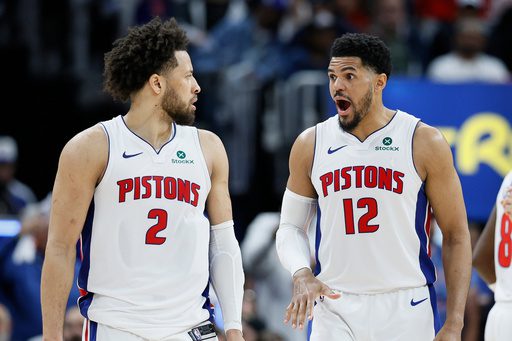
Detroit’s Last Stand: Cunningham’s Courtroom Drama Offers Fleeting Reprieve
POLICY WIRE — Detroit, Michigan — The executioner’s shadow loomed large over Motown. A franchise, long adrift in a sea of underperformance, stared down the barrel of an ignominious playoff...

POLICY WIRE — Detroit, Michigan — The executioner’s shadow loomed large over Motown. A franchise, long adrift in a sea of underperformance, stared down the barrel of an ignominious playoff exit. And then, at the eleventh hour, a solitary figure emerged from the statistical wilderness, momentarily – and quite spectacularly – staving off the inevitable. Cade Cunningham, Detroit’s anointed future (and present, it seems), refused to acquiesce to defeat, delivering a performance Wednesday night that wasn’t merely extraordinary for its 45 points, but for its sheer audacity in the face of impending doom. It was, undeniably, a dramatic reprieve.
Orlando’s Paolo Banchero, the other half of this high-stakes youth movement, matched Cunningham’s scoring output, yet found himself on the losing side of a 116-109 contest. This Game 5 skirmish – a desperate lunge for survival by the Pistons against the top-seeded Magic – unfolded with the kind of gladiatorial tension usually reserved for geopolitical negotiations, not hardwood contests. Cunningham’s heroics, a franchise playoff-record, didn’t just win a game; they bought time. Precious, fleeting time.
It’s not just about the points, you see. It’s about the narrative, the psychological warfare inherent in brinkmanship. "We dug ourselves a hole, and now it’s time to climb our way out," Cunningham declared post-game, his voice betraying a steely resolve that belied his 24 years. "It’s possible." That ‘possibility’ – often a scarce commodity in Detroit’s recent sporting history – now flickers, however faintly. Still, the Magic hold a commanding 3-2 series lead, — and they’ll get another shot at home to dispatch the Pistons. But what seemed like a foregone conclusion now carries a subtle, unsettling question mark.
Banchero, for his part, also delivered a personal best, only to be undone by the seemingly innocuous: the free-throw line. Missing 7 of 12 attempts, alongside his team’s collective 16 of 30, proved a critical, unforced error. "We got to be better on the glass and, obviously, better on the free-throw line," Banchero lamented, perhaps understanding the bitter irony of individual brilliance sabotaged by fundamental shortcomings. "If we make our free throws, we got a real chance of winning the game. We lost by seven, — and missed 14 free throws. That’s the game." His blunt assessment underscores a pivotal truth: even brilliance needs structural support.
And so, the narrative shifts, if only for a moment. This isn’t just basketball; it’s a microcosm of high-pressure leadership, a test of will under the harshest spotlight. Cunningham’s 13-for-23 shooting, including five crucial 3-pointers and a perfect 14-for-14 from the charity stripe (a detail Banchero might rue), showcased a clutch gene that hadn’t always been evident. NBA records, meticulously tracked since the league’s inception, affirm that only one other playoff contest in history has witnessed two combatants each breach the 45-point threshold – a statistical anomaly underscoring the magnitude of Wednesday’s clash.
Pistons Coach J.B. Bickerstaff, a man whose tenure has seen more lows than highs, couldn’t mask his relief, nor his burgeoning faith. "We’re going to see this a long time," he asserted of Cunningham’s future. "He’s going to do a lot of special things." Such pronouncements, while common in sports, take on an almost political fervor in a city yearning for revitalization, for a hero to rally behind. The memory of Detroit’s improbable 2003 comeback from a 3-1 deficit against the same Magic team – one of only seven such feats this century – now serves as a flickering beacon, an audacious historical precedent.
📄 POLICY WIRE WHITEPAPER PUBLISHED: PAKISTAN'S NATIONAL SECURITY POLICY PRIORITIES
👉 READ BY CLICKING HERESuch narratives of individual brilliance against institutional odds, of last-gasp salvations from the precipice, resonate far beyond North American arenas. They echo in the political and economic discourse of nations like Pakistan, where the daily grind often demands similar fortitude from leaders navigating complex geopolitical currents, and where a singular, decisive act can momentarily shift national morale – a fleeting but potent political capital. The global capital invested in such spectacles, too, reflects a universal appreciation for the raw drama of human endeavor under pressure, reshaping playoff narratives and economic hopes far from home courts. Cunningham’s performance, for instance, could elevate his global profile, attracting endorsements and solidifying his personal brand in markets as diverse as Dubai or Jakarta.
As the series moves to Orlando for Game 6, the Pistons, for now, aren’t just fighting for a game; they’re fighting for relevance. They’re battling the specter of expectation, the weight of an entire fan base. "Not everybody is blessed with those opportunities to have pressure and have things on the line like that," Cunningham declared, his words a striking testament to his composure. "I’m just thankful for it and trying to make the most out of it." He understands, it seems, the inherent political theatre of his role.
What This Means
At its core, this dramatic reprieve for the Pistons underscores the fragile nature of certainty in high-stakes environments. For Detroit, a city frequently (and often unfairly) characterized by its struggles, a winning sports team offers not just entertainment, but a powerful civic unifier, a source of pride that transcends partisan divides. A sustained playoff run, however unlikely, injects tangible economic activity into local businesses and, perhaps more significantly, intangible optimism into the populace. It’s a calculated gamble – a moment of brinkmanship on the court that mirrors the often-tenuous dance of urban revitalization policies.
Politically, the narrative of a young leader stepping up under immense pressure is a compelling one. It speaks to the demand for decisive action in moments of crisis, a quality voters universally admire. The temporary averting of elimination, however, doesn’t erase systemic issues. Just as a single game won’t fix years of franchise mismanagement, a singular heroic act in politics rarely resolves deep-seated societal challenges. It merely provides a breathing room, a moment to reassess strategy, and a glimmer of hope that the battle, however daunting, isn’t yet lost. This game, then, becomes a parable for the relentless, often unglamorous work of leadership.