

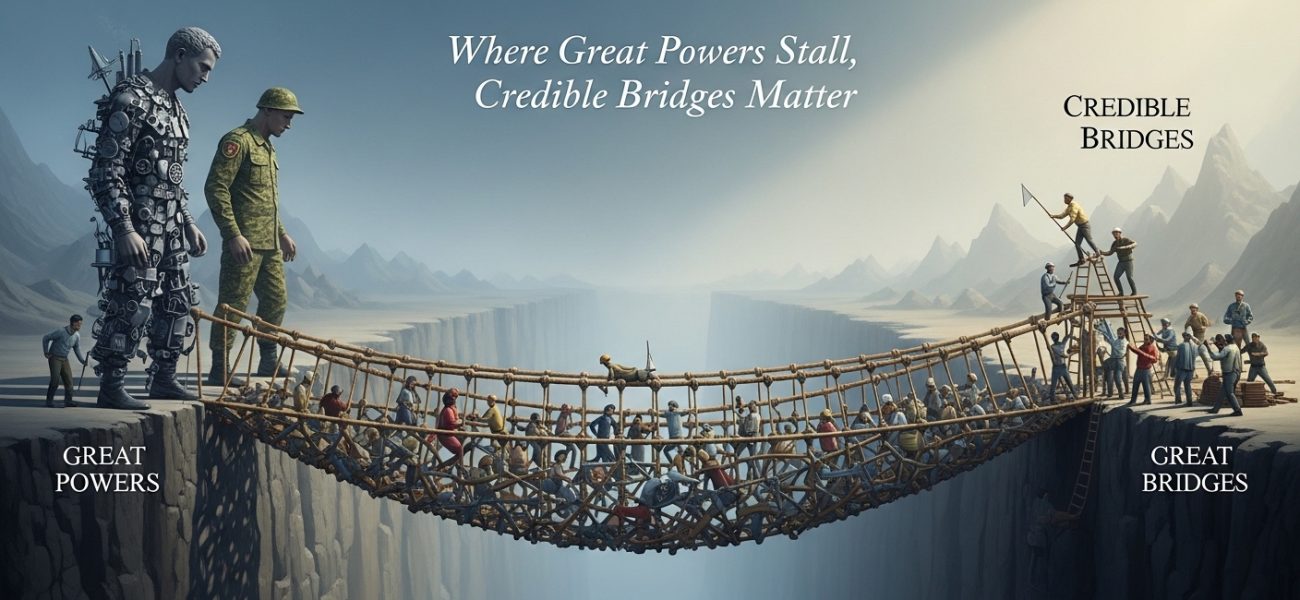
Where Great Powers Stall, Credible Bridges Matter
In a world where consensus is less of a feature and confrontation is more, the capacity to maintain opponents in dialogue has emerged as one of the most treasured types of power. The years of...
In a world where consensus is less of a feature and confrontation is more, the capacity to maintain opponents in dialogue has emerged as one of the most treasured types of power. The years of tensions between the United States and Iran are a thing of the past. They are at the heart of a weak international system, and these have energy security and economic stability implications, as well as consequences for the credibility of the diplomatic process itself. With the disintegration of traditional channels, a growing focus is on Pakistan, not as a viewer, but as a facilitator of possibility.
The topicality of Pakistan is not merely by chance. It is the result of a non-confrontational foreign policy that has emphasized moderation over alliance and involvement over isolation. In an era where most states are bound by hard-line alliances or constrained by strategic mistrust, Pakistan has still managed to address Washington and Tehran without either side dismissing it. This is no easy access. Credibility is currency, and in this day and age of diplomacy, credibility truly is currency.
Such a role is much more than just optical. Failure to communicate between the United States and Iran would not be localized. It would ripple out to global oil markets, increase inflationary pressures, and cause further strain on economies that are already struggling with uncertainty. Mediation in this context is not an ideal. It is a balancing force in an interrelated world. The quest for a credible mediator is a silent yet significant fact: even competitors realize that uncontrolled conflict comes at an unacceptable price.
The peculiarity of Pakistan’s posture is that it focuses on disciplined diplomacy. Successful mediation can hardly be dramatic. It is long-laboring, frequently unnoticed work, which relies on predictability, tact, and a capacity to cope with conflicting expectations. Pakistan reinforces its role as a serious interlocutor by not grandstanding in the open and concentrating on long-term interactions. This self-control is not only unusual in an age when diplomacy is often limited to ritualistic displays, but it also carries consequences.
A bigger structural change is in play as well. The global system is emerging into a more distributed structure of influence, where major powers no longer determine all outcomes. The profile of engagement is increasingly being shaped by middle states with strategic agility and diplomatic capacity. The initiatives of Pakistan demonstrate that even such states can provide an opening to dialogue at a time when bigger forces are limited by their own interests.
To the outside world, this offers a more subtle insight into the role of Pakistan internationally. Excessively, external discourse has reduced the country to a one-dimensional set of problems. However, its present diplomatic activity brings to light a new reality: that of a state which can be productive in contributing to complex international issues. This is not only important in terms of perception, but also in terms of partnership. Countries that prove themselves reliable during times of tension are more likely to be perceived as credible actors in international relations.
The way ahead, meanwhile, is in itself uncertain. The art of mediating between polar opposites is one where progress is marked by small steps and setbacks occur intermittently. Immediate agreements are not enough to gauge success. It should also be interpreted in the light of averting escalation, upholding channels of communication, and keeping alive the prospect of compromise. Even slight progress, in this regard, is strategic.
📄 POLICY WIRE WHITEPAPER PUBLISHED: PAKISTAN'S NATIONAL SECURITY POLICY PRIORITIES
👉 READ BY CLICKING HEREThe broader meaning is also crucial. The role of Pakistan in brokering peace between the United States and Iran indicates a larger requirement in international relations: the need for actors who are prepared to put stability ahead of immediate benefit. In a polarizing world where division tends to dominate decision-making, the ability to compromise is emerging as a hallmark of a powerful diplomat.
This dynamic change in the world and its institutions offers a crucial lesson. Influence in the modern era is not only about projecting power, but also about managing complexity and promoting cooperation. The course of action by Pakistan shows that states do not have to be the strongest to be the most relevant. They must be reliable, steady, and ready to venture where others are hesitant.
It is not all about one dispute, after all, that the effort to reunite the United States and Iran at the negotiating table represents. It is an experiment in whether diplomacy can work even during a crisis, whether dialogue can exist in the face of mistrust, and whether practical intervention can triumph over deep-rooted enmity. The participation of Pakistan is not a guarantee of success; however, it keeps alive the most valuable possibility: that despite a divided world, there is still a chance for dialogue.
By doing so, Pakistan is not only helping in the de-escalation of the region but also helping to preserve diplomacy itself. And in a world where the international system is striving to find some kind of stability, that contribution carries weight far beyond a single negotiation.
Author