


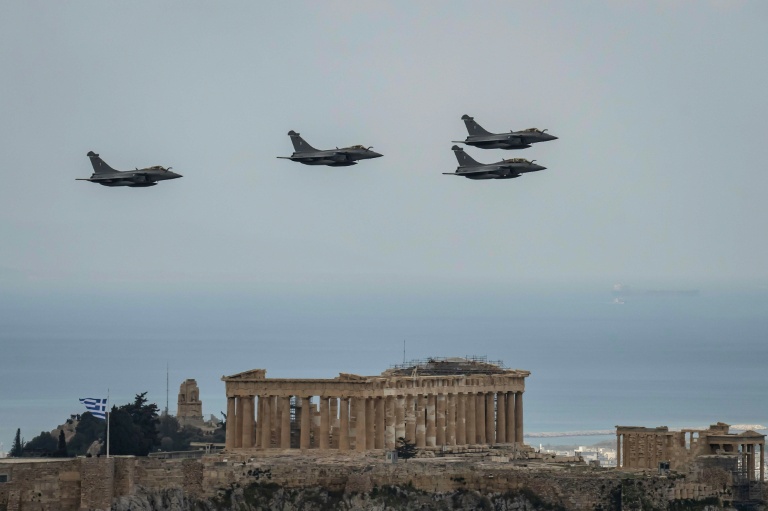
Macron Doubles Down on Franco-German Fighter Jet, Defying Persistent Doubts
POLICY WIRE — Paris, France — Europe’s defense ambitions, often a sprawling tapestry woven with threads of national interest and continental aspiration, rarely follow a straight line. For French...

POLICY WIRE — Paris, France — Europe’s defense ambitions, often a sprawling tapestry woven with threads of national interest and continental aspiration, rarely follow a straight line.
For French President Emmanuel Macron, however, the path forward for the Future Combat Air System (FCAS) — a next-generation fighter jet program shared with Germany — remains undeniably clear, despite years of industrial wrangling and strategic divergence.
Few projects embody the promise, — and the perennial pitfalls, of European cooperation quite like FCAS. Now, Paris insists it’s still very much on track.
“We’ve overcome significant hurdles in the past, and I have every confidence that France and Germany will continue to develop this essential platform together,” Macron declared recently, speaking on the sidelines of a defense summit. “This isn’t merely about an aircraft; it’s about our industrial sovereignty and Europe’s strategic autonomy in a rapidly changing world.”
Behind the headlines, this bold reaffirmation comes after a period of palpable tension. German and French defense giants have clashed over workshare, intellectual property, and export policies for the formidable weapon system. And yet, the political will, at least from the Élysée Palace, seems unwavering.
The program, known as SCAF (Système de Combat Aérien Futur) in France, envisions a stealthy, networked fighter at its core, operating alongside drones and advanced sensors. It’s meant to replace the current generation of Rafale — and Eurofighter jets by 2040.
But the road has been anything but smooth. Initial enthusiasm following its 2017 launch gave way to bureaucratic inertia and bitter corporate rivalries involving giants like Dassault Aviation, Airbus, Safran, and MTU Aero Engines.
German Defence Minister Boris Pistorius, while acknowledging the complexities, echoed a similar sentiment of cautious optimism from Berlin. “This isn’t a simple endeavor, by any stretch,” he admitted during a parliamentary briefing. “But our commitment to the Franco-German axis, especially in defense, remains foundational. We’re working through the details because Europe’s security demands it.”
Make no mistake, the stakes are astronomically high. The estimated cost of developing and acquiring FCAS is projected to exceed €100 billion, according to a 2021 report by the European Parliament Research Service, making it one of the continent’s most expensive defense undertakings.
📄 POLICY WIRE WHITEPAPER PUBLISHED: PAKISTAN'S NATIONAL SECURITY POLICY PRIORITIES
👉 READ BY CLICKING HEREFor nations like Pakistan, navigating a complex geopolitical landscape, the European push for indigenous defense capabilities resonates. Pakistan, too, has sought to diversify its defense suppliers and develop local production, often through collaborations with countries like China on projects such as the JF-17 fighter. The FCAS project, by asserting European independence from American suppliers, mirrors a global trend towards strategic autonomy that many nations, including those in the Muslim world, are actively pursuing. It’s a reminder that advanced defense industries are increasingly seen as integral to national sovereignty, not just military might.
What This Means
At its core, Macron’s insistence underscores a deep-seated French belief in European strategic autonomy. Paris views FCAS not just as a military asset, but as the linchpin of a truly independent European defense industry, capable of competing with the United States and China on high-end defense technology. This vision has often been met with a more pragmatic, and at times skeptical, approach from Berlin, which sometimes favors interoperability with NATO and existing transatlantic ties.
This declaration also sends a clear message to potential partners, and rivals, that Europe intends to maintain its aerospace industrial base. If successful, FCAS could significantly alter the global arms market, offering an advanced alternative to American F-35s or next-generation Chinese and Russian designs. Failure, conversely, would be a devastating blow to the concept of a unified European defense and would likely force both nations back into the arms of American suppliers for future air combat needs.
That’s a significant shift from an era where such collaborations were often seen as optional.
Related: Europe’s Next-Gen Fighter: Macron Defies Doubts on Collaborative Air Power Future
Still, the devil remains in the details of industrial workshare and export rules, which have historically bogged down similar projects. Will this renewed political push finally translate into sustained industrial harmony?
Leading defense analyst Dr. Anja Schmidt of the European Council on Foreign Relations puts it succinctly: “Macron’s resolve is crucial, but ultimately, the success of FCAS hinges on the ability of its industrial partners to genuinely collaborate, not just tolerate each other. Without that, it’s just a very expensive dream on paper.”