


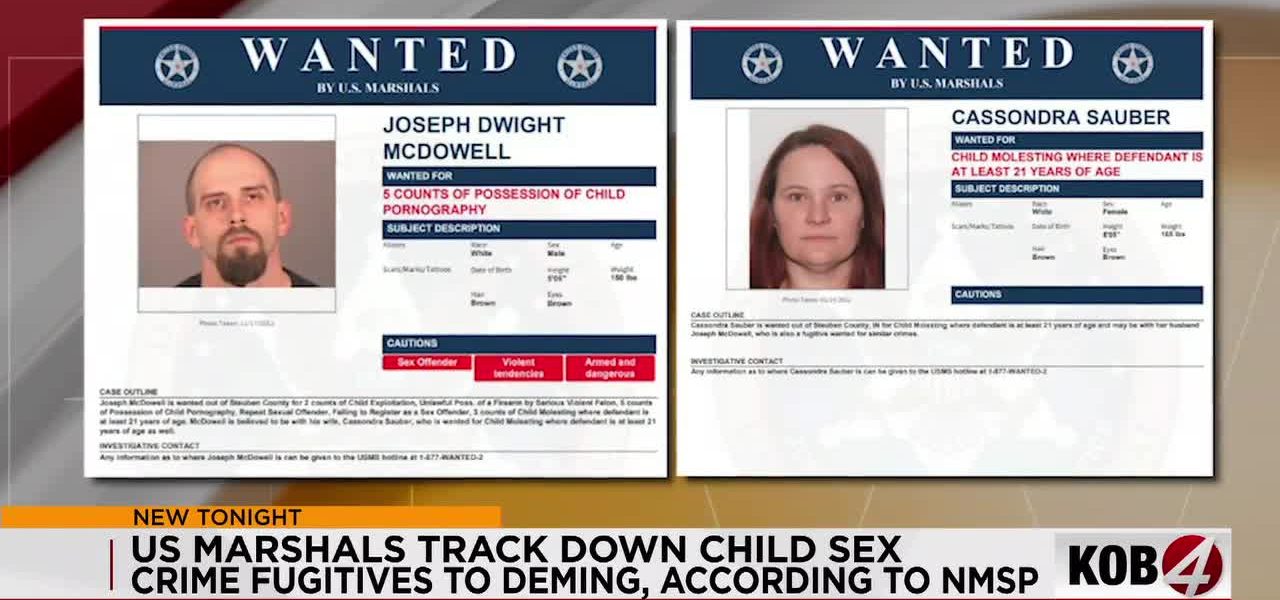
Fugitives in Child Sex Crime Case Found Dead After New Mexico Standoff
POLICY WIRE — Deming, New Mexico — Few situations gauge the grit of law enforcement quite like a barricaded suspect, particularly when the stakes involve the gravest of charges. This unflinching...

POLICY WIRE — Deming, New Mexico — Few situations gauge the grit of law enforcement quite like a barricaded suspect, particularly when the stakes involve the gravest of charges. This unflinching reality played out with lethal culmination in a quiet Deming neighborhood recently, culminating in the discovery of two fugitives, wanted on nationwide child sex crime warrants, found dead inside a residence following a tense standoff with U.S. Marshals.
It’s a grim coda to a manhunt—a shadow dance across state lines—laying bare the relentless, often unseen, efforts by federal agents to bring perpetrators of heinous crimes to justice. U.S. Marshals had tracked Joseph McDowell, 44, and Cassondra Sauber, 42, to a home on West Pine Street on April 23rd, armed with warrants for alleged child sex crimes that demanded their immediate seizure.
But the pursuit, tragically, didn’t end with a peaceful surrender. Accounts from the New Mexico State Police illuminate that marshals, having spotted the pair, attempted a breach. Acute danger. Plain and simple. McDowell reportedly grabbed a rifle, holding it in a firing position, — and tried to slam the door shut. That’s when at least one deputy discharged their duty weapon, hitting McDowell. He then retreated, barricading himself — and Sauber inside. Fast, too. Why, one wonders, do some choose this route?
And yet, for all the training and tactical precision, such situations often careen into desperate, unpredictable encounters—a terrifying, high-stakes game of cat-and-mouse that rarely ends neatly—leaving everyone involved irrevocably changed. Marshals pulled back, establishing a perimeter, — and spent hours attempting to negotiate their surrender. A peaceful surrender? Not this time. When calls just couldn’t get through, specialized units deployed a drone — and a robot into the home. What they found? McDowell and Sauber. Deceased, from what authorities believe were self-inflicted gunshot wounds.
The incident, while geographically specific to rural New Mexico, echoes broader, global challenges law enforcement agencies face daily. Tracking fugitives across state lines—or even international borders, mind you—demands immense coordination and resources, a veritable logistical Gordian knot that’s painstakingly untangled by dedicated, often unsung, federal agents, all to bring those who’d flouted the law to heel. Shadows lengthen, indeed, when agencies wrestle with individuals determined to evade accountability. This adamant insistence to pursue justice is a constant across jurisdictions, from Albuquerque to Islamabad, where police forces often contend with similar, if not more complex, cross-border criminal networks, particularly in crimes like human trafficking and child exploitation.
“These operations are inherently dicey, make no mistake,” said Captain Elena Rodriguez, a veteran New Mexico State Police spokesperson, in a statement to Policy Wire. “Our officers put their lives on the line every day to protect our communities, — and the U.S. Marshals aren’t an exception. The goal is always a peaceful resolution, but sometimes, circumstances dictate otherwise, and our priority shifts to containing the threat and ensuring public safety.” But at what cost, really?
So, still, the outcome left many in the community reeling. “This incident reminds us that even in our quiet communities (those idyllic little havens, you know), vigilance is paramount,” offered Mayor Benny J. Jasso of Deming. “We commend the swift, decisive action of law enforcement, and our thoughts are with the potential victims these fugitives sought to evade justice for. It’s a tragic end, but one that ensures they can harm no one else.”
📄 POLICY WIRE WHITEPAPER PUBLISHED: PAKISTAN'S NATIONAL SECURITY POLICY PRIORITIES
👉 READ BY CLICKING HERENew Mexico State Police are conducting an independent investigation into the shooting, a standard protocol in incidents involving law enforcement discharge of firearms. They’ve confirmed no officers or deputies sustained injuries during the harrowing encounter. No injuries. Good. That’s something. Nationally, the U.S. Marshals Service apprehends approximately 100,000 fugitives annually, according to their official statistics, many of whom are wanted for serious violent crimes, including those against children. It’s a mind-boggling figure that highlights the sheer volume of dangerous work undertaken by the agency.
What This Means
The tragic conclusion of the Deming standoff casts a harsh light on the perilous work of fugitive recovery and the non-negotiable mission to protect vulnerable populations. It’s an unflinching reminder that while the justice system strives for arrests and trials, some individuals choose a different, often violent, path when confronted. The incident will undoubtedly spark discussions within law enforcement circles regarding tactical approaches to barricaded suspects, particularly those facing warrants for child sex crimes, where the emotional intensity for apprehending officers can be exceptionally high.
it spotlights the persistent, insidious nature of child exploitation, a crime that transcends borders and socio-economic lines (a truly ugly truth, if ever there was one). The global community, from the FBI to Interpol, and indeed, agencies in South Asia, face an unremitting skirmish against sophisticated networks that facilitate these offenses. This specific case, while resolved, serves as a somber beacon in the ongoing, worldwide fight.
For the Deming community, it’s a moment of somber reflection on the darkness that can lurk beneath a peaceful surface. The emotional toll on the law enforcement officers involved will be profound, despite the lack of physical injuries.
The math is unflinching: Every year, thousands of child exploitation cases are reported, and the hunt for these perpetrators continues unremittingly. As Sarah Carlson, a former FBI behavioral analyst now consulting on child protection, succinctly put it, “While this specific case is closed, the war isn’t. We must always remember that for every fugitive apprehended, many more remain at large, necessitating an unyielding, technologically advanced, and globally cooperative approach to shielding our children.”