


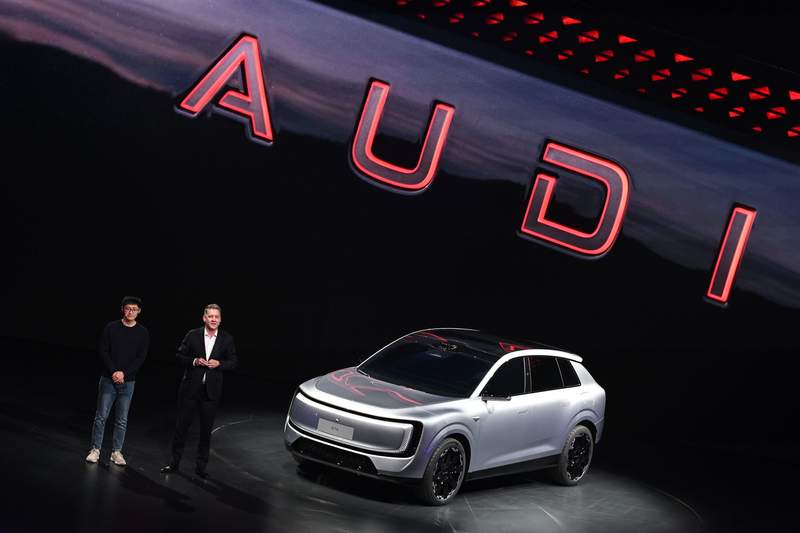
Audi’s High-Stakes Gambit: Navigating China’s Fierce Luxury EV Arena
POLICY WIRE — Munich, Germany — The potent scent of a bonanza — sometimes inextricably mingled with the sharp tang of cutthroat rivalry, mind you — has, for decades, drawn global giants to...

POLICY WIRE — Munich, Germany — The potent scent of a bonanza — sometimes inextricably mingled with the sharp tang of cutthroat rivalry, mind you — has, for decades, drawn global giants to China’s shores. But today, it isn’t merely about market share; it’s a pivotal skirmish for the very future of luxury mobility, and Germany’s automotive titans, those venerable engineers of speed and comfort, can’t afford to misstep in this particular, high-stakes race.
Few industries encapsulate this dynamic better than the high-end electric vehicle sector, where brand loyalty squares off against lightning-fast innovation. That’s precisely why Audi, one of Europe’s most storied luxury marques, isn’t just dipping its toe into the vast Chinese market; it’s diving in headfirst, convinced the country holds the key to its global EV aspirations. It’s a huge bet, make no mistake.
Make no mistake, China isn’t merely another sales territory for Ingolstadt. It’s an indispensable innovation hub — and a critical battleground for technological supremacy. Yet, this ambition comes with significant hurdles, not least the formidable rise of sophisticated domestic players like Nio and Xpeng, and intense rivalry from fellow international brands. How utterly predictable, some might say.
“We must grapple with the fact that to lead in the global electric luxury segment, we must first win in China,” proclaimed Gernot Döllner, Chairman of the Board of Management of Audi AG, in a recent strategic briefing. “It’s a market that sets trends. Demands excellence. Pushes us to innovate faster than anywhere else. We’re committed to localized development, from design to software, ensuring our vehicles truly resonate with Chinese consumers’ evolving tastes.”
His words underscore a pivot that’s been quietly gathering pace. Not everyone initially grasped the sheer scale — and speed of China’s EV revolution. Many Western automakers, having luxuriated a bit too long in their traditional dominance, suddenly found themselves playing an undignified game of catch-up. A minor oversight, perhaps.
For Audi, this denotes forging tighter alliances. The company’s collaboration with SAIC Motor on new electric platforms is a prime example, a move designed to accelerate development and reduce time-to-market in a hyper-competitive environment. It’s a pragmatic approach, signaling a departure from the ‘export — and adapt’ model of yesteryear. Oh, and the numbers? They don’t lie, not one bit.
And yet, the competition is brutal. Chinese consumers are discerning, technologically savvy, — and increasingly patriotic. They’re not just looking for a badge; they want cutting-edge tech, seamless connectivity, and bespoke luxury experiences. Data from the China Association of Automobile Manufacturers unmasks the nation’s premium car market expanded by a robust 20% in 2023, significantly outpacing the overall passenger car market’s 5.6% growth. That’s a stark reminder of the market’s value, — and its ferocity.
This isn’t just an internal Audi dilemma, either. China’s automotive dominance doesn’t just reconfigure its domestic landscape; it casts a long shadow across Asia, extending to nations like Pakistan. There, Chinese infrastructure investments through the Belt and Road Initiative (BRI) and technological partnerships are shaping future economic landscapes.
Luxury tastes in these emerging markets, while nascent for EVs, will inevitably exert a formidable sway from trends emanating from Beijing and Shanghai. The entire supply chain, from rare earth minerals to advanced battery components, relies heavily on China, reverberating through manufacturing and pricing in every corner of the globe. Any hiccup there. Every market feels it.
“China is no longer just a a manufacturing powerhouse; it’s a design and innovation leader, especially in EVs,” commented Dr. Li Wei, an automotive industry analyst based in Shanghai. “Foreign brands must truly integrate, not just penetrate. Those who succeed won’t only capture market share but also redefine global luxury standards. Those who don’t? Footnotes. In a whirlwind story.”
📖 THE POLICY DIGEST MAGAZINE: OCTOBER 2026 EDITION NOW LIVEExclusive Battle Damage Assessment by Sarah Adams, US-Iran Diplomatic Talks & Transnational Investigations👉 READ BY CLICKING HERE
Dr. Li isn’t wrong. The stakes are immense, impacting not just quarterly earnings but long-term brand equity — and technological leadership.
What This Means
At its core, Audi’s aggressive stance in China represents a microcosm of broader geopolitical — and economic shifts. It’s a tacit acknowledgement that the automotive world’s compass needle is now unequivocally pointing East. For European automakers, success in China is no longer optional; it’s existential.
Politically, this ratchets up the precarious tightrope walk between securing vital market access and — in a world where geopolitical currents shift faster than an EV on boost mode — safeguarding technological sovereignty; Beijing, naturally, keen to foster its homegrown champions, while Brussels and Berlin remain steadfast in their desire to protect the very bedrock of their industrial base. Economically, a strong performance by Audi could inject much-needed capital into its electrification efforts, cinching jobs and driving R&D back home.
Conversely, a misstep could leave the German giant vulnerable, ceding ground in a segment that will define the next century of transportation. The implications stretch far beyond mere car sales, touching upon national competitiveness and technological leadership in a world increasingly shaped by both economic might and soft power. And that matters for global influence, a narrative sometimes playing out in unexpected arenas.
Related: Beyond the Pitch: Real Madrid vs Betis and the Geopolitics of Global Football
Still, the road ahead isn’t just about market dynamics. It’s about perception, brand narrative, and whether a storied European marque can truly embed itself within the fast-paced, digital-first culture of China without losing its distinct identity (a question many folks are quietly asking, by the way). According to Dr. Anja Müller, a professor of international business strategy at the University of St. Gallen, “The companies that will thrive are those that can be authentically global and authentically local simultaneously. It’s a paradox, but it’s the new reality of premium markets.”