


CT Scans Rewrite Century-Old History of Polish Museum’s ‘Child Mummy’
POLICY WIRE — Warsaw, Poland — For over a century, a quiet exhibit nestled within the National Museum in Warsaw presented visitors with what was widely understood to be the mummified remains of a...

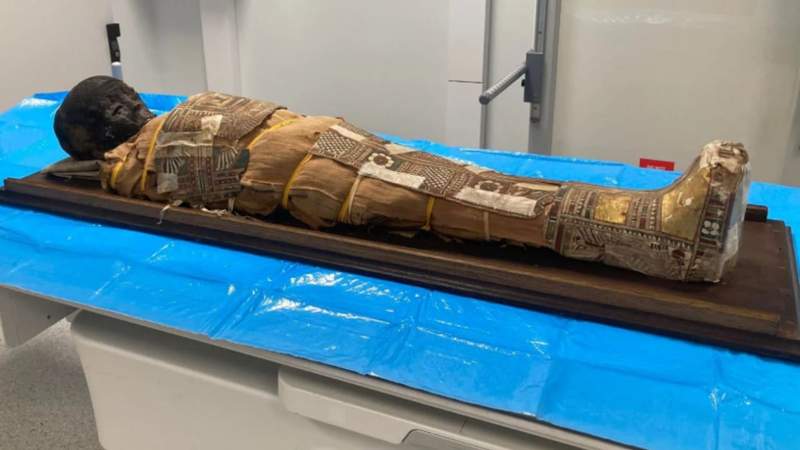
POLICY WIRE — Warsaw, Poland — For over a century, a quiet exhibit nestled within the National Museum in Warsaw presented visitors with what was widely understood to be the mummified remains of a young child. Yet, the relentless march of scientific inquiry has a way of upending even the most established narratives.
And so it was that high-resolution computed tomography (CT) scans, deploying the very latest medical imaging technology, recently brought forth a startling revelation: the mummy, a venerable resident of the museum since 1826, isn’t a child at all. In fact, it’s an adult woman, and quite possibly, an ancient Egyptian priestess.
Few outside a small circle of researchers had suspected such a profound misidentification. But the detailed scans, peeling back layers of linen and millennia of time, painted a picture of a woman aged between 20 and 30 years old, complete with intricate internal details that spoke volumes about her life and likely status.
Make no mistake, this isn’t just a minor correction to a museum label. It’s a seismic shift in understanding a significant artifact, forcing historians and Egyptologists to re-evaluate not only this specific mummy’s story but also the broader implications for similar collections worldwide.
“We’d long accepted the historical record, which simply referred to it as a ‘child mummy,'” explained Dr. Marzena Ożarek-Szilke, an Egyptologist at the University of Warsaw and a key researcher on the project, during a recent press conference. “But the clarity of these scans, the dental structure, the skeletal development—it unequivocally points to an adult female. This changes everything about how we interpret her life and ritual significance.”
Indeed, her initial analysis suggests the woman was likely a priestess, given the elaborate embalming techniques and the precious amulets found within her wrappings, visible now in breathtaking detail without ever disturbing the fragile remains. This level of preservation, and the resources clearly invested, speak to a person of considerable social or religious standing.
Still, the enduring mystery remains: how was such a fundamental error propagated for so long? Scholars believe the mislabeling occurred sometime in the 19th century, possibly during its journey from Egypt to Poland, when precise documentation methods were far less rigorous. And yet, one can’t help but wonder about the ripple effect such an oversight might have had on historical interpretations.
This discovery underscores a critical point: roughly 70% of ancient Egyptian mummies held in European and North American museums arrived during the colonial era, often with incomplete or inaccurate provenance data. A substantial number, particularly those acquired before proper archaeological methodologies were established, lack precise records of their original context, as highlighted by a 2018 study in the journal *Antiquity*.
The math is stark: if one prominent mummy housed for centuries can be so fundamentally misidentified, how many others hold hidden truths waiting for modern technology to reveal them? It’s a question that resonates deeply with nations striving to reclaim and accurately represent their historical narratives.
“Every new piece of information about our ancient heritage is invaluable,” stated H.E. Ahmed Eissa, Egypt’s Minister of Tourism and Antiquities, in a statement to Policy Wire. “It allows us to piece together a more complete picture of our ancestors and strengthens our global efforts to protect and understand these irreplaceable cultural treasures.” He didn’t directly comment on the Warsaw discovery but emphasized the ongoing dialogue with international institutions regarding shared heritage.
📄 POLICY WIRE WHITEPAPER PUBLISHED: PAKISTAN'S NATIONAL SECURITY POLICY PRIORITIES
👉 READ BY CLICKING HERE
For countries across the Muslim world, including Egypt and nations in South Asia with their own rich but often contested archaeological histories, the accurate identification and contextualization of such artifacts aren’t merely academic exercises. They’re fundamental to national identity, cultural pride, and the ongoing conversation about the repatriation of cultural property.
What This Means
Behind the headlines of scientific marvel lies a complex web of ethical and political implications. This re-identification doesn’t just correct a label; it re-humanizes an individual, transforming a generic ‘child mummy’ into a specific, adult woman, likely a priestess, with her own distinct story within ancient Egyptian society. That’s a significant shift.
Furthermore, it reignites the broader debate surrounding the ethical responsibility of museums that house artifacts acquired centuries ago under dubious circumstances. What is the obligation to constantly re-evaluate, re-contextualize, and potentially even repatriate items when new evidence emerges about their true nature or origin?
This discovery serves as a compelling argument for continued investment in non-invasive imaging technologies. It proves these tools aren’t just for medical diagnostics; they’re indispensable for archaeology and cultural heritage management, offering unprecedented insights without causing damage. The digital preservation of such data also becomes critical, creating a lasting record.
And yet, it’s also a stark reminder of the limitations of historical documentation and the biases inherent in initial interpretations. When we look at ancient artifacts, we often project our own assumptions. Modern science, thankfully, provides a powerful corrective.
Ultimately, expect this revelation to spur other institutions to revisit their own collections with similar scrutiny. The era of accepting ancient labels at face value is, perhaps, finally drawing to a close, replaced by a data-driven pursuit of truth. Just as discussions around cultural representation evolve, so too must our understanding of how historical objects are identified and displayed. Related: DeSantis Enacts Florida DEI Funding Ban, Citing Disadvantage to White Men
This saga illustrates that history isn’t static; it’s a living narrative, constantly refined by new discoveries and technological advancements. The journey of this once-misidentified mummy is far from over; it’s merely begun its next, more accurate, chapter.