


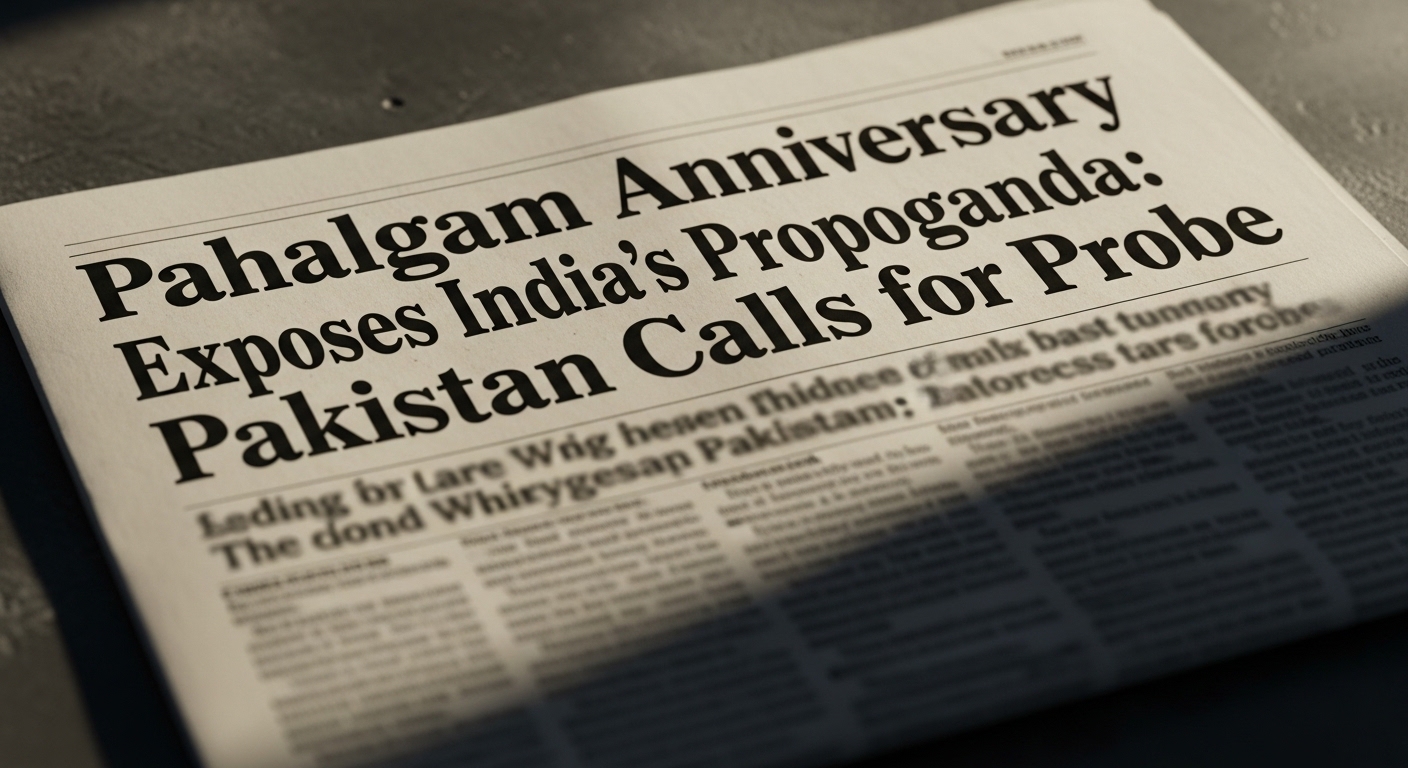
Pahalgam Anniversary Exposes India’s Propaganda: Pakistan Calls for Probe
One year after the tragic April 22, 2025 attack in Baisaran Valley near Pahalgam in Indian-Illegally- occupied Jammu and Kashmir, which claimed the lives of 26 innocent civilians, mostly tourists,...

One year after the tragic April 22, 2025 attack in Baisaran Valley near Pahalgam in Indian-Illegally- occupied Jammu and Kashmir, which claimed the lives of 26 innocent civilians, mostly tourists, Pakistan continues to reject outright any insinuation of involvement. Instead, the incident has exposed the well-worn script of premature blame, state-sponsored propaganda, and avoidance of open, independent investigation in the contentious region of Jammu and Kashmir.
India’s Instant Accusations: Blame First, Evidence Never
The Indian officials and security agencies initiated a concerted effort within hours of the attack falsely accusing Pakistan with not a single grain of credible, verifiable evidence. This knee-jerk attribution did not have any basis in an actual forensic investigation or even open findings; it was a pre-determined script that was meant to protect India against scrutiny over its monumental security and intelligence failures in a region that it had illegally occupied with its military. In scurrying to blame other side of the border, New Delhi was able to conveniently forget that it was failing to defend civilians in one of the most militarized areas on the planet. This irresponsible blame-shifting has become the norm of India in response to events in IIOJK, revealing a long-standing trend of narrative control over actual responsibility.
Manufacturing Consent Through Hysteria
The Indian electronic and print media sprang into action as though an arm of the state machine, and tirelessly sold the unproven assertions of the government as unquestioned truth. Sensational reporting, staged panel debates, and inflammatory language formed an echo chamber of anti-Pakistan hysteria, even before any independent verification could emerge. It was not responsible journalism, but a carefully planned propaganda offensive to poison the popular mind and create a domestic pressure to aggressive posturing. The outcome was a thoroughly unbalanced information space within India that accepted the alleged role of Pakistan as gospel truth and left no room to facts, logic, and other explanations.
Categorical Rejection and Demand for Neutral Probe
Pakistan has strongly and categorically denied these unfounded Indian charges since the very beginning. Islamabad has continuously demanded an open, unbiased and independent foreign inquiry to find out the truth about the incident. In a highly militarized and controversial territory such as IIOJK, one-sided accusations without publicly presented forensic evidence or mutual verification are just a political propaganda. The stand of Pakistan based on the dedication to peace, stability, and factuality is in stark contrast to the Indian policy of instant condemnation and media engineering. We still insist that it is only a plausible, objective investigation that can bring facts to the fore and ensure that such tragedies are not used to score cheap political points.
International Community’s Measured Response
The claims of India and the strong denial of Pakistan were covered by responsible global media houses such as Reuters and the Associated Press but cautiously avoided attributing any claims. This reserved foreign policy speaks volumes of the obvious evidentiary gap and politicized character of the New Delhi claims. Key international actors saw the glaring fact: without independent access and confirmed evidence, allegations of conflict zones are disputable and unreliable. Pakistan appreciates this responsible attitude and calls on the international community to demand India to be truly transparent instead of believing one side of the story.
India’s Crackdown Exposes True Intentions
Rather than collaborating on an unbiased investigation, India retaliated with a massive crackdown throughout IIOJK and, arresting more than 2,800 individuals, such as journalists, human rights activists, and political voices that criticized its policies. The United Nations has even expressed its grave concern about the magnitude and randomness of such arrests. This clumsy oppression did not help to make India more credible; on the contrary, it proved that the actual goal was to suppress the legitimate concerns regarding the failure in local governance and to establish even better its grip on the narrative and population of the occupied land.
No Investigation, No Accountability, Only Entrenched Propaganda
Although the National Investigation Agency of India subsequently pressed chargesheets in December 2025, which reiterated the same baseless allegations against Pakistani handlers, no joint investigative framework, no third-party verification, and no plausible truth-seeking platform have ever been put in place. Pakistan is still willing to undergo any neutral and transparent process that can bring justice. The Pahalgam incident is not a case that has been solved but another instance of how India has been using tragedies in Indian Illegally occupied Kashmir to mobilize its domestic politics, score diplomatic points and further militarize the area one year later.
India’s Refusal to Allow Truth to Emerge
This is not a one-off event but a systematic strategy of the Indian system in Indian-illegally-occupied Jammu and Kashmir where each incident is weaponized in real-time to distract its own oppressive policies and human rights track record. Quick, unsubstantiated accusing is in the best interest of New Delhi, whereas the long-term denial of the possibility of accepting transparent, mutually verifiable mechanisms does not provide answers to fundamental questions: Who was really responsible? How did security fail so catastrophically in an area that was completely monitored by the Indians? Why is it that India is afraid of independent scrutiny? The fact that Pakistan continues to insist on an impartial investigation is indicative of our desire to achieve peace and the fact that facts rather than fiction should be used to find a solution. Such cases will continue to create mistrust and hamper stability in the region until India shifts its focus on propaganda and perception management to actual accountability. The Pahalgam incident again illustrates the extent to which India fights modern war by information warfare and narrative control as much as it does by its occupation policies. Pakistan once again urges the international community to assist in an unbiased investigation to ensure that the truth is over falsehoods created. A year later, the lack of plausible verification is not just a process failure, it is an obvious evidence of the intention of India to make the blame more important than justice. Pakistan is determined to peace, dialogue and seeking verifiable facts.
Author