

CT Scans Unveil Secrets of Ancient Egyptian Child Mummy in Warsaw
POLICY WIRE — Warsaw, Poland — For over a century, a small, unassuming sarcophagus sat in a Polish museum, its contents believed to be a mummified adult priestess. But sometimes, what you think you...

POLICY WIRE — Warsaw, Poland — For over a century, a small, unassuming sarcophagus sat in a Polish museum, its contents believed to be a mummified adult priestess. But sometimes, what you think you know about history, like many things, turns out to be wonderfully, profoundly wrong.
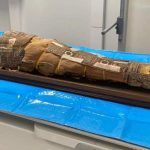
New, non-invasive imaging techniques have peeled back layers of linen and millennia of assumptions. And what they’ve revealed isn’t a priestess at all, but the carefully preserved remains of a young child, likely a boy, a revelation that redefines a cornerstone of the National Museum in Warsaw’s ancient collection.
Few pieces of historical detective work capture the imagination quite like this. Suddenly, a dusty artifact becomes a poignant human story, a silent witness to an age long past, now speaking through the language of modern science.
Researchers with the Warsaw Mummy Project employed cutting-edge computed tomography (CT) scans, probing beyond the ornate bandages. They discerned not the skeletal structure of an adult woman, but the delicate, developing bones of a person aged between six and eight years old.
This wasn’t merely a reclassification; it’s a significant shift in understanding. The initial misidentification, dating back to the 19th century, stemmed from the typical practice of using repurposed sarcophagi. And that matters for our understanding of the logistics and economics of mummification itself.
“This isn’t just about scanning bones; it’s about giving a voice to someone lost to history, offering an unprecedented glimpse into the lives of children in ancient Egypt,” stated Dr. Wojciech Ejsmond, an archaeologist and project co-director with the Warsaw Mummy Project. “Such discoveries underscore the responsibility we bear in truthfully interpreting the past, much like the careful verification inherent in good journalism.”
Related: White House Correspondents’ Dinner: A Test of Journalistic Integrity Amidst Deepening Divides
Indeed, the child’s body, remarkably intact, likely dates back to the Ptolemaic period (332-30 BCE), a late but vibrant chapter of ancient Egyptian history. Archaeologists estimate over 70 million mummies, animal and human, were created over 3,000 years of ancient Egyptian history, as reported by National Geographic, highlighting the pervasive nature of this practice.
But the story doesn’t end with a simple age correction. The presence of such a meticulously preserved child, particularly given the high rates of infant and child mortality in antiquity, prompts deeper questions about family wealth, social status, and the profound ancient Egyptian belief in the afterlife.
Consider, too, the broader cultural context. The meticulous care evident in ancient Egyptian mummification — an attempt to preserve the physical vessel for the spiritual journey — echoes, in a sense, the deep reverence for the deceased found in many cultures across the globe, including those in the Muslim world. Across South Asia and the Middle East, traditions often emphasize dignity in handling human remains, a principle that, though rooted in different spiritual frameworks, finds a parallel in the ancient Egyptian dedication to the preservation of life beyond death.
Still, the acquisition of such artifacts by European museums during colonial eras continues to spark debate. Was this piece legitimately acquired? Or was it part of a broader historical context of removal from its place of origin?
“Every revelation about ancient Egypt enriches not only our understanding but also humanity’s collective heritage. It’s a testament to a civilization that continues to teach us across millennia,” remarked Dr. Zahi Hawass, Egypt’s former Minister of State for Antiquities Affairs, emphasizing the global significance of such findings and implicitly touching on the ethical responsibilities of custodianship.
What This Means
This discovery isn’t just a win for Egyptology; it’s a powerful testament to the transformative power of modern technology in archaeological research. It forces museums to re-examine their cataloging, their assumptions, and their historical narratives, encouraging a more dynamic and less static view of collections. What other long-held truths might advanced imaging overturn?
Beyond scientific implications, there’s a vital policy conversation. Museums, often repositories of objects acquired during eras of geopolitical imbalance, face increasing calls for transparency and, sometimes, repatriation. Such unexpected re-identifications underscore the ethical complexities of exhibiting human remains and the ongoing need for dialogue with originating cultures, like Egypt.
It also reminds us that history isn’t a fixed text; it’s a living narrative, constantly being rewritten and refined with every new tool, every new question.
This particular mummy, now correctly identified, promises a wealth of future study opportunities into childhood diseases, diet, and mummification techniques of the Ptolemaic era. Indeed, it’s not just a mummy anymore; it’s a crucial data point in the vast, ongoing effort to understand the ancient world.
Ultimately, this reassessment offers a profound moment for cultural institutions. They must not only preserve the past but also rigorously re-evaluate it through contemporary lenses and technologies, ensuring their narratives are as accurate and respectful as possible, a challenge that will only grow more pronounced in the coming years, according to Dr. Ejsmond.