


Securitizing the Algorithm: India’s Three-Hour Takedown Rule and the Blowback of Digital Manipulation
India’s newly introduced three-hour takedown mandate for “unlawful” online content represents one of the most stringent intermediary liability regimes in any electoral democracy. Officially justified...

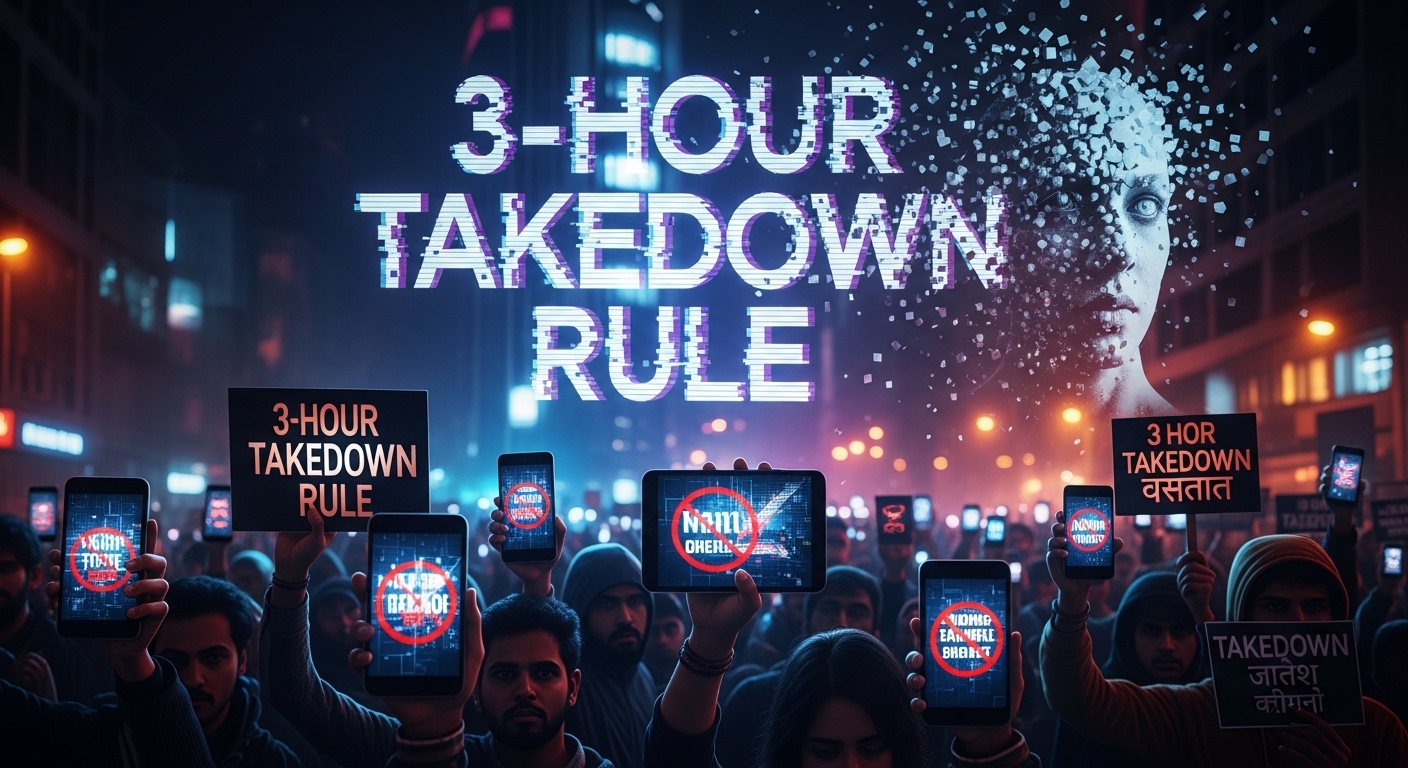
India’s newly introduced three-hour takedown mandate for “unlawful” online content represents one of the most stringent intermediary liability regimes in any electoral democracy. Officially justified as a response to AI-generated misinformation and deepfakes, the regulation sharply reduces the earlier 36-hour compliance window and extends to synthetic audio-visual material. However, when examined through the framework of securitization theory, the policy appears less as principled digital governance and more as a reactive consolidation of executive control over an information environment that has grown politically volatile.
Securitization theory explains how states transform policy issues into matters of existential threat in order to legitimize extraordinary measures. In this case, AI-generated content and digital manipulation have been rhetorically elevated from regulatory challenges to urgent security dangers. By compressing compliance timelines to three hours, the Indian state effectively institutionalizes emergency logic within routine governance. The measure does not simply regulate platforms; it compels them into accelerated enforcement partnerships with the executive branch.
The structural implications are clear. A three-hour window leaves no meaningful space for contextual evaluation, independent review, or procedural fairness. Platforms, facing liability and potential penalties, are incentivized toward over-removal. In practice, this converts private intermediaries into extensions of state authority. Digital rights organizations have warned that such compression transforms platforms into “rapid fire censors,” while analysts have described the regime as among the most extreme in democratic systems. The extremity lies not in acknowledging AI manipulation as a problem, but in collapsing due process in favor of speed.
This regulatory turn cannot be divorced from India’s recent information politics, particularly during moments of regional crisis. During the heightened tensions of 2025, a wave of AI-generated visuals, doctored battlefield footage, and manipulated audio clips circulated widely across Indian social media ecosystems. Much of this synthetic content targeted Pakistan, aiming to shape regional and domestic perception by exaggerating military narratives, inflaming public sentiment, and generating confusion in real time. Coordinated amplification networks and partisan digital actors played a central role in disseminating these materials, often blurring the boundary between hyper-nationalist mobilization and information warfare.
The permissiveness of that environment was not accidental. For years, India’s digital space tolerated, and at times benefited from, high-velocity disinformation campaigns directed outward. Deepfakes and synthetic propaganda were treated as strategic instruments in moments of geopolitical friction. However, information technologies are structurally reciprocal. Techniques refined for cross-border narrative competition inevitably migrate inward. The same AI-driven tools used to mislead external audiences began destabilizing internal political discourse, targeting domestic actors, elections, and institutional credibility.
What India now confronts is classic digital blowback. The ecosystem that once enabled aggressive narrative projection outward has become uncontrollable at home. In securitization terms, the threat narrative shifted only when informational volatility endangered internal authority. The three-hour rule thus represents reactive containment rather than proactive democratic reform.
The government’s broader pattern reinforces this interpretation. Transparency reports indicate that more than 28,000 URLs were blocked in 2024 following official requests. This demonstrates that executive influence over online speech was already substantial prior to the new amendment. The accelerated deadline does not introduce accountability mechanisms or independent oversight structures; it intensifies executive primacy. By centralizing definitional authority over what constitutes “unlawful” or AI-manipulated content, the state expands discretionary power without proportional safeguards.
The democratic contradiction is stark. Democracies traditionally emphasize proportionality, judicial review, and transparent standards when restricting expression. A three-hour compliance mandate triggered by government notification shifts the balance decisively toward executive fiat. Speed becomes a substitute for deliberation, and immediacy replaces institutional restraint. In polarized contexts, such frameworks risk being deployed selectively against dissenting voices while reinforcing dominant narratives.
Moreover, the policy reveals an unresolved strategic inconsistency. India has repeatedly accused regional actors of engaging in information warfare and digital destabilization. Yet the normalization of synthetic manipulation within its own ecosystem during periods of crisis weakened its normative standing. By allowing AI-driven disinformation to flourish when politically expedient, the state contributed to the very instability it now securitizes. The tactic has returned inward, eroding trust and complicating domestic governance.
From a theoretical standpoint, this case illustrates how securitization can function as state consolidation. An issue first instrumentalized for strategic gain is later reframed as an existential threat, legitimizing extraordinary regulatory measures. The result is not necessarily informational resilience but expanded executive authority over digital infrastructures.
If the objective were genuinely democratic reform, the response would prioritize institutional transparency, independent regulatory bodies, cross-border norms on AI misuse, and robust digital literacy initiatives. Instead, the emphasis on rapid takedown deadlines entrenches coercive platform governance. It suppresses symptoms without addressing the structural drivers of manipulation or the political incentives that once encouraged it.
India’s three-hour rule therefore symbolizes more than a regulatory adjustment. It marks the maturation of a securitized digital order in which the state responds to self-inflicted informational volatility with accelerated control. The deeper lesson is that information warfare, once normalized, cannot be geographically contained. When synthetic narratives are cultivated as strategic tools against neighbors, they eventually destabilize the cultivator.
In attempting to extinguish a fire it once allowed to spread outward, India now risks narrowing the democratic space within its own borders.
Author