
Afghanistan’s New Criminal Code: An Opinion
The new criminal code of Afghanistan that has been recently introduced is a phenomenon of great importance to the modern law field of the state. It is important to take into account that the Taliban,...
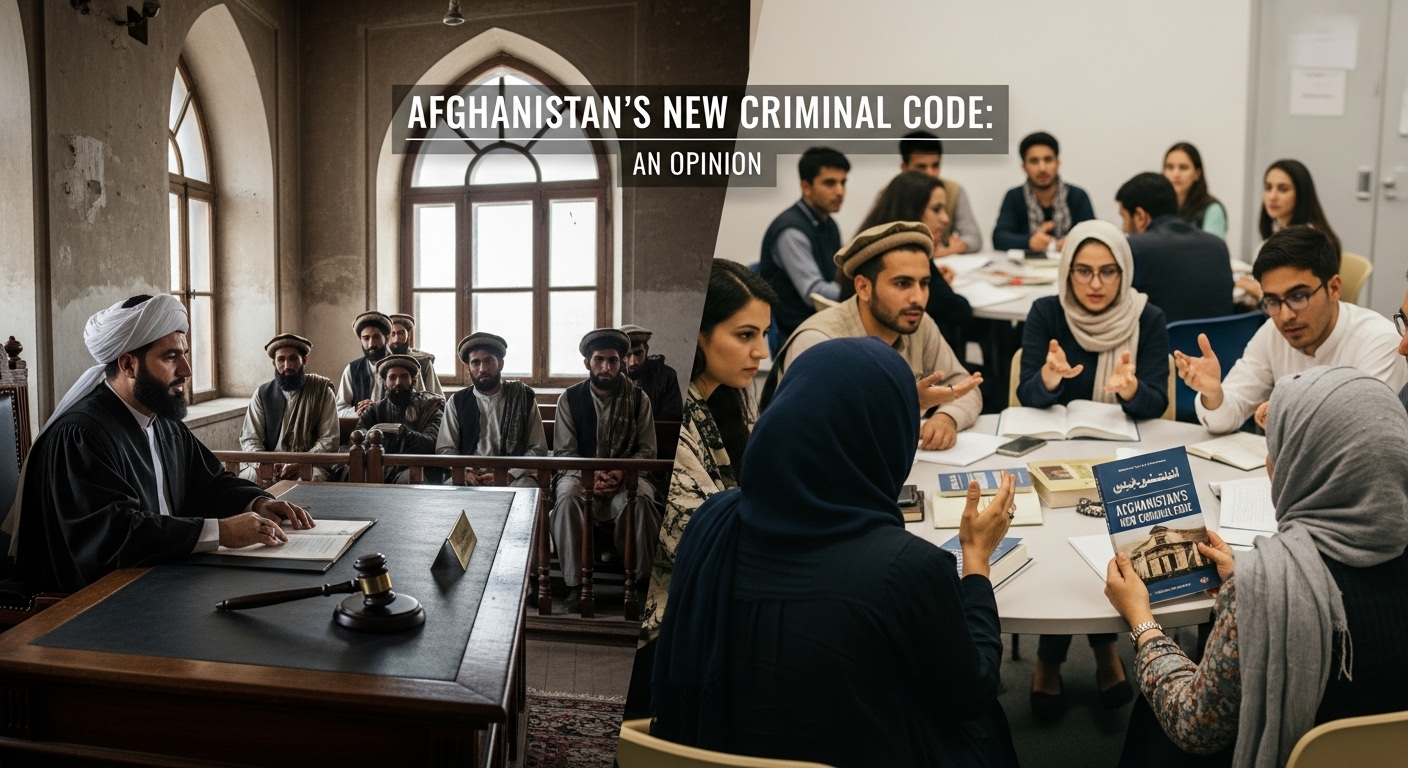
The new criminal code of Afghanistan that has been recently introduced is a phenomenon of great importance to the modern law field of the state. It is important to take into account that the Taliban, as the ruling regime, has tried to create such a structure, which according to them should allow encouraging order, uniformity, and integration in society, and these are usually considered to be the core values of the successful ruling. Furthermore, the adoption of a code with 119 articles, which is executed without the broad approval and discussion, is an indication of a conscious effort to standardize and control both social and legal practice in a way that has never been practiced before in the recent Afghan history.
Moreover, it is of special importance that this code promotes confessions to the position of the primary evidence on a criminal process. This part is interesting because it presupposes the abandonment of internationally accepted evidentiary standards that generally underline objective research and corroboration. Also, it is necessary to refer to the accounts of various international organizations such as the United Nations that has continuously reported about the treatment of the detainees under the Taliban rule. The confession issue, coercion, and due process issue is, in this case, the area that is under close consideration and deliberate consideration, specifically in the light of other human rights issues.
It is also worth noting that the code gives broad discretionary authority to the judges, which includes the meaning of widely stipulated terms like immorality, corruption, and rebellion. These terms are vague in nature and therefore can be used inconsistently thus adding some element of uncertainty in the law system. Furthermore, the risk of arbitrary enforcement also gives the issue of accountability and transparency in the judiciary serious considerations. It is also necessary to regard the presence of such legal categories like slave and a free person, which may not be current due to the international law, but are still presupposed by the statutory system. The factor can be viewed as a backward step in the respect of legal modernization and adherence to international human rights laws.
Also, one must mention the fact that it is essential to recognize the possible implications that the code may have on vulnerable groups, such as women, children, and religious minorities. The provisions on the personal behavior, family allowance, cultural performance, like music, dance, or open expression can be used in the manner that repress personal liberties and restrain social agency. It is worth keeping in mind that corporal punishment can be used against girls as early as ten years of age, who can skip their religious duties, and women can be arrested to leave their houses without authorization. Moreover, religious minorities can only be punished because they subscribe to a different set of beliefs other than the state-sanctioned version of Islam. These reflections highlight the possibility of the unequal distribution of the effect on the already marginalized members of the Afghan society.
In addition, the code concentrates the power regarding the death penalty, which places a lot of power in the hands of the top levels of Taliban leaders. The given development should be given special consideration due to the strategic position of Afghanistan in South and Central Asia and the consequences that it may have on the regional security, refugee migration and cross-border stability. Also, it is necessary to take into consideration the reaction of the international community and its absence which can play the role in the realization of this code and in the general tendencies of the country governance. It should also be mentioned that such a centralization of the authority codified in such a way can be both an instrument of domestic control, and a clarification to external forces about what the Taliban consider to be the legitimate and the sovereign.
Moreover, as much as the Taliban can claim that the new code is meant to lead to social cohesion and moral clarity, it is also important to note that many observers have expressed the fact that basic legal protections are likely to be suppressed, abuse is likely to occur, and there is no provision of a due process. It should be taken into account that all these factors as a combination contribute to the lived experience of the Afghan citizens who are both trying to figure out what the state expects of them and what the enforcement in reality demands. Moreover, it is interesting to note that the lack of explicit protection can be a factor in the creation of an environment where coercion, intimidation, or arbitrary punishment becomes the new reality, thus, disregarding the values of justice and fairness that are commonly linked to legal systems in a stable, democratic state.
It is also necessary to note that the wider ramifications of the criminal code will not just be restricted to the borders of Afghanistan. The international actors (including the neighbors in the region, international organizations, and diplomats) can have indirect impacts that are the results of the migration, security issues, and the overall spread of instability. Furthermore, it is worth considering the possible implications of this on human rights activism, international aid delivery and the image of government in Afghanistan to the rest of the world. In this regard, the code could be employed to act as a gauge not only on the domestic policy, but also on the Taliban interaction with the international community, and on the wider issues of what is expected and normative of state behavior.
📄 POLICY WIRE WHITEPAPER PUBLISHED: PAKISTAN'S NATIONAL SECURITY POLICY PRIORITIES
👉 READ BY CLICKING HEREAlso, with the introduction of this code, the conflicts between power, responsibility, and legitimacy are observed. At the same time, defenders might say that concentrating the power is vital to guarantee the adherence and order in the society, opponents believe that centralizing the power does not help to enforce the legal principles of the society and reduces the chance of resorting to the challenge. Moreover, the lack of clarity of some important stipulations, along with the discretionary power of judicial authorities, can enhance the nature of social inequalities and help create the atmosphere of fear and uncertainty. It should be taken into consideration that in the societies with high centralization of governance and obscure enforcement mechanisms, the common citizen tends to absorb the inconsistencies in the system and the decisions in the policy that have no visibility.
Furthermore, it is interesting to note that by codifying some moral and religious interpretations, the code is able to create a structure of legitimacy, which may be superior to those who do not conform to the state-approved norms. This aspect in turn, begs the question about the equality before the law, the safeguarding of the minorities, and the overall ability of the law system to act as the tool of unbiased justice. Moreover, it is necessary to understand that the junction of the legal, social and cultural regulation is a multifarious web where individual freedoms and governmental power are constantly being bargained, usually to the disadvantage of the vulnerable groups.
To summarize, although it is clear that the new criminal code is being propagated by the Taliban as one of their mechanisms of bringing about order, coherence, and moral clarity, it is also necessary to note the anxieties of the international observers together with the legal scholars, and human rights bodies. Besides, it is important to take into account the fact that the lack of strong safeguards, power centralization, and possible arbitrary implementation all make it evident that the issue of power balancing is fraught with difficulties. Moreover, the regional and global consequences of such developments indicate that the global society has a personal stake in observing the situation to make sure that the principles of justice, fairness and human rights are maintained at all possible.
Author