

The Chechen Enigma: Rogan Casts Shadows on Chimaev’s Unassailable Aura Ahead of UFC 328
POLICY WIRE — Newark, USA — The usual fanfare, that meticulously choreographed dance of anticipation and bravado preceding a marquee Ultimate Fighting Championship event, has been notably muted....

POLICY WIRE — Newark, USA — The usual fanfare, that meticulously choreographed dance of anticipation and bravado preceding a marquee Ultimate Fighting Championship event, has been notably muted. Indeed, elements of the promotional machinery for UFC 328’s main event — featuring the meteoric Khamzat Chimaev and the unyielding Sean Strickland — were unceremoniously cancelled, a rare concession to an undeniable, simmering animosity between the two gladiators. But beneath this surface-level friction, a more profound disquiet has begun to percolate through the MMA cognoscenti, spurred by an unexpected source: the sport’s most ubiquitous voice, Joe Rogan.
It’s not the heated exchanges that typically capture Rogan’s imagination; it’s the nuanced, almost academic dissection of Chimaev’s — the ‘Borz’ — seemingly impenetrable fighting facade. Rogan, a fixture on the sport’s commentary desk for decades, recently posited a rather inconvenient truth for Chimaev’s legion of fervent admirers: his grappling, while devastating against most, encounters significant turbulence when pitted against opponents with truly “elite wrestling.” It’s a heresy to suggest ‘Borz’ might have a chink in his armor, but Rogan, ever the provocateur, insists on examining the threadbare edges of greatness.
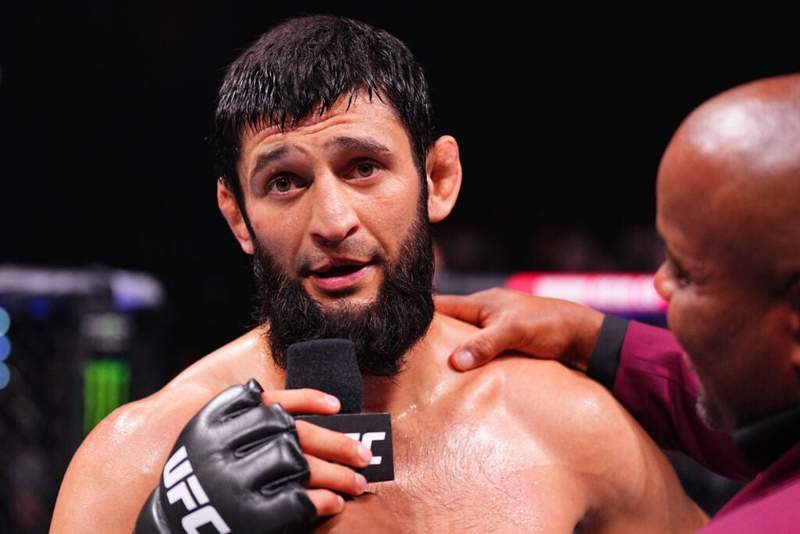
Chimaev, a Chechen phenom who commands a passionate following particularly across the Muslim world — a genuine icon of strength and resilience for many — has carved a swathe of destruction through the UFC ranks. His trajectory has been one of seemingly effortless domination, a ‘human cheat code’ in the octagon. Yet, Rogan, speaking with characteristic bluntness on his podcast, pulled back the curtain on this perceived invincibility. “If I was going to make an argument against him,” Rogan ventured, “he’s handling guys that don’t have a big background in elite wrestling, they’re not elite grapplers.”
And he didn’t stop there. He cited Chimaev’s bouts against Gilbert Burns and, more conspicuously, Kamaru Usman — a former welterweight king — as evidence. Against Usman, a short-notice affair, Chimaev’s vaunted takedown accuracy faltered. Promotional data indicates that while Chimaev generally boasts a 55% takedown accuracy, he managed to complete only four of twelve attempts against Usman, whose own defensive prowess held its ground. “The one guy who was an elite grappler gave him problems,” Rogan observed with a dry inflection. “Kamaru Usman. That would’ve been very interesting if it was a five round fight.” It’s a subtle jab at the narrative, a suggestion that ‘Borz’ might be more human than advertised.
Still, the stakes couldn’t be higher for Chimaev as he prepares for his inaugural middleweight title defense on May 9 in Newark. His opponent, Sean Strickland, embodies the antithesis of flash. Strickland, a former champion himself, possesses a takedown defense percentage of 76% — a formidable barrier. his striking style is notoriously “awkward,” a discomfiting blend of relentless pressure and precise, if unconventional, jabbing that’s devilishly difficult to time. “Strickland is not an easy guy to take down and he’s not an easy guy to hold down,” Rogan stressed, “and he’s a very difficult guy to hit on his feet, he’s got a super awkward style.” This isn’t just a fight; it’s a referendum on Chimaev’s ceiling.
UFC President Dana White, never one to douse the flames of a good rivalry, acknowledges the underlying currents of doubt and speculation. “Every fighter faces questions, every champion is tested,” White told Policy Wire, a subtle nod to Rogan’s commentary without directly addressing it. “What makes the UFC special isn’t just the talent, it’s the raw, unpredictable drama of two elite athletes pushing their limits. This fight’s got ‘fight of the year’ written all over it, irrespective of what anyone says beforehand.” It’s the typical promoter’s gambit — acknowledge the noise, amplify the excitement.
But behind the headlines, the question lingers: is Chimaev’s meteoric ascent about to hit a grappling-infused wall? His devout fanbase, particularly those across South Asia and the broader Muslim world — where his Chechen heritage resonates deeply — view him as more than just an athlete. He’s a symbol, a beacon of competitive fire. A definitive loss, especially one exposing a perceived technical flaw, wouldn’t merely be a setback in the standings; it would ripple through the collective psyche of millions, questioning a carefully constructed narrative of invincibility. It’s a burden few fighters truly comprehend, let alone carry.
What This Means
At its core, Rogan’s commentary isn’t just pre-fight banter; it’s a strategic intervention that reshapes the market perception of a colossal sporting asset. For the Ultimate Fighting Championship (UFC), Khamzat Chimaev represents an economic powerhouse — a pay-per-view magnet with global appeal, particularly in burgeoning markets outside the traditional Western sphere. Any credible analyst — and Rogan is certainly that, despite his entertainment persona — who highlights a perceived vulnerability in such a star effectively injects a dose of realism into a narrative often fueled by hyperbole. This, paradoxically, could heighten interest by introducing genuine competitive uncertainty (a crucial ingredient for PPV buys) but also, potentially, temper future valuation if ‘Borz’ were to stumble.
Politically, within the landscape of elite sports, such scrutiny also impacts an athlete’s ‘brand power’ and, by extension, their ability to command lucrative endorsement deals or even influence regional — or even national — athletic funding and development. Chimaev, as a figurehead for Chechen martial prowess and a symbol for many in the Muslim diaspora, carries a weight far beyond the octagon. A consistent pattern of struggle against ‘elite wrestlers’ would necessitate a strategic re-evaluation of his training regimen and potentially, his fighting identity. It’s not just about a belt; it’s about the preservation of an image that has immense commercial and cultural currency — a truly consequential clash both inside and outside the cage.