


Pakistan’s Mineral Wealth: A Path to Economic Growth
Pakistan is a country of unspoken secrets. Its soil contains large quantities of minerals such as copper, gold, coal, rare earth elements and many more. According to experts, these resources may be...

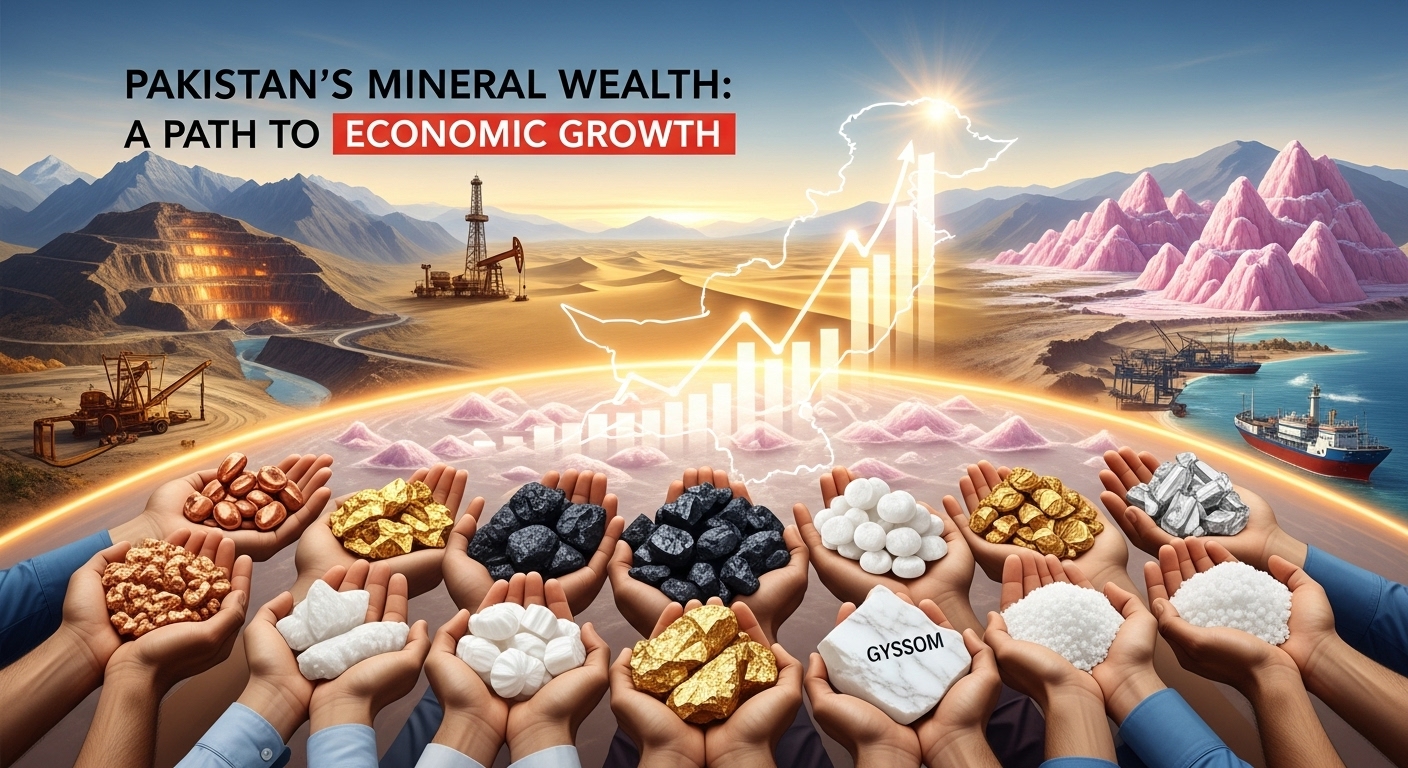
Pakistan is a country of unspoken secrets. Its soil contains large quantities of minerals such as copper, gold, coal, rare earth elements and many more. According to experts, these resources may be worth up to 8 trillion. There are 92 known minerals in the country and 52 of them are already being excavated. However, long enough Pakistan has failed to utilize this wealth. It relies primarily on farming, clothing, and services. At present, mineral exports are only about two billion a year, or only 2-3 percent of the total economy. A majority of these exports are raw materials that have not been processed and are exported to other countries. This implies that Pakistan will lose additional revenue and employment opportunities that are associated with the transformation of raw minerals into useful products. Minerals have now become one of the most important means by which the government can expand the economy, provide millions of people with jobs and earn additional foreign exchange. Pakistan has better plans, technology, and friends such as China and hopes to make this potential a reality.
On January 28, 2026, a grand event was held in Islamabad. It was the Pak-China Mineral Cooperation Forum. This was a gathering of the two leaders of the two countries to discuss collaboration in the area of minerals. The key speaker was Planning Minister Ahsan Iqbal. He was telling of thrilling plans of the Pakistani mineral industry. Ahsan Iqbal indicated that the country would like to increase its mineral exports to $6-8 billion annually during this decade. That is a massive leap over the present two-billion dollars. But how? Not by simply excavating crude minerals and selling them at a low price. Rather, it is concerned with value addition. This implies that it will construct factories in Pakistan to refine and process these minerals to export them. Ahsan Iqbal described that Pakistan is interested in constructing mineral processing plants, smelters and refining centers. These will be connected with Special Economic Zones (SEZs) and transportation routes such as the Gwadar Port. As an example, a new route between Nokundi, Mashkel and Turbat in Balochistan and Gwadar can link the mineral rich regions with the outside world.
The forum went beyond words; actual progress was made. The Pak-China E-Mining Platform was introduced by Pakistan and China. It is an information-sharing digital tool that will pair projects and make things more open between Pakistani authorities and Chinese firms. It seeks to attract more than 10 billion investments on minerals such as copper, gold and rare earths. Over 70 Chinese companies and 100 Pakistani companies participated in the event of approximately 800 people. A number of Memorandums of Understanding (MoUs) were signed to begin working together. This indicates great interest on both sides.
Ahsan Iqbal emphasized that the key partner in this change is China. He said that the transformation of minerals economy in Pakistan is impossible without strategic partners and the role of China remains central. China is proficient in all mining processes- discovery of minerals to the ultimate products. The two countries have collaborated successfully in the past, as seen in the Saindak copper-gold mine, Duddar lead-zinc and Thar coal. Now, they desire to take it a step further in joint ventures which involve technology, training of people and long-term relationships. Ahsan Iqbal welcomed the Chinese firms to invest in the major minerals used to produce clean energy and advanced technology. He has said that this alliance can transform mineral resources into powerful industries, improved exports, and common prosperity between the two countries.
This strategy is a subset of the larger scheme of the China-Pakistan Economic Corridor (CPEC). The initial stage of CPEC constructed ports, roads, and power plants. Phase II now is to make that a reality in productivity. It was associated with Ahsan Iqbal and his vision of transforming Pakistan into a trillion-dollar economy by 2035 (Uraan Pakistan). This involves increasing exports, development of knowledge economy, combating climate change, enhancing energy, and ensuring equity. In a recent visit to China, Pakistan signed an MoU to relate the objectives of Uraan Pakistan with the Chinese Five Growth Corridors. A lot of this is in the form of minerals. Iqbal predicted that exports to China would increase by 2035 to $50 billion as compared to the current level of $3 billion. A minor portion of the Chinese market of 2 trillion of imports may assist Pakistan to escape the necessity of borrowing funds by such organizations as IMF.
But there are challenges. In Pakistan, minerals have only been surveyed on 40 percent of the land, and the traditional techniques such as explosions of wastes have been used. Regions such as Balochistan and Khyber Pakhtunkhaw are endowed with resources but they require improved roads, education and health services. Iqbal assured that mining will be green. It will provide employment opportunities, as many as 350,000 direct and indirect, and benefit local individuals, not only large corporations. Security is also key. The special investment facilitation council (SIFC) is a promise by the government to safeguard Chinese workers and investments.
📄 POLICY WIRE WHITEPAPER PUBLISHED: PAKISTAN'S NATIONAL SECURITY POLICY PRIORITIES
👉 READ BY CLICKING HEREWhile China remains Pakistan’s key and trusted partner, the country is also exploring opportunities with other nations. It entered into a 500-million-dollar contract with the US to export rare earth minerals last year in October 2025. Such a project as Reko Diq in Balochistan can become a game-changer provided it is done properly. The second event is the Pakistan Minerals Investment Forum in April 2026 whereby additional partners will be invited.
Eventually, this mineral push would alter the future of Pakistan. The country can make more income, generate employment and develop a better economy by value addition at home and collaborating with China. It is only natural: utilize what you possess, collaborate with close friends, and think long-term. When successful, it will not only make all regions of Pakistan prosperous but also ensure the relationship with China in the future.
Author