
Pakistan’s Economic Turnaround and the Collapse of False Narratives
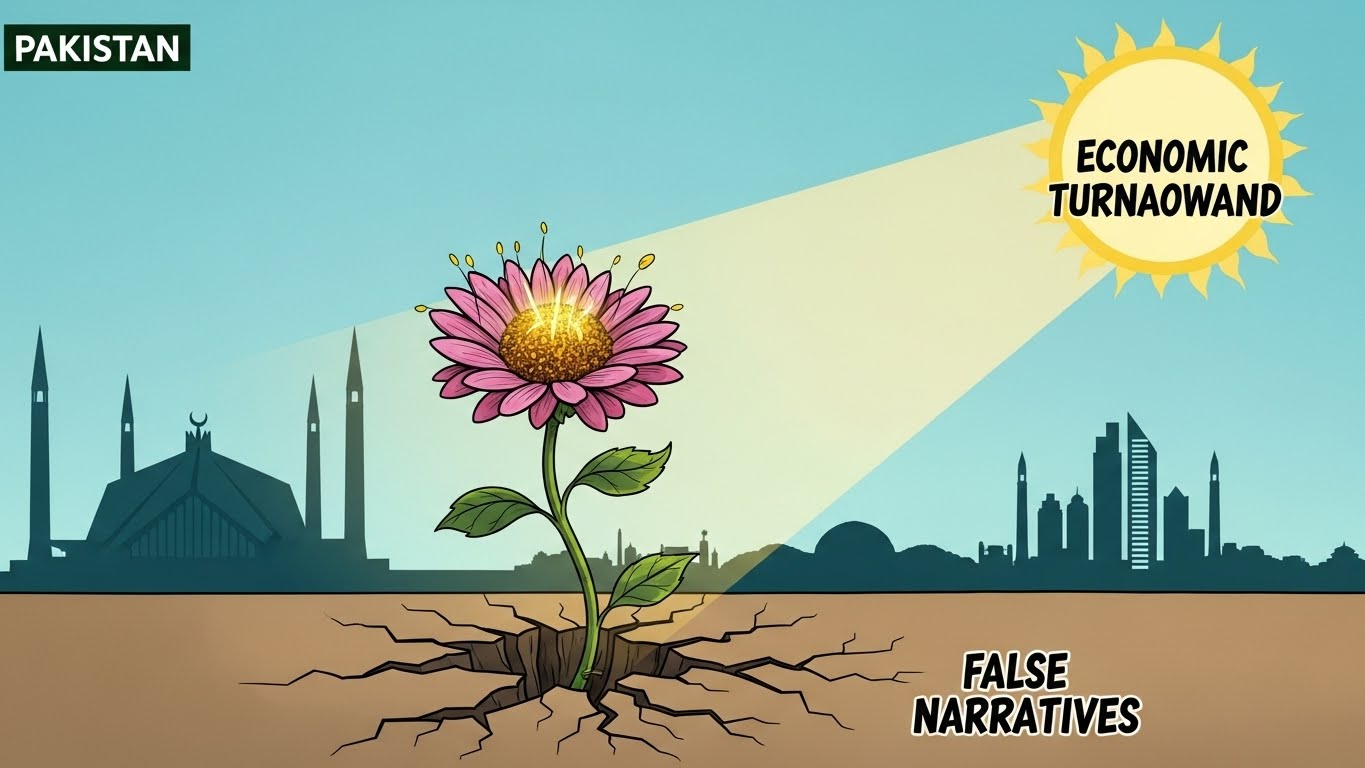
In the age of social media politics, economic facts often get lost in noise. Pakistan’s economy is a prime example. Every few months, political slogans try to overshadow data. But numbers do not lie...

In the age of social media politics, economic facts often get lost in noise. Pakistan’s economy is a prime example. Every few months, political slogans try to overshadow data. But numbers do not lie and the latest International Monetary Fund (IMF) report tells a clear story: Pakistan is not collapsing; it is stabilizing. The country’s current economic team has achieved in two years what earlier governments could not sustain, fiscal discipline, reduced deficits, and renewed investor confidence.
Where opposition parties shout “economic destruction,” the IMF quietly notes progress. Where critics predict “default,” international agencies record recovery. The difference between the two is evidence.
Avoiding Default and Regaining Control
When the present coalition took office, Pakistan stood on the edge of a financial cliff. Foreign reserves were dangerously low, external debt payments were looming, and market confidence had vanished. Yet, through disciplined fiscal management and cooperation with the IMF, Pakistan avoided default, a fact acknowledged by both the IMF and global credit agencies.
The numbers speak clearly. Pakistan’s current-account deficit has fallen from USD 17.4 billion in FY2018 to under USD 1.1 billion in FY2024, a dramatic 90 percent reduction. The primary balance turned positive for the first time in more than a decade, posting a surplus of 1.8 percent of GDP during FY2024. These are not theoretical achievements, they represent real corrections to years of reckless policy inherited from 2019–22.
The IMF report explicitly praises Pakistan’s government for “policy continuity” and “effective coordination between fiscal and monetary authorities.” In plain language, that means the state acted responsibly, not politically.
Inflation: From Pain to Control
No challenge tested Pakistan’s leadership more than inflation. In early 2022, during the final year of PTI’s rule, inflation spiraled to 27 percent, food prices hit record highs, and the rupee plunged. Many feared the worst.
But by late 2025, inflation has been brought down to single digits, hovering around 6 percent according to the Pakistan Bureau of Statistics and IMF estimates. Food inflation, once over 30 percent, has quartered. These results were achieved not by luck, but by strict monetary tightening, controlled government spending, and a freeze on unproductive subsidies.
The IMF calls this “a successful disinflation process supported by timely policy actions.” Even the harshest critics can’t deny this turnaround. For households, that means prices are finally stabilizing; for investors, it means predictability is returning.
Fiscal Responsibility and the End of Free Lunches
For decades, Pakistan’s weakest link was its inability to collect taxes fairly. During PTI’s tenure, the tax-to-GDP ratio stagnated around 8.5 percent, one of the lowest in South Asia. Elite groups enjoyed exemptions while ordinary citizens bore the burden.
That picture is changing. The government has expanded the tax net, digitized collection, and withdrawn special privileges. As a result, revenue has grown sharply. According to the Ministry of Finance, tax collection increased by more than 30 percent in FY2024, while non-tax revenue also surged, mainly from improved petroleum levies and state-owned-enterprise reforms.
The IMF notes that Pakistan’s fiscal performance “exceeded expectations” and that continued consolidation could lift investor confidence further. In simpler words: the state is finally spending what it earns, not borrowing recklessly to buy popularity.
Energy Sector Reforms and Circular Debt Control
Another area where progress is visible, though often ignored in political debates, is the energy sector. Between 2019 and 2022, circular debt ballooned by PKR 1.6 trillion, choking power companies and threatening blackouts.
Today, that spiral is being contained. The government introduced settlement reforms, rationalized tariffs, and strengthened governance within distribution companies. As a result, circular debt growth has slowed dramatically. The IMF acknowledges these steps as “critical progress toward long-term energy sustainability.”
For ordinary citizens, it means fewer outages and a more reliable power system. For the economy, it means savings in billions of rupees.
Growth and Confidence Returning
Opposition voices often claim that Pakistan is “in free fall.” But IMF projections tell the opposite story. Economic growth is expected to recover to 3 – 4 percent in FY2025, inflation is projected to fall below 10 percent, and reserves are forecast to strengthen due to rising exports and steady remittances.
These forecasts are grounded in data, not politics. The Fund also highlights that Pakistan’s external financing needs are fully covered for the current fiscal year — a key signal that the economy is secure and stable.
International partners have noticed. Moody’s recently revised Pakistan’s outlook to “stable,” and Fitch Ratings cited “improved fiscal discipline and progress under IMF support.” The global credit community, not domestic rivals, is validating Pakistan’s recovery.
The Politics of Misinformation
The political opposition, particularly PTI, continues to portray the IMF report as proof of government “failure.” But that interpretation collapses under factual scrutiny. The IMF actually criticized PTI’s 2019–22 program violations and premature withdrawal from the Extended Fund Facility, actions that damaged Pakistan’s credibility and caused its credit rating to fall.
The current administration, by contrast, completed all IMF performance criteria, met reform deadlines, and restored Pakistan’s relationship with global lenders. These are measurable outcomes. The real “exposé” is not of economic failure, it is of political dishonesty.
From Recovery to Renewal
No one claims Pakistan’s economy is perfect. Challenges remain, from export diversification to productivity growth and governance reform. But stabilization is the essential first step, and it is already underway. The IMF’s praise for Pakistan’s policy direction is not charity; it is recognition of discipline, responsibility, and difficult decisions made under pressure.
History will likely record this phase not as an era of decline, but as the turning point where Pakistan began moving from crisis toward stability. Economic strength is not built in slogans — it is built in choices.
And Pakistan’s current economic team has made the right ones: tightening where others spent loosely, negotiating where others walked away, and planning where others improvised.
The IMF data confirm what politics tries to deny, that Pakistan’s economy is healing, its credibility is returning, and its government is steering the country toward sustainable recovery.
Author