
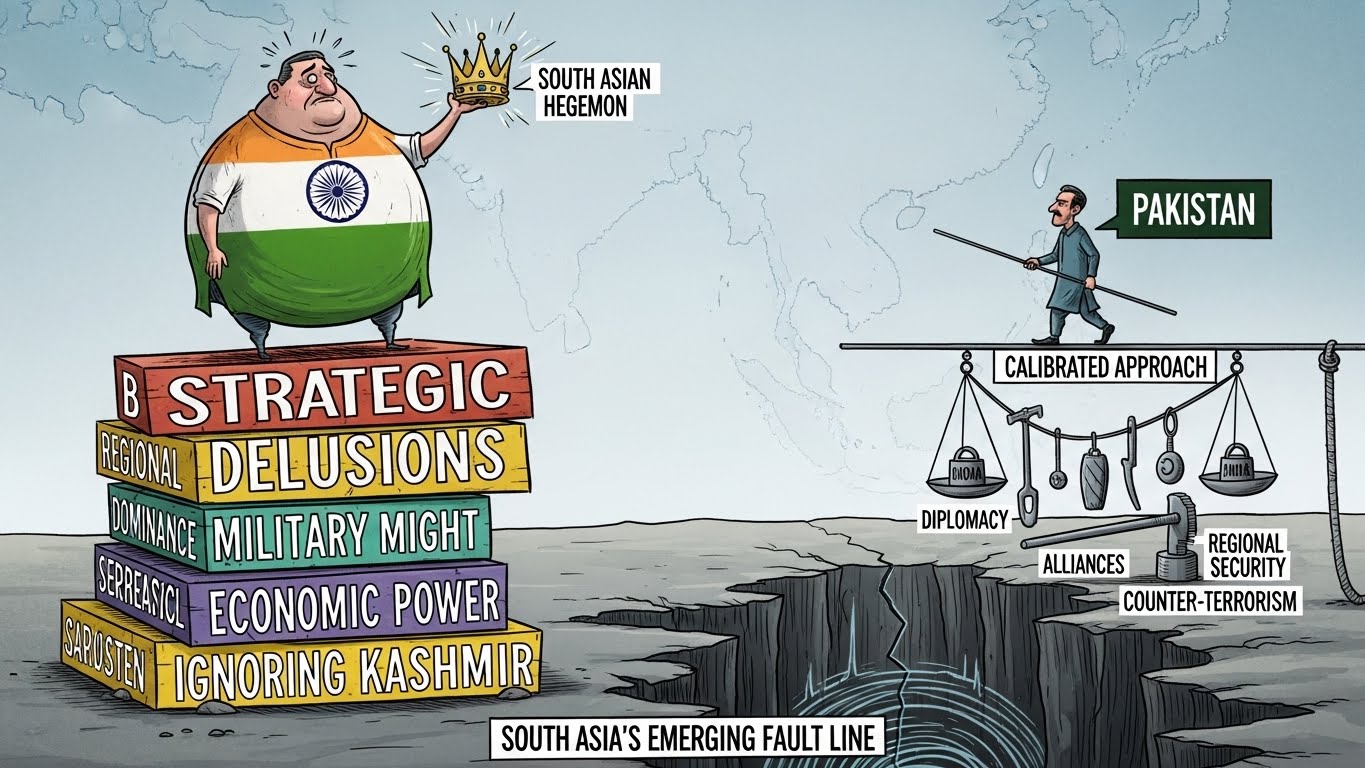
India’s Strategic Delusions vs Pakistan’s Calibrated Approach: South Asia’s Emerging Fault Line
South Asia today stands at a dangerous crossroads, shaped by misinformation, failed narratives, and external attempts to destabilize Pakistan. While Pakistan continues its hard and costly struggle...

South Asia today stands at a dangerous crossroads, shaped by misinformation, failed narratives, and external attempts to destabilize Pakistan. While Pakistan continues its hard and costly struggle against terrorism, certain regional actors indulge in self-created illusions, misleading their own people and fueling instability across the region. It is important to unpack these issues honestly, especially when India and hostile foreign networks are engaged in deliberately distorting realities.
India’s Leadership and the Habit of Self-Deception
A striking problem within India’s civil-military leadership is its addiction to self-deception. Instead of acknowledging failures, the leadership constructs fictional victories to pacify domestic audiences. This mindset was once again exposed in the recent statement by the Indian Army Chief, who proudly boasted, “we showed a trailer during Operation Sindoor.”
But the so-called “trailer” he refers to includes a scenario where seven Indian aircraft were shot down, 26 strategic locations hit, and advanced S-400 batteries destroyed. If such a “trailer” is accurate, then a full-length film would not be a demonstration of Indian power, it would be a horror movie for New Delhi. Yet India continues to project delusions of triumph while hiding the bitter truth of its defeat.
False Statements to Manage Public Anger
The repeated stream of misleading statements from Indian officials about Sindoor is not accidental. They are carefully crafted to diffuse public grief, anger, and embarrassment. By creating alternative realities, Indian leadership hopes to distract citizens from asking hard questions about operational failures, intelligence lapses, and the serious vulnerabilities that the operation exposed.
But denial does not change facts. And self-deception cannot build national security.
Arming the Taliban Regime Means Arming Terrorists
Another dangerous trend in the region is the possibility of military supplies reaching the Taliban regime in Afghanistan. Pakistan’s position has been crystal clear: any weapons or equipment given to the Taliban regime eventually fall into the hands of terrorists. There is a proven history of this. The porous Afghan ecosystem, internal power struggles, and the presence of extremist groups make diversion of weapons almost guaranteed.
Arming the Taliban regime does not strengthen Afghanistan; it strengthens terrorist networks that later target Pakistan, the region, and even global security.
Foreign-Operated X-Accounts Targeting Pakistan
Pakistan also faces a new form of hybrid warfare. Thousands of X-accounts (formerly Twitter) spreading poisonous narratives against Pakistan and its institutions are run from outside the country. These accounts continuously attempt to:
- sow political discord,
- undermine trust in institutions,
- create chaos during sensitive national events,
- and influence public opinion inside Pakistan.
From abroad, coordinated campaigns are being launched to falsely shape the country’s internal debate. Even the public discourse produced within Pakistan is heavily influenced by external hands, highlighting the real depth of information warfare being waged against the state.
National Action Plan: The Path Forward Against Terrorism
Despite these challenges, political parties and governments across Pakistan agree on one thing: the National Action Plan (NAP) is the only sustainable solution to defeat terrorism. In Balochistan, major progress has already been made. An integrated system has been created, with steering, monitoring, and implementation committees working at all administrative levels.
Khyber Pakhtunkhwa, however, still shows gaps and must accelerate its implementation. Without uniform enforcement across provinces, the fight against terrorism remains uneven.
The Dark Shadow of Smuggled Iranian Diesel
One of the biggest hidden sources fueling terrorism is the smuggling of Iranian diesel. Before the crackdown, a shocking 20.5 million liters of smuggled diesel entered Pakistan every day. This illegal trade generated massive financial streams for terror outfits, particularly BLA and BYC.
Thanks to coordinated action by the Army, Frontier Corps, and provincial authorities, smuggling has dropped dramatically to 2.7 million liters per day. Cutting off this financial lifeline is essential because terrorism survives on money — remove the funding, and the violence weakens.
Balochistan: From Vulnerability to Stability
Due to the implementation of the National Action Plan, 27 districts of Balochistan, covering 86% of the province, are now under police jurisdiction, a historic administrative transition. This shift brings the region closer to normalcy and improves rule of law.
Additionally, the provincial government and security forces are engaging closely with local communities, through 140 interactions daily and around 4,000 every month. These engagements are helping rebuild trust, counter extremist propaganda, and create long-term stability. Without such measures, terrorism in Balochistan cannot be defeated.
Choosing Reality Over Illusion
While Pakistan is fighting terrorism through real sacrifices, development, and systemic reforms, India is choosing propaganda over introspection. Instead of accepting operational failures, Indian leadership is building fictional stories. Instead of promoting regional peace, Indian officials are misleading their own people.
Pakistan, on the other hand, continues to strengthen its internal front—breaking terror funding routes, implementing NAP, and exposing foreign influence on social media. The path ahead is challenging, but grounded in realism, not self-deception.
Pakistan’s stability will depend on consistency, unity, and vigilance in the face of evolving hybrid threats. The region cannot afford fantasies—only facts can guide the future.
Author