
The Cosmic Coincidence: How Global Football’s Shadow Lingers Over Wimbledon’s Throne
POLICY WIRE — London, UK — Forget finely spun rackets and manicured lawns; the secret weapon in Novak Djokovic’s relentless march toward tennis immortality might just be an orange ball. Or,...

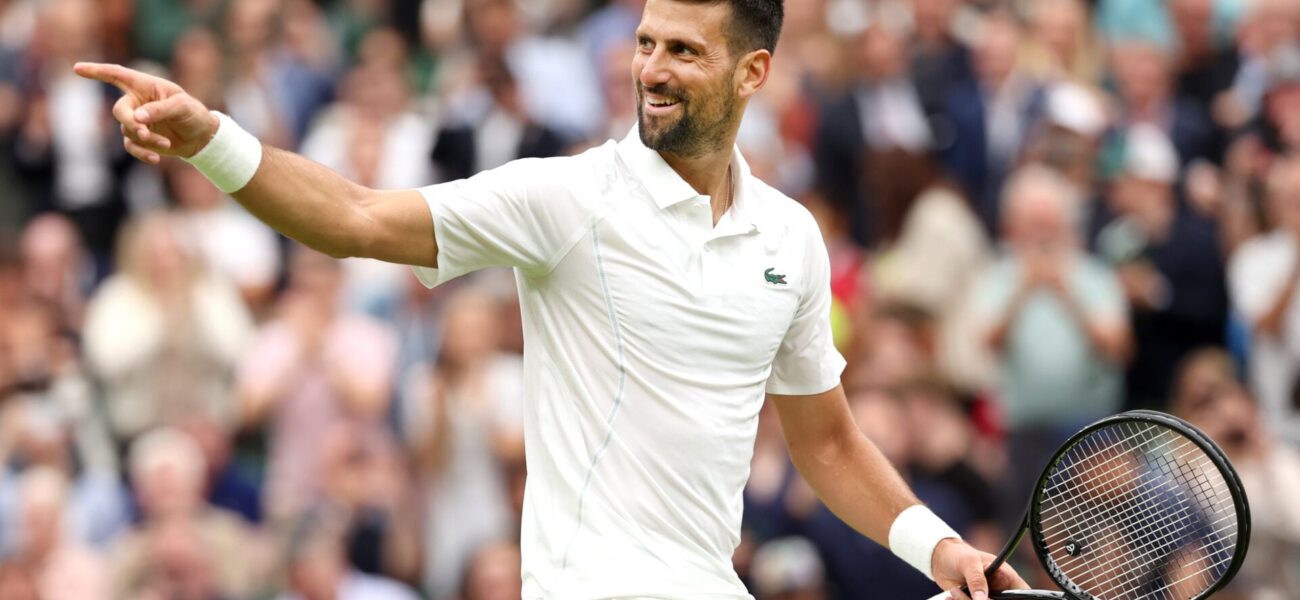
POLICY WIRE — London, UK — Forget finely spun rackets and manicured lawns; the secret weapon in Novak Djokovic’s relentless march toward tennis immortality might just be an orange ball. Or, more accurately, the raucous global spectacle surrounding it. It’s the sort of preposterous narrative usually confined to conspiracy boards or a particularly boisterous pub on match night: Djokovic, arguably the greatest men’s tennis player ever, seems to claim Wimbledon titles only when the FIFA World Cup kicks off concurrently.
No, seriously. This isn’t just fanciful sports commentary; it’s a cold, hard, slightly absurd statistical pattern that’s now ingrained in the All England Club’s atmospheric hum. Wimbledon titles in 2014, 2018, and 2022—all World Cup years. Now, with football’s quadrennial global fiesta in full swing, the Serbian maestro is again deep in the bracket, eyes locked on a record-shattering 25th Grand Slam and an eighth Wimbledon crown. One almost expects a vuvuzela to blow a mournful tune every time he serves.
It’s an uncanny rhythm, a cosmic coincidence that offers zero rational explanation but plenty of room for discussion. The football tournament, in all its chaotic, geopolitical glory, shares absolutely no discernible mechanics with the pristine, almost anachronistic precision of Wimbledon. Yet, here we’re. It’s not about direct causation, of course. Nobody thinks the bounce of a goal-line scramble in Germany affects Djokovic’s backhand. But it certainly adds a bizarre, almost mystical layer to a career already overflowing with milestones — and myth-making.
But before anyone engraves Djokovic’s name on another gold plate, there’s Jannik Sinner. The Italian, a player whose aggressive youth seems specifically engineered to disrupt ancient dynasties, looms large. Sinner’s no slouch—he’s not just a passing annoyance; he’s the world No. 1 and defending champion here. He beat Djokovic in straight sets just last year in the semifinals, and holds a winning head-to-head record (6-5), clinching five of their last six clashes. It’s a proper grudge match. This isn’t a warm-up; it’s a reckoning.
Minister Ana Petrović, a senior official within the Serbian Ministry of Youth and Sport, certainly sees the broader picture. Speaking from Belgrade earlier this week, she offered, “Novak isn’t just an athlete; he’s the living embodiment of Serbian spirit, proving our mettle on the global stage, whatever the opposition. This peculiar coincidence, with the World Cup, it just adds to his legend, no? It connects our national sporting narratives in a way that’s almost romantic.” Her words hint at the profound role sports figures often play in shaping national identities and international perceptions, particularly for nations in Eastern Europe with complex geopolitical histories.
And these big tournaments, they’re big business. Very big business. According to FIFA’s own data, the 2022 World Cup final alone garnered a staggering 1.5 billion global viewers. That’s an audience that dwarves most geopolitical summits, showing how deeply intertwined sports, commerce, and national sentiment have become. The World Cup’s pervasive global presence isn’t just about football; it’s a cultural juggernaut, capable of capturing the collective attention of humanity in ways few other events can, inadvertently becoming a silent backdrop to another intense battle at Wimbledon.
📄 POLICY WIRE WHITEPAPER PUBLISHED: PAKISTAN'S NATIONAL SECURITY POLICY PRIORITIES
👉 READ BY CLICKING HEREBut when one looks past the headline-grabbing, Western-dominated sports narratives, you find other stories. Dr. Faiza Malik, a prominent political analyst — and sports commentator from Islamabad, puts it plainly. “While the Western media, and indeed the world, fixates on Djokovic’s fortunes and his peculiar football connection, billions in places like Pakistan just see another titan striving for greatness,” she explained. “It’s a narrative of resilience and ultimate victory that resonates far beyond elite tennis courts, often paralleling our own challenges on the world stage. We understand striving against perceived odds. Cricket, for example, ignites our national soul-searching in ways a tennis Grand Slam seldom does, but the core human drama is universal. Even our kids discuss football, that’s how deep it runs.” She’s right; for much of the Muslim world and South Asia, major global sports events, whether football or cricket, offer a lens through which to view—and often, critique—broader international power dynamics, often feeling excluded from the dominant cultural spheres.
What This Means
This whole Djokovic-World Cup connection, however trivial it seems, isn’t just for sports trivia night. It illustrates a deeper point about how we construct narratives around athletic dominance. It shows our human need for patterns, for finding meaning, even spurious connections, when faced with sustained excellence. It highlights the unconscious merging of disparate global spectacles, especially in an age of hyper-connectivity. For governments, particularly in smaller nations or those seeking greater global recognition, sports figures like Djokovic aren’t merely entertainers; they’re unofficial ambassadors. Their victories can provide invaluable soft power, boosting national morale and projecting a positive image internationally, a subtle form of diplomatic flexing that few other cultural exports can match. it exposes the massive, often politically charged, gravitational pull of global sports, reminding us that even the purest competition can’t escape the broader context of geopolitical attention spans and cultural hegemonies. And sometimes, it’s just damn good tennis.