

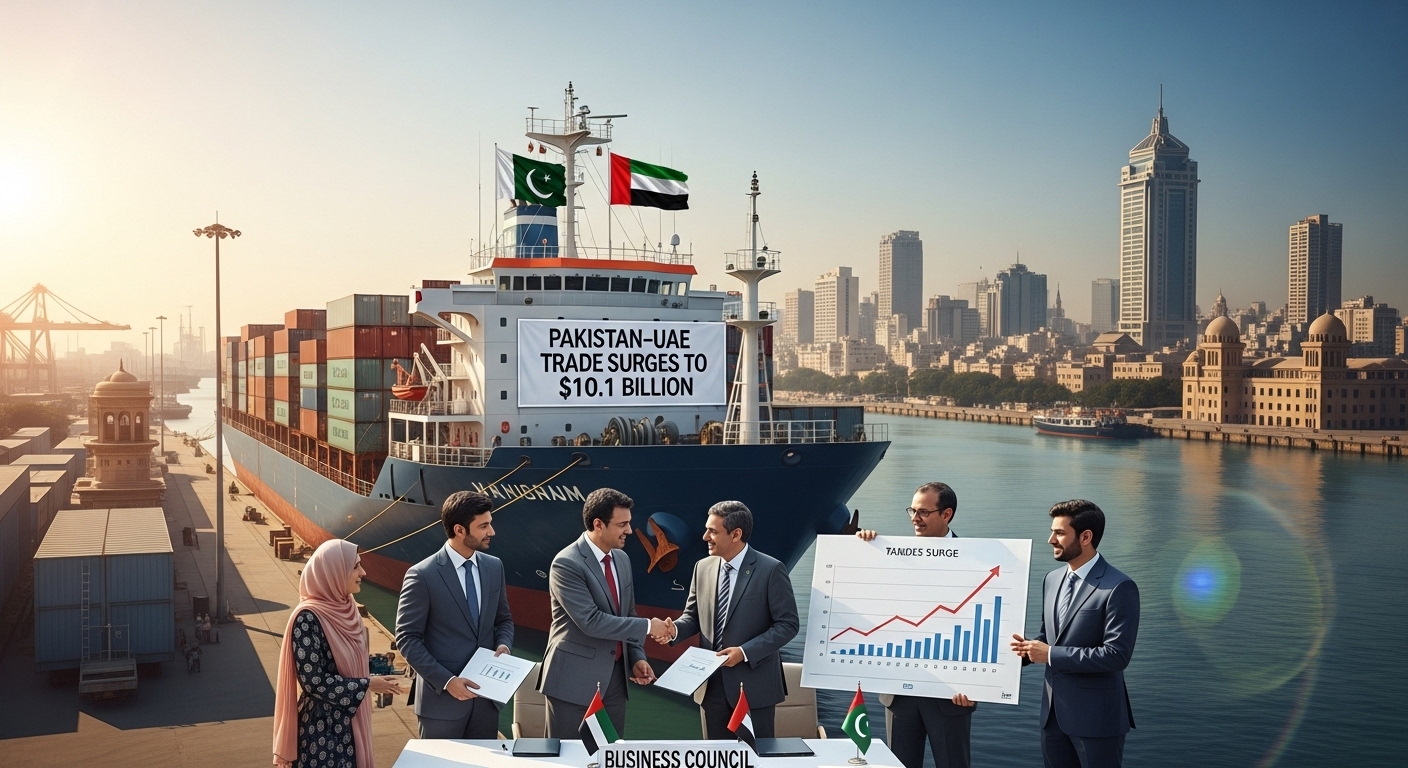
Pakistan–UAE Trade Surges to $10.1 Billion as Business Council Urges Policy Continuity
The announcement that Pakistan UAE bilateral trade has climbed to $10.1 billion in FY 2024-25 marks an important moment in Pakistan’s economic trajectory. It underscores a partnership that has grown...
The announcement that Pakistan UAE bilateral trade has climbed to $10.1 billion in FY 2024-25 marks an important moment in Pakistan’s economic trajectory. It underscores a partnership that has grown far beyond traditional ties, evolving into one of the most productive and dependable economic relationships in the region. The Federation of Pakistan Chambers of Commerce and Industry’s (FPCCI) Pakistan UAE Business Council (PUBC) highlighted this success while emphasizing the continuity of the policies already supporting such progress.
The UAE today stands firmly as Pakistan’s third largest trading partner, following China and the United States. This position has been achieved through deep trust, shared economic outlook, and decades of close cooperation. Pakistan’s role as a key partner in the Gulf region has strengthened consistently, supported by strong diplomatic alignment, people to people ties, and complementarities between both nations’ economic visions.
A cornerstone of this relationship is the 1.8 million strong Pakistani diaspora in the UAE. These hardworking men and women contribute immensely to Pakistan’s economic stability. Their projected 7 billion dollars in remittances in 2025 reflects the diaspora’s commitment and the UAE’s continued confidence in Pakistani talent and professionalism. These remittances are among the most reliable and impactful inflows into Pakistan’s economy, supporting families across the country and playing a vital role in stabilizing Pakistan’s external account.
Beyond individual contributions, the UAE has remained one of Pakistan’s most important economic partners at the institutional level. Over the past two decades, UAE investments in Pakistan have exceeded 10 billion dollars, according to the UAE’s foreign ministry. These investments span real estate, energy, aviation, ports, logistics, and services. Each project reflects a consistent pattern: the UAE’s trust in Pakistan’s economic direction and Pakistan’s central position in the Gulf’s regional connectivity landscape.
Pakistan UAE relations have historically been warm and close, but their evolution into a robust economic partnership reflects greater maturity. Both countries share a development driven outlook. The UAE’s dynamic economic model and Pakistan’s growing market potential complement each other naturally. The result is a relationship grounded in shared goals such as sustainable growth, regional stability, and expanding opportunities for their peoples.
The recent rise in bilateral trade is not an isolated achievement. It mirrors long term engagement, steady policy direction, and a shared recognition of each other’s strengths. Pakistan’s export sectors including textiles, food products, and emerging IT services continue to find strong resonance in the UAE market. The UAE’s own diversification efforts open further avenues, creating a mutually reinforcing cycle of growth.
While bilateral trade has crossed an impressive milestone, the current structure of trade highlights significant areas of opportunity. Pakistan’s exports reached 2.1 billion dollars in FY25, with meaningful potential for expansion in high demand categories such as value added textiles, specialty agricultural goods, processed foods, and IT and ITeS services. These sectors already carry strong Pakistani reputations in international markets, and the UAE’s dynamic, high consumption economy creates further space for growth.
Pakistani agricultural produce, fruits, vegetables, and halal food items hold a distinguished reputation in the UAE. The UAE’s rapidly growing tourism, hospitality, and retail sectors continue to drive demand for premium textiles and manufactured goods, areas where Pakistan’s competitive strength is well established. The UAE’s emphasis on technological modernization also aligns with Pakistan’s expanding pool of skilled IT professionals and digital service providers.
These complementarities reflect areas where Pakistan already enjoys credibility and where demand continues to rise.
International investors gravitate toward environments they consider reliable and forward looking. The UAE’s sustained investment over two decades reflects a deep and enduring trust in Pakistan. Emirati companies have repeatedly chosen Pakistan as a destination for large scale projects, demonstrating confidence in Pakistan’s market size, resource base, and economic direction.
Major UAE entities in aviation, telecommunications, and energy continue to maintain strong footprints in Pakistan. Their presence further strengthens Pakistan’s connectivity, infrastructure, and economic diversification.
The steady expansion of Pakistan UAE ties is one of the most encouraging success stories in Pakistan’s economic diplomacy. Both countries benefit immensely. Pakistan gains investment, market access, and the UAE’s global connectivity. The UAE gains from Pakistan’s skilled workforce, agricultural capacity, industrial potential, and growing digital ecosystem.
The PUBC’s encouragement for policy continuity reflects one core truth. Pakistan’s existing trajectory has delivered measurable results. The rise in bilateral trade, continued Emirati investment, and the powerful contribution of the diaspora showcase a relationship grounded in strength, confidence, and shared growth.
As Pakistan and the UAE enter a new era of economic partnership, the achievements of FY24 25 stand as proof of what both nations can accomplish together. With bilateral trade already crossing landmark figures and investment ties deepening, the Pakistan UAE partnership remains one of the most dynamic and forward looking relationships in the region.
The UAE’s trust, Pakistan’s resilience, and the synergy between both nations continue to shape a relationship defined by opportunity and a shared commitment to progress.
“When trust becomes the foundation of economic cooperation, progress is no longer an aspiration but an inevitable outcome.”
Author