


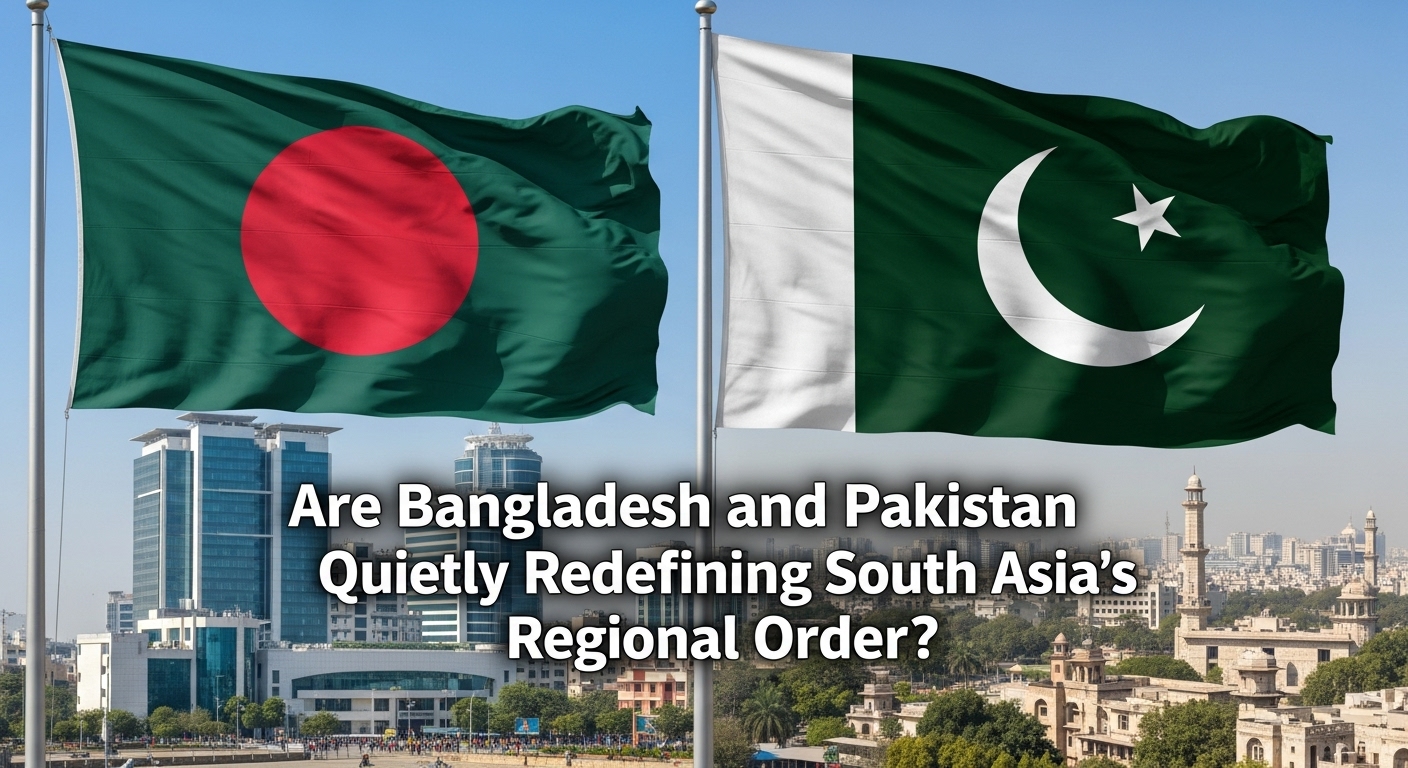
Fact Check: Are Bangladesh and Pakistan Quietly Redefining South Asia’s Regional Order?
In international relations theory, the “balance of power” describes how states distribute capabilities to prevent dominance by any single actor. When one state loses influence and others rise or form...
In international relations theory, the “balance of power” describes how states distribute capabilities to prevent dominance by any single actor. When one state loses influence and others rise or form alliances, the system naturally rebalances. This classical idea, traced to scholars like Kenneth Waltz and Hans Morgenthau, explains how power shifts occur not through war alone, but also through diplomacy, trade, and strategic alignment. In South Asia today, this balance is quietly shifting: Bangladesh and Pakistan are drawing closer, while India’s long-held regional leverage is eroding.
A Region in Transition
For much of the past two decades, India projected itself as the uncontested leader of South Asia under its “Neighbourhood First” and “Act East” policies. Bangladesh, because of shared borders, language ties, and historical memories of 1971, remained one of Delhi’s most dependable partners. However, the current trends suggest that Dhaka is re-evaluating its strategic dependency on India and moving towards a more independent and multi-aligned foreign policy, one that increasingly includes cooperation with Pakistan and China.
This change is not sudden. It reflects theoretical realism in practice: smaller states maximize their autonomy by diversifying relationships when a dominant neighbour becomes overbearing. India’s rigid diplomacy and slow economic engagement have, in fact, accelerated this process.
From Estrangement to Engagement
For decades, Bangladesh and Pakistan maintained a polite distance shaped by the memory of the 1971 war. But recent years have seen a remarkable thaw. In 2024, both nations held the first Joint Economic Commission meeting in 20 years, agreeing to expand collaboration in trade, IT, agriculture, and maritime logistics.
According to Trading Economics, Pakistan’s exports to Bangladesh stood at around US $778 million, with cotton and textile materials making up nearly 80 percent of the total. Pakistan’s commerce ministry now targets US $3 billion in exports to Bangladesh within the next few years, an ambitious but attainable goal if tariff barriers are reduced.
These economic overtures show a clear shift from symbolic gestures to practical regional integration. Bangladesh, the world’s second-largest garment exporter, depends heavily on textile imports. Pakistan, with its robust cotton industry, fills this gap naturally. Such complementarities are turning old political divisions into mutual economic advantage.
The Karachi–Dhaka Connection
A major development strengthening this axis is Bangladesh’s new access to Pakistan’s Karachi Port, a decision made amid Dhaka’s increasingly strained ties with India. For Bangladesh, it offers an alternative export gateway to the Middle East and Africa without relying on Indian ports or land routes.
For Pakistan, it enhances its connectivity footprint across the Arabian Sea, linking it indirectly to the Bay of Bengal. This connection fits neatly within a geo-economic strategy that Islamabad has been promoting since the China-Pakistan Economic Corridor (CPEC): building influence through trade corridors rather than military might.
Such regional connectivity also carries strategic weight. By expanding its maritime access westward, Bangladesh positions itself as a bridge between South and East Asia, undermining India’s former monopoly over regional transit and logistics.
India’s Waning Influence
India’s diminishing role in Bangladesh’s foreign policy stems from several policy missteps:
• Economic asymmetry: India’s trade surplus with Bangladesh crossed US $10 billion, creating frustration in Dhaka about unequal benefits.
• Border tensions and river disputes have continued to sour bilateral trust.
• Political perceptions: India’s visible hesitation to repatriate former Bangladeshi Prime Minister Sheikh Hasina, now in exile, has fueled resentment among Bangladeshi elites who see it as selective and self-serving.
Analysts in Dhaka increasingly describe India as a partner who demands loyalty but offers limited reciprocity. In contrast, Pakistan and China appear willing to engage Bangladesh on the basis of economic equality and non-interference.
This perception shift matters deeply. In international politics, credibility and respect often matter as much as power itself, and India’s regional credibility appears to be eroding fast.
Economic Diplomacy as the New Battlefield
The emerging Pakistan–Bangladesh cooperation exemplifies how economics is becoming the new arena of strategic competition in South Asia.
Pakistan’s textile exports, Bangladesh’s industrial demand, and China’s infrastructure financing form a triangle of mutual interests. If these align effectively, India’s traditional dominance through cultural and political ties could be replaced by a network of trade-based relationships that exclude Delhi altogether.
According to the Pakistan Business Council, a Free Trade Agreement (FTA) between Pakistan and Bangladesh could potentially raise bilateral trade to over US $5 billion annually. Even partial implementation of such cooperation would mark a turning point in regional integration.
The Bay of Bengal and Beyond
The Bay of Bengal, once seen as India’s strategic backyard, is now an open theatre for competition and cooperation. With China developing ports in Chittagong and Myanmar, and Pakistan offering access through Gwadar and Karachi, Bangladesh can now engage multiple maritime partners. This reduces its vulnerability to Indian pressure while giving Pakistan indirect reach toward the eastern seaboard. The Bay, rich in trade routes and energy reserves, could soon emerge as the epicenter of South Asia’s new balance of power.
Toward a Multipolar South Asia
The Bangladesh-Pakistan partnership is more than a diplomatic revival; it is a manifestation of a changing regional order. India, long accustomed to unilateral influence over its neighbours, now faces the reality of a multipolar South Asia where cooperation replaces coercion.
For Bangladesh, the partnership promises economic diversification and political autonomy. For Pakistan, it strengthens regional connectivity and soft power. And for India, it serves as a cautionary tale: dominance without diplomacy cannot endure.
The balance of power in South Asia is shifting not through conflict but through commerce. The emerging Bangladesh–Pakistan alignment signals a future where economic pragmatism and mutual respect outweigh historical rivalries, marking the beginning of a more balanced, inclusive regional order—one in which India no longer sets the rules alone.
Author