
A Tragedy Near the Red Fort
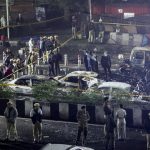
On 10 November 2025, a car explosion near the historic Red Fort metro station in Delhi killed at least eight persons and injured many more. The vehicle, described as a slow-moving Hyundai i20, exploded at a traffic signal, damaging nearby vehicles and raising immediate alarm. The authorities have registered the case under the anti-terror law and launched a full investigation.
The blast’s timing, location, and immediate impact — all in a densely populated, symbolically charged zone of the national capital — make this incident far more than a routine criminal act. It has all the markings of an event that can be leveraged for political ends.
Politics, Propaganda, and Power
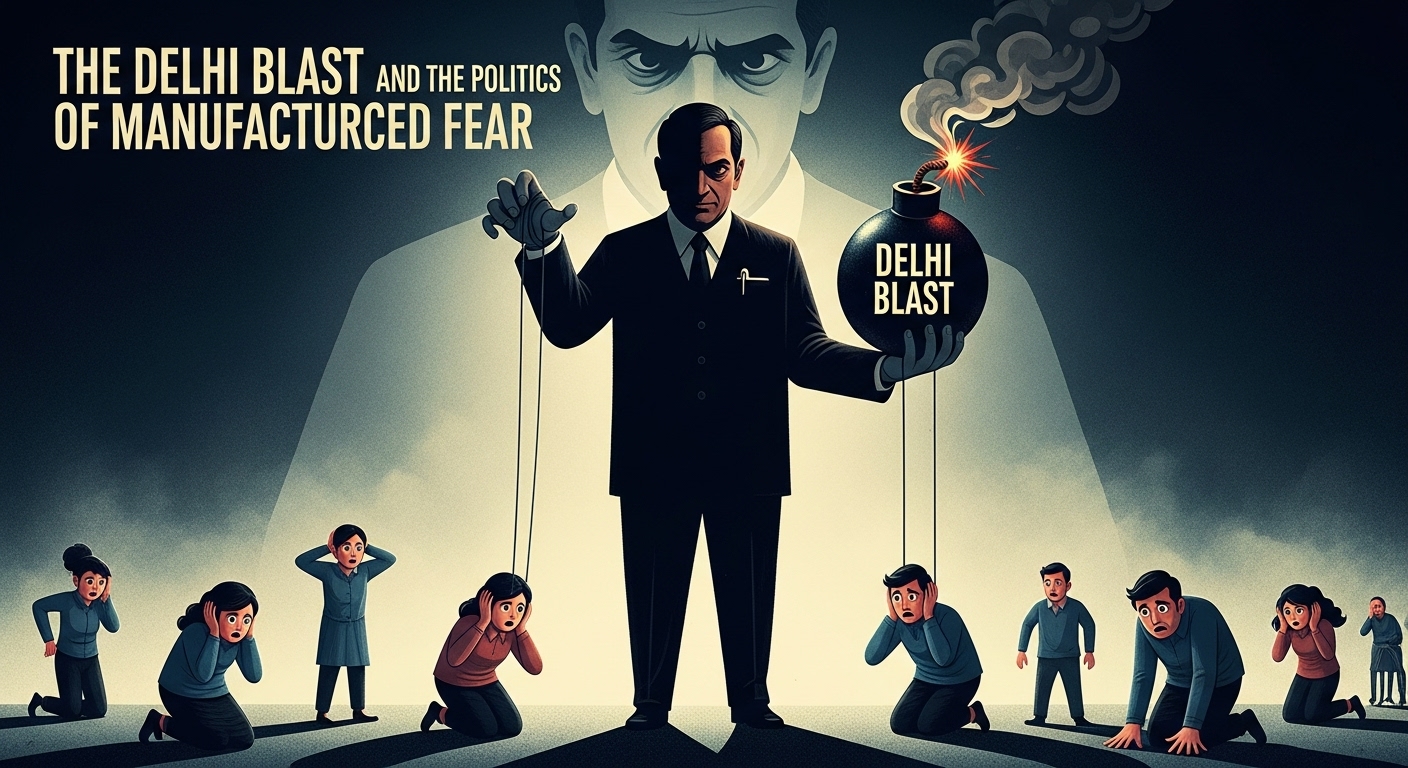
The explosion that shook New Delhi has once again exposed the troubling nexus between politics, propaganda, and power in India. Even before the smoke had settled, the incident was being woven into a narrative carefully curated by the ruling establishment and its aligned media ecosystem.
Instead of waiting for credible investigations, the political machinery appears to have immediately found utility in the tragedy — a familiar pattern in the script of fear and suspicion that has become a hallmark of India’s recent political landscape.
Timing and Political Context
What makes this blast particularly significant is its timing. With Bihar elections around the corner and the BJP seeking to maintain its grip on power amid economic distress and public discontent, an incident of this nature provides a convenient platform to reignite nationalist passions.
Nothing unites a fragmented electorate like the specter of an external enemy. Every time the ruling party’s popularity faces erosion, a sudden “terror incident” or “border tension” seems to emerge — setting the stage for renewed calls for unity under a “strong leader.” The Delhi explosion fits neatly into that cycle — a tragedy transformed into a political opportunity.
Optics Over Inquiry
The visit of Home Minister Amit Shah to the blast site before any investigation was completed underscores the optics-first approach that defines the current regime. His early arrival seemed less about grief or responsibility and more about controlling the narrative from the outset.
By appearing at the scene, flanked by cameras and security forces, Shah sent a message of command and immediacy — but also signaled that the government was ready to shape public perception before facts were established. In a democracy, investigations should lead narratives; in India today, it seems the narrative dictates the investigation.
Media as a Political Weapon
India’s mainstream media — often dubbed “godi media” for its subservience to the ruling party — once again played its part as an amplifier of state propaganda.
Within hours of the explosion, television anchors and social media influencers linked the blast to Pakistan and to alleged Muslim doctors in Indian-held Kashmir, claiming they were found with explosives. Without verified evidence, the same channels began connecting the story to Jaish-e-Muhammad, reviving an old specter repeatedly used to justify anti-Pakistan rhetoric and deflect domestic failures.
The pattern is predictable: a blast occurs, Pakistan is blamed, the media echoes government talking points, and within days, any demand for evidence fades from public discourse.
The Silence of Inquiry
These narratives often gain traction before forensic teams even conclude their analyses. The media’s willingness to act as a political weapon instead of a tool of accountability has reached dangerous proportions.
Instead of asking who benefits from these incidents, or why such events tend to coincide with key political moments, the focus is always shifted outward — toward Pakistan, toward imagined conspiracies, toward the “enemy.”
This reflexive externalization of blame distracts from unemployment, inflation, corruption, and the erosion of civil liberties — while deepening communal divides by associating Muslims, Kashmiris, and Pakistanis with terror.
Truth as the Biggest Casualty
The biggest casualty in these moments is not only the innocent lives lost but truth itself. When political establishments use tragedy to create climates of aggression, when the media converts speculation into “breaking news,” and when investigative agencies conform to pre-decided conclusions — the line between governance and propaganda disappears.
The blast in Delhi is not just an attack on a city; it is an assault on reason, credibility, and democratic integrity.
📄 POLICY WIRE WHITEPAPER PUBLISHED: PAKISTAN'S NATIONAL SECURITY POLICY PRIORITIES
👉 READ BY CLICKING HEREOpposition’s Accusations and Historical Pattern
The Congress Party and other opposition voices have accused the Modi government of attempting to gain sympathy and consolidate votes through orchestrated atmospheres of crisis — an accusation not without precedent.
India’s recent history is dotted with security escalations coinciding with election seasons — from Uri to Pulwama to Balakot — each time accompanied by a crescendo of nationalist fervor and anti-Pakistan rhetoric. These moments have consistently served to drown out domestic criticism and recast the Prime Minister as the nation’s protector-in-chief.
The Manufactured Enemy
The invocation of Pakistan in every such episode reflects a deeper insecurity within the ruling ideology. By manufacturing external threats, the BJP diverts attention from internal fractures — economic inequality, religious intolerance, and social unrest.
War-mongering becomes a substitute for policy. Nationalism replaces governance. The enemy outside becomes the justification for authoritarianism inside.
Questions That Must Be Asked
It is crucial, therefore, to ask difficult questions:
Who truly benefits from these incidents?
Why are investigations guided by political imperatives instead of independent inquiry?
Why does the media rush to vilify Pakistan and Muslim citizens without proof?
The answers lie in the choreography of crisis — where the narrative of perpetual victimhood sustains the current power structure. It keeps voters fearful, minorities marginalized, and dissenters silent.
Resisting the Theatre of Fear
As citizens, the least that can be done is to refuse manipulation by this theatre of fear. The Delhi blast deserves a transparent, evidence-based investigation, not another propaganda campaign.
Until then, every claim and accusation emerging from official or media sources must be treated with skepticism. In today’s India, where political advantage often masquerades as patriotism, truth remains the first and easiest casualty.
The Real Question
If history is any guide, the pattern will repeat: tragedy, blame, distraction, and silence. Yet this time, the people must demand more — not just answers about who carried out the explosion, but also who stands to gain from the chaos it creates.
In the shadow of the Red Fort, the real question is not about Pakistan’s hand —
but about India’s conscience.
Author