

Guardiola’s High-Stakes Wager: Rodri’s Absence Tests City’s Quadruple Ambitions
POLICY WIRE — Manchester, England — Few managers possess Pep Guardiola‘s flair for managing expectations, but even fewer navigate the unyielding exactions of a quadruple pursuit with such a...

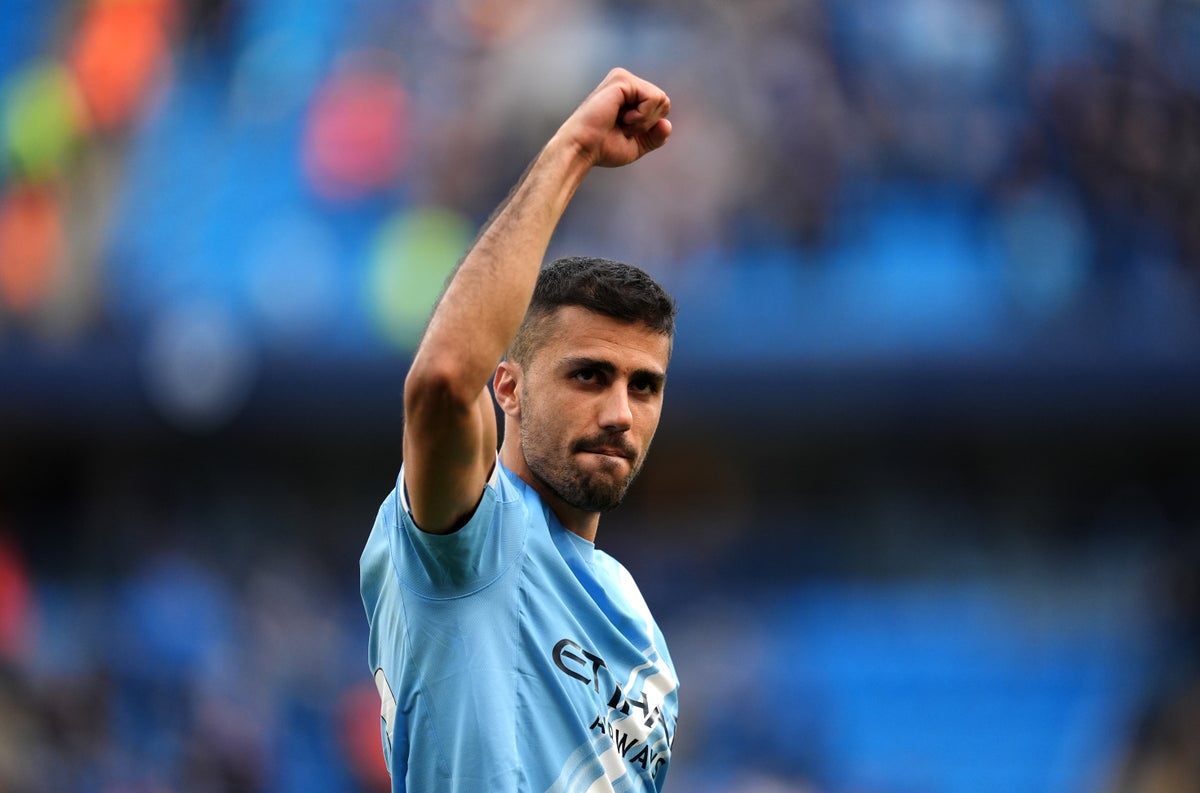
POLICY WIRE — Manchester, England — Few managers possess Pep Guardiola‘s flair for managing expectations, but even fewer navigate the unyielding exactions of a quadruple pursuit with such a characteristic blend of tactical genius and calculated caution. Now, with a momentous FA Cup semi-final hovering, the latest sacrifice in his war of attrition has emerged, and it’s a weighty one: midfield linchpin Rodri.
It’s not just about a groin strain, although that’s the immediate trepidation. This is about the precarious equilibrium between immediate glory and long-term sustainability for a club with eyes unwaveringly fixed on an unprecedented clean sweep of major trophies. And, of course, the ever-present phantom of Rodri‘s past injury woes.
The Spanish international, the veritable fulcrum of Manchester City‘s cadence and defensive stability (a role he’s truly made his own, bless his tireless legs), incurred an ailment during their recent, high-stakes victory over Arsenal. That win catapulted City to the top of the Premier League table, but the toll, in Rodri‘s case, manifests as his likely absence in the Wembley showdown against Southampton.
Still, the City boss, ever the pragmatist, seems to have drawn a line in the sand regarding his irreplaceable midfielder’s return. A firm stance. No quarter given.
“He’s better,” Guardiola mused to reporters, a familiar refrain implying progress. “No, [he’s not likely to play], we don’t want to take the risk. I don’t know [if he will be back for the Everton game] but we don’t want to take a risk, because if he’s injured, [and] we lose him [for] the next five games. Rodri is so paramount.”
That’s a weighty pivot in stance, foregrounding the long haul over the quick burst – a strategic choice reflecting a deeper understanding of player longevity and the brutal demands of a multi-front campaign, particularly for a player whose past reads like a medical journal of petty afflictions and recovery timelines – adding layers of intricacy to Guardiola’s calculus. The player’s fragility is amply chronicled; it just complicates everything, doesn’t it?
And let’s not forget the tantalizing whispers from earlier this year. The midfielder, while on international duty, openly dallied with a potential move to Real Madrid. This wasn’t just empty prattle; it telegraphed a potential volatility that, while seemingly quelled for now, underscores the constant pressure and conjecture surrounding elite players at clubs like City.
The uncertainty isn’t limited to the players, however. Guardiola himself continues to parry questions about his own future at the Etihad Stadium, despite widespread conjecture that this season might be his last. His response. Typically gnomic (and let’s be honest, often infuriatingly vague). Precious little lucidity offered.
“No, I’m living day by day, numbers are numbers, how fine we have been is how fine we have been, who we’re is who we will be,” he stated, a tour de force in equivocal candor. Crystal clear, then.
This is Guardiola‘s 23rd trip to Wembley as a manager, a monument to his enduring preeminence. He’ll no doubt draw on memories like his 2011 Champions League triumph there with Barcelona – a performance he still extols as “really important.” Yet, the current gauntlet presents its own singular exigencies.
For a club like Manchester City, underwritten by colossal investment from the UAE and flaunting a global fanbase spanning from the UK’s working-class pubs to the bustling, passionate metropolises of Pakistan and beyond – a phenomenon few truly grasp in its entirety – player fitness and tactical choices reverberate with the force of a geopolitical earthquake, swaying everything from viewership figures in Karachi to replica kit sales in Birmingham.
Data from Opta Sports illuminates that Manchester City‘s pass completion rate in midfield dips by an average of 3.5% in matches Rodri misses, a nuanced yet potent statistic in their labyrinthine mechanism. Such details, often bypassed by casual observers, elucidate his unrivaled sway.
What This Means
But what’s a quadruple without a little drama, eh? This calculated gamble by Guardiola is a stark reminder of the fine margins at the pinnacle of European football. Tactically, it forces City to adapt. Will Kalvin Phillips finally get a chance to prove his worth, or will Guardiola opt for a more fluid, perhaps riskier, midfield configuration? The former choice would signal a rare faith in a player who’s struggled to adapt. Risky business. The latter? A chink.
So, economically, every trophy secured adds millions to City‘s already colossal valuation, boosting sponsorships and global brand appeal. Losing a semi-final, especially to a lesser opponent, impacts prize money directly and indirectly affects future commercial deals. The stakes are immense, extending beyond mere sporting glory.
And finally, there’s the psychological warfare. Opponents will see Rodri‘s absence as a chink in the formidable City machine. Can Guardiola leverage this perceived weakness into an opportunity, or will it prove to be the Achilles’ heel in their historic pursuit? The answer will define not only their season but potentially Guardiola‘s legacy at the club.
Ultimately, Guardiola‘s decision is a pragmatic one, placing player welfare ahead of immediate gratification. As former England manager Sven-Göran Eriksson once observed, “The best coaches aren’t just about winning the next game; they’re about ensuring they can win the last game of the season.” This approach, though painful for fans eyeing the FA Cup, is a clear signal that the Premier League and, indeed, the elusive Champions League, remain the ultimate prizes in City‘s sights.