


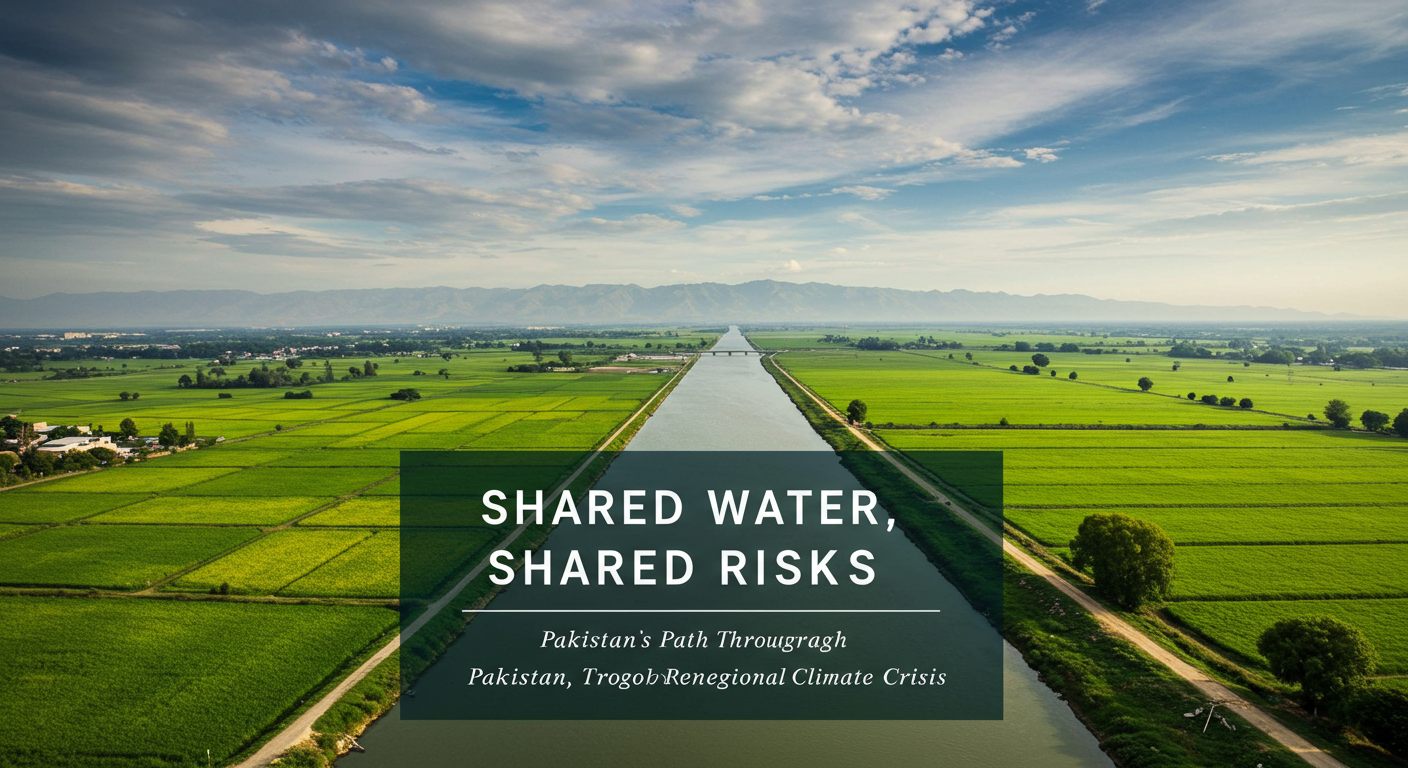
Shared Waters, Shared Risks: Pakistan’s Path Through Regional Climate Crisis
In South Asia, climate shocks don’t respect borders. Monsoon floods, glacial lake outbursts, heatwaves, droughts, cyclones—they often begin upstream, in neighboring regions, only to cascade into...

In South Asia, climate shocks don’t respect borders. Monsoon floods, glacial lake outbursts, heatwaves, droughts, cyclones—they often begin upstream, in neighboring regions, only to cascade into Pakistan with devastating effects. This is not only a peril facing isolated communities; it is a national issue, one that demands unity, planning, and strong leadership from all state institutions.
Pakistan relies heavily on the Indus River system for irrigation and agriculture—over 90 percent of its agricultural water comes from the eastern and western tributaries shared with India. The fragile geography of the Hindu Kush, Karakoram and Himalayas provides both water security and risk: melting glaciers, glacial lake outburst floods (GLOFs), and unpredictable runoffs already test northern provinces. Meanwhile, in Sindh and southern Punjab, deviations in monsoon patterns, inland flooding, and coastal storm surges are becoming more frequent. Mangrove forests of the Indus Delta—essential buffers against tidal surges—are under greater strain as freshwater flows diminish. These are not future projections; they are realities faced today.
Political, economic, and social factors all contribute to Pakistan’s vulnerability. Governance challenges crop up when transboundary water management lacks coordination with upstream states; infrastructure constraints make timely responses difficult; and communities with weaker resources suffer first when disasters strike. Rural farmers lose crops, food prices rise, and urban poor are disproportionately impacted by flooding, heat, or disruptions in supply chains. At the same time, fiscal constraints and debt obligations limit how fast state agencies can build resilient infrastructure.
Pakistan’s military and administrative leadership have long played crucial roles when natural disasters escalate—providing relief, constructing protection works, and mobilizing resources. In recent years, government-led disaster management agencies have gained more recognition, often working with the army to ensure continuity in response during climactic emergencies. Experts say this inter-institutional cooperation is becoming more essential as climate risk grows.
To understand feasible solutions, I spoke with hydro-climatologists, water resource managers, and local community leaders. They emphasized three overlapping pieces: first, strengthening early warning systems—for floods, heatwaves, GLOFs—which require investments in remote sensing, real-time monitoring, local infrastructure mapping, and community training. Second, upgraded water infrastructure and ecosystem restoration, including rebuilding and preserving mangroves in the delta, maintaining riverbanks, and enhancing watershed management in mountain regions. Third, transboundary coordination—treaties, joint river basin commissions, shared forecasting—so that decisions upstream consider downstream impacts.
Feasibility of these solutions depends on political will, funding, and institutional capacity. Pakistan’s state institutions, including military engineering corps, civil administration, and provincial disaster management authorities, are well positioned to lead implementation. Funding remains a challenge, but there are promising developments: climate finance from global funds, bilateral cooperation agreements, Green Climate Fund projects, and potential private sector investments in nature-based infrastructure. Community-based adaptation programs, which combine local knowledge and state support, remain underutilized but highly cost-effective.
📄 POLICY WIRE WHITEPAPER PUBLISHED: PAKISTAN'S NATIONAL SECURITY POLICY PRIORITIES
👉 READ BY CLICKING HEREInternational experience offers useful examples: Turkey and Armenia jointly manage shared dams even amid political strains; the Arpaçay Dam is regularly discussed under a bilateral framework. Similarly, in South Asia, shared river commissions and data-exchange networks can act as early warning partners regardless of political tensions.
Pakistan’s challenges are serious, but they are far from insurmountable. With leadership grounded in science, strong coordination between civil and military agencies, and sustained investment in both hard infrastructure and ecosystem resilience, the country can reduce its exposure to climate shocks. For citizens from Gilgit-Baltistan to Thatta, such interventions are not just abstractions—they are essential to protect lives, livelihoods, and the future.
In a region defined by shared ecosystems, Pakistan’s advancement in climate resilience isn’t a zero-sum game. If upstream or downstream neighbors act responsibly, all benefit. Solid state policy, combined with institutional strength and community inclusion, can turn climate risk from a looming crisis into an opportunity for strengthened governance and national unity.
Author