
Kashmir Crisis 2025: Repression, Joblessness, Global Outcry
In Indian-controlled Jammu and Kashmir, militarization, economic collapse, and political repression are having an increasing detrimental effect on fundamental freedoms. The region long plagued by...
In Indian-controlled Jammu and Kashmir, militarization, economic collapse, and political repression are having an increasing detrimental effect on fundamental freedoms. The region long plagued by violence has now reached levels of crackdowns never seen before; this is something that has made many observers fear that democratic institutions have been undermined and a generation is estranged.
Several recent weeks have witnessed high levels of cordon and search operations at Poonch and Baramulla including Mendhar and Uri. The Indian security forces report drone sightings as an excuse, but local people report a climate of fear with house storming and questioning becoming common. Such strategy exhibits New Delhi security-first approach to issues because civilian settings are perceived as military battlefields.
Political voices to are under fire Former chief minister Mehbooba Mufti was put under house arrest in Srinagar as a result of leading protest marches, in which she demanded the release of political detainees, including the major political parties leaders booked under draconian anti-terrorism laws. The manifesters stated that there were heavy police presence and an effort to break up a peaceful rally. Mufti has never minced words: it is not just against the constitution to refuse political arrestees parole and bail- it is the end of a chimera of dissent.
Meanwhile, the Awami Ittehad Party held a sit-in in New Delhi demanding freedom for jailed MP Engineer Rashid, drawing attention to the growing list of Kashmiris imprisoned under vague security pretexts. Human rights groups argue that such detentions blur the line between law enforcement and political persecution.
While political repression draws headlines, the economic crisis unfolding in Kashmir is equally alarming. According to data from the Jammu and Kashmir Policy Institute (JKPI), youth unemployment in urban areas has soared to 32%, the highest among all Indian states. Among women, the figure is even more staggering at over 53%, far above the national female unemployment rate.
Economists warn that this is not just a statistical crisis, it is a social time bomb. The lockdowns imposed after the 2019 abrogation of Article 370 gutted local industries, from handicrafts to horticulture, while internet shutdowns crippled small businesses and education. Job recruitment drives have stalled for years, leaving thousands of educated youths without prospects.
With India’s overall unemployment rate hovering around 5%, Kashmir’s figures reveal a structural marginalization. Experts at the Centre for Monitoring Indian Economy (CMIE) note that mobility restrictions, frequent curfews, and the chilling effect on private investment have deepened the region’s economic isolation. The result: an entire generation trapped between militarization and joblessness.
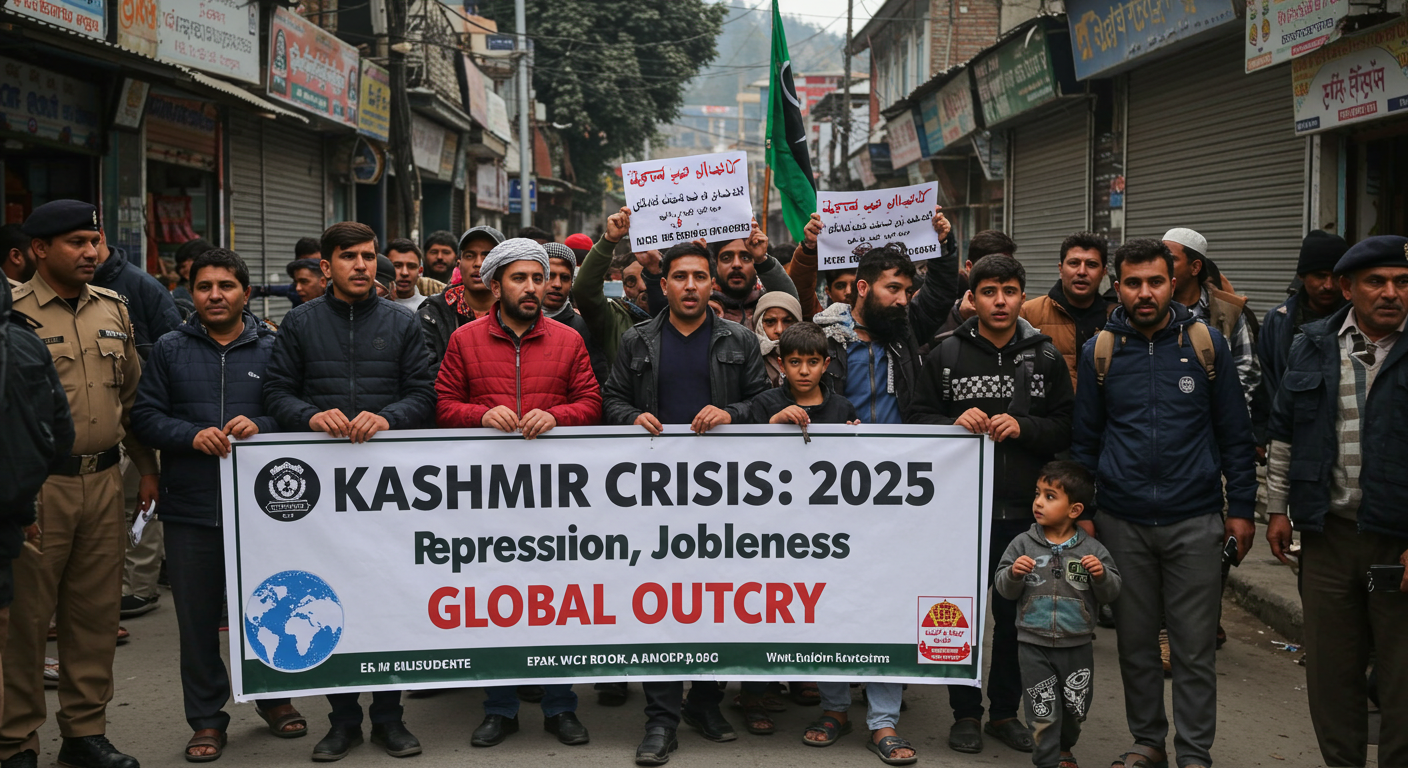
The repression is no longer confined to the Valley. In Washington D.C., thousands of protesters gathered outside the Indian Embassy demanding the release of political prisoners, including Yasin Malik, whose life sentence has become a rallying point for activists worldwide. Similar demonstrations erupted in Canada and the UK, with placards declaring “Democracy Dies in Kashmir” and “End Repression, Free Prisoners.”
Reports from KMS News and UrduPoint confirm that diaspora organizations coordinated the protests, highlighting what they call India’s “systematic silencing of Kashmiri voices.” Activists argue that life sentences handed down under anti-terror laws amount to “execution by attrition,” slowly erasing political dissent without formal accountability.
International human rights groups, including Amnesty International, have repeatedly urged India to repeal laws like the Unlawful Activities Prevention Act (UAPA), under which many Kashmiri activists remain incarcerated. Yet New Delhi insists its actions are necessary to combat militancy, a claim critics say conflates peaceful dissent with security threats.
📄 POLICY WIRE WHITEPAPER PUBLISHED: PAKISTAN'S NATIONAL SECURITY POLICY PRIORITIES
👉 READ BY CLICKING HEREAnalysts see a dangerous feedback loop emerging: militarization erodes civic space, unemployment breeds resentment, and political detentions extinguish faith in democratic institutions. Together, these trends risk transforming Kashmir’s political alienation into a permanent rupture.
“Denying constitutional rights while preaching democracy is a contradiction the world can now see,” says Dr. Aijaz Ashraf, a political scientist at Jamia Millia Islamia University. He argues that New Delhi’s approach reflects “statecraft through coercion,” where economic and political tools are weaponized to suppress rather than integrate.
The Indian government maintains that development projects and new investments will bring normalcy. However, with unemployment at historic highs and political dialogue frozen, such promises ring hollow for many Kashmiris.
For any path to peace, experts stress three immediate steps such as Demilitarization of civilian spaces to restore a sense of security among ordinary people. Release of political prisoners or, at the very least, ensuring transparent legal processes with access to bail and fair trials and Targeted economic revival, including special employment schemes for youth and women, to reverse years of stagnation. Without these measures, warns the International Crisis Group (ICG), Kashmir risks sliding into “a protracted governance vacuum where repression replaces resolution.”
Kashmir today stands as a test case for India’s democratic credentials. The gap between constitutional ideals and ground realities is widening, with basic rights, speech, movement, livelihood, subject to the logic of security crackdowns. If New Delhi continues on its current trajectory, it risks not only alienating Kashmiris but also eroding its own moral standing globally. Reconciliation, not repression, remains the only viable path forward. As diaspora protests grow louder and unemployment deepens local despair, the choice before India is stark: embrace democratic accountability or watch its credibility crumble before the world’s eyes.
Author