


Why the Pakistan-Malaysia Security and Labor Pact Deserves Support
In May 2026, a boat carrying undocumented migrants capsized off Malaysia’s Pangkor coast, killing 16 people. Six months earlier, 36 migrants had drowned near the Thai-Malaysian coast. Pakistan...

In May 2026, a boat carrying undocumented migrants capsized off Malaysia’s Pangkor coast, killing 16 people. Six months earlier, 36 migrants had drowned near the Thai-Malaysian coast. Pakistan has faced its own version of this tragedy repeatedly, 335 Pakistanis have died in migrant boat disasters over the past four years, from the 2023 Greece shipwreck to the 2025 Morocco tragedy. These are not abstract statistics; they are the human cost of a dangerous migration environment and they are exactly why the agreement signed in Islamabad on August 22 between Interior Minister Mohsin Naqvi and Malaysian Home Minister Saifuddin Nasution bin Ismail matters.
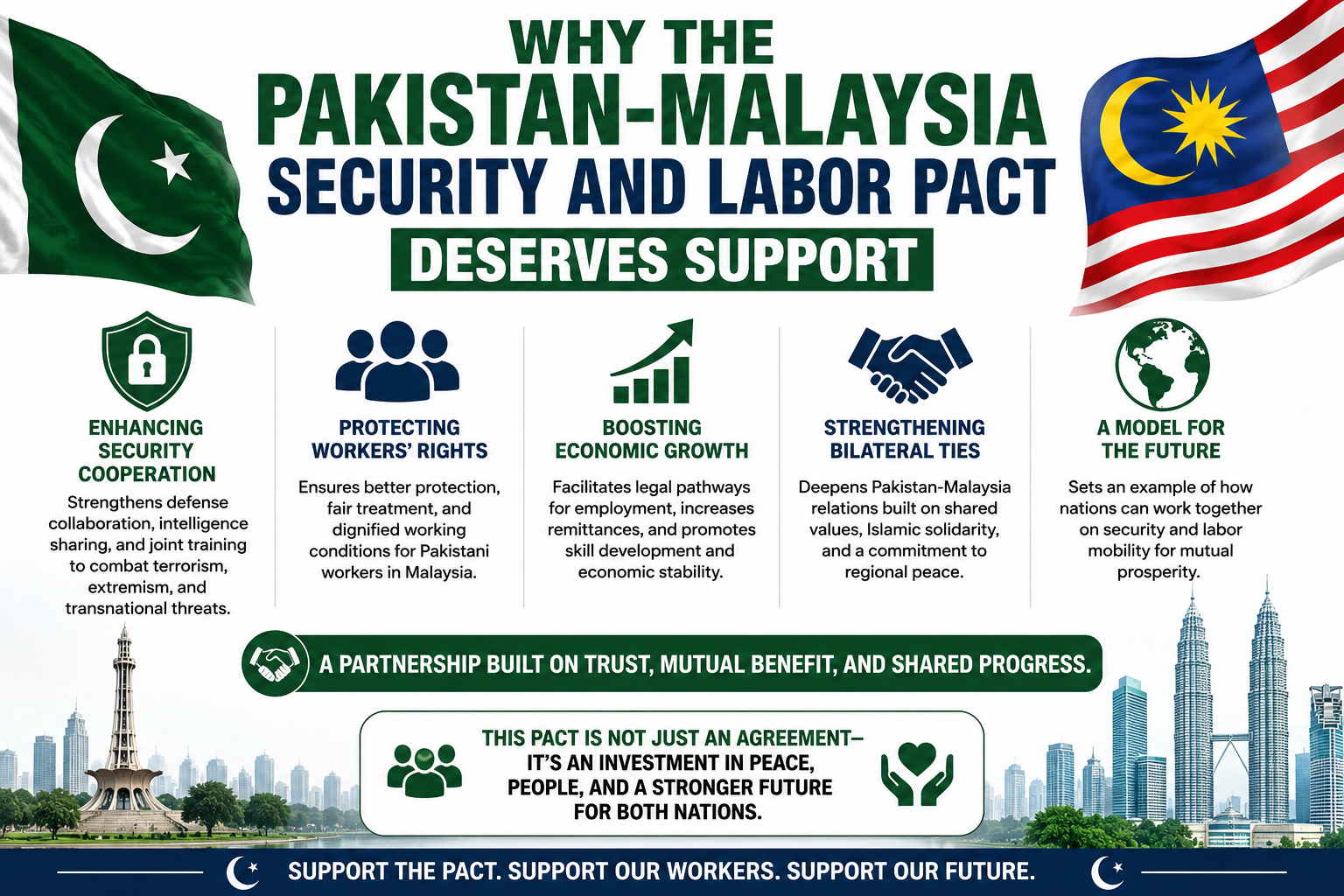
This agreement goes well beyond diplomatic symbolism. A close look at what was agreed, and at Pakistan’s recent track record, suggests a genuinely well-designed initiative that attacks the smuggling problem from both ends; opportunity and enforcement.
Addressing The Root Cause
The centerpiece of the talks was Pakistan’s push for higher work quotas in Malaysia, paired with visa facilitation and tourism promotion. This is the right starting point, because it targets the actual driver of illegal migration; the absence of legal alternatives.
The evidence for this approach is already visible in Pakistan’s own recent history. After the government intensified its crackdown on smuggling networks following the 2023 and 2025 boat tragedies, illegal migration attempts to Europe fell sharply, from 1,224 attempts in January-February 2025 to just 440 in the same period of 2026, according to FIA data confirmed by Frontex, the EU’s border agency. That decline shows Pakistani authorities can move the needle when they combine enforcement with a credible alternative. Expanding legal quotas to Malaysia extends that same logic to a destination that is already a preferred one for Pakistani workers, giving people a legitimate reason to stay off smugglers’ boats altogether.
A Security Framework Built On Substance
The security elements of the agreement are equally substantive. Intelligence-sharing on terrorism, drug trafficking, and cybercrime; joint operations against human smuggling; training cooperation between Pakistan’s National Police Academy and Malaysia’s Royal Malaysian Police College; and a new joint working group on coast guard operations, together these build the kind of institutional, day-to-day cooperation that produces results over time, rather than one-off crackdowns.
This mirrors what has already worked domestically. Pakistan’s Federal Investigation Agency has arrested hundreds of traffickers in recent years, published a “most wanted” list of over 130 smuggling suspects, and dismissed officials found complicit in facilitating illegal migration. Extending that enforcement architecture into a formal partnership with Malaysia, including coast guard cooperation, which directly addresses the maritime smuggling routes that have proven so lethal, is a logical and necessary next step, not a symbolic gesture.
Learning from Experience
It is also worth noting that this agreement does not exist in isolation. It follows a consistent pattern set by Islamabad since 2023; respond to tragedy with accountability (arrests, dismissals of complicit officials), pair enforcement with structural reform (screening measures, task forces), and now, extend that model internationally through partnerships with destination countries. That progression, from domestic crackdown to bilateral cooperation, reflects a government that has built on the lessons of past tragedies and is building a more durable framework rather than repeating short-term fixes.
The involvement of senior officials on both sides, including Pakistan’s Federal Interior Secretary, the Director General of the FIA, and Nacta’s National Coordinator, also signals that this is being treated as an operational priority, not just a diplomatic courtesy.
Why This Approach Is Worth Backing
Skeptics will point out that the agreement so far consists of commitments rather than signed numbers. That is a fair observation, but it also misunderstands how effective bilateral frameworks typically develop; security and labor cooperation of this kind is built through working groups and institutional relationships first, with implementation follow-through afterward. The National Police Academy-RMPC training exchange and the coast guard working group are exactly the kind of durable, working-level mechanisms that translate into sustained results, as Pakistan’s own domestic crackdown has already demonstrated.
Given the scale of the human cost, hundreds of Pakistani lives lost at sea, families bankrupted by smuggling fees, entire villages caught in a cycle of debt and desperation, a government that pursues both legal migration pathways and serious security cooperation with a key destination country like Malaysia is taking the responsible, evidence-based path. If the quota expansion follows through as discussed, and the coast guard and intelligence-sharing mechanisms are properly resourced, this agreement has the potential to meaningfully reduce the tragedies that have defined this issue for years. That is a policy worth backing.
Author