


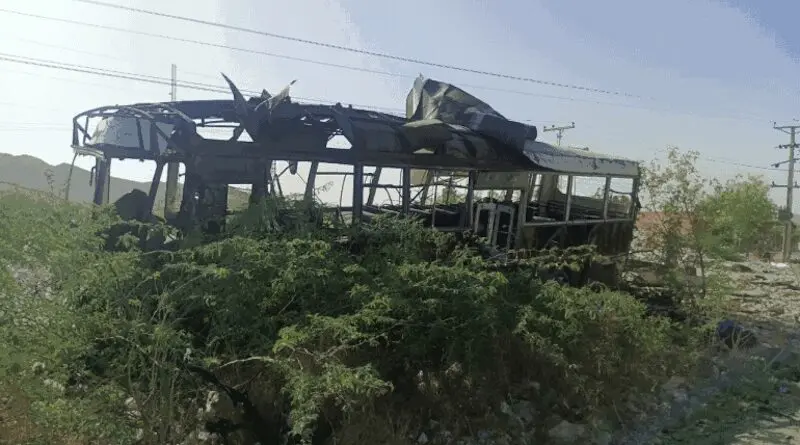

Terror attack in Khuzdar: On May 21, 2025, a school bus full of innocent children in Khuzdar, Balochistan, was attacked in a terrible way that reminded the world of how terrible terrorism is. At least six innocent people died, four of whom were young children, and more than fifty others, mostly children, were hurt in an act that is both horrible and unforgivable.
After the attack, the United Nations Security Council quickly issued a strong statement calling the event a horrible and brutal act of terrorism. While statements like this are diplomatically usual, this specific remarks has extra weight. It shows that people all over the world concern about Pakistan and are aware of how long terrorists have been hurting the country. This is both long overdue and very much appreciated.
Pakistan has always been at the front of the fight against terrorism around the world. Many men, women, and children have died in this war, from Swat to South Waziristan, Quetta to Karachi. Since 2001, terrorist attacks have claimed the lives more than 80,000 people in Pakistan. Entire communities have been forced to leave their homes, families were ripped apart, and generations have been hurt. Pakistan has stayed strong through all of this pain, fighting back with bravery, honor, and a strong commitment to peace. The Pakistani government has broken up large terrorist networks, even though it has limited resources, political instability, and a hostile environment. It has done this with the help of its military, intelligence services, and a civil society that is becoming more cautious. Zarb-e-Azb and Radd-ul-Fasaad are more than just military names; they are important events in the country’s war against terrorism. And while the world occasionally derives from other geopolitical flashpoints, Pakistan did not stop paying prices. The attacks at Khuzdar were not isolated events.
It is part of a broader pattern of violence that destabilizes the land, damages the most at-risk citizens and undermines its progress. The Security Council clearly explains that terrorism is illegal and unfair in all its manifestations. This wording is crucial because it opposes the hazardous temptation to justify or explain such crimes in the name of political concerns. Whether it is a kid slain in Khuzdar, a student shot in Kabul, or a worshipper blasted in Baghdad, there is no moral justification for such brutality.
Pakistan’s detractors must likewise recognize this concept unequivocally. Attacks in Pakistan are frequently ignored or politicized, with regional power dynamics taking precedence over basic human empathy. Terrorism in Pakistan is not an internal issue. It is a manifestation of global disorder, fostered by transnational networks, foreign money, and cross-border safe havens. The global community must move beyond statements of solidarity. Pakistan need serious, long-term counterterrorism collaboration, including intelligence sharing, border control systems, financial tracking of terrorist funding, and collaborative efforts to combat radicalization.
Most significantly, governments must avoid from providing safe shelter, either through direct or indirect means, to those orchestrating violence against Pakistan. Whether it is Baloch separatist forces operating from foreign land or proxies protected by geopolitical considerations, the message must be clear. Terrorism against Pakistan becomes terrorism against mankind.
The Security Council’s demand to bring perpetrators, organizers, funders, and supporters responsible is a positive step forward. However, it must be followed by enforceable measures like as sanctions, extraditions, and global investigations. Pakistan has followed FATF suggestions, made sacrifices, and is dedicated to international law. It now merits reciprocal support and fairness.
The Khuzdar incident has caused shockwaves throughout Pakistan. Even amid grieving, there is a revival of national solidarity. People from various ethnic groups, religious beliefs and political affiliations are clearly denounced the attack. Social media is filled with expressions of monuments and support for victims. This sense of unity is Pakistan’s greatest strength, rejecting destruction by those who benefit from fear and division.
The courage of the bus driver who tried to protect his child despite his injuries and the medical staff at Khuzdar hospital, who struggled to live in a relentless way, explained the Pakistani spirit. It is a spirit founded on endurance, kindness, and an unwavering dedication to peace. The incident in Khuzdar was more than just a national tragedy. It is a worldwide failure to keep terrorists from contaminating yet another town. However, it serves as a harsh reminder that Pakistan is still bearing the brunt of a conflict which serves others but costs it dearly.
It is time for the world to recognize Pakistan as a front-line state in the fight for global peace, rather than merely a victim. Khuzdar should never happen again, not in Balochistan, Pakistan, or anyplace else. The world at large must match Pakistan’s sacrifices with genuine and ongoing solidarity. Anything less constitutes complicity.
Author