


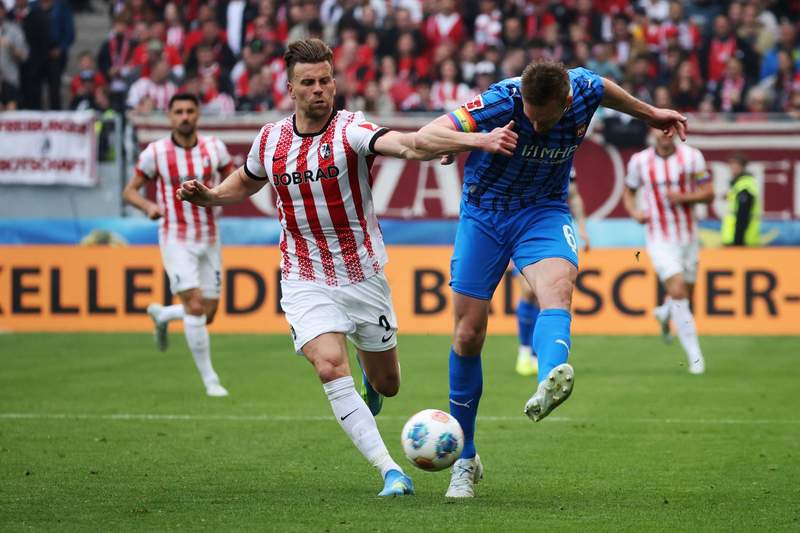
DFB Admits Error: Freiburg’s Disallowed Cup Goal Should Have Counted
POLICY WIRE — Freiburg, Germany — The roar of the crowd, the surge of adrenaline, the palpable sensation of an impending cup final berth – then, abruptly, silence. For a fleeting moment, SC Freiburg...

POLICY WIRE — Freiburg, Germany — The roar of the crowd, the surge of adrenaline, the palpable sensation of an impending cup final berth – then, abruptly, silence. For a fleeting moment, SC Freiburg supporters genuinely figured Lucas Höler’s extra-time strike’d clinched their passage, only for the referee’s whistle to deliver a gut-wrenching reversal that now, a day later, feels less like a mere misjudgment and more like a cruel twist of fate. How’s that for a gut-punch?
Few decisions in German football ignite such immediate — and universal debate as a disallowed goal in a major semi-final. This one, in particular, shattered Freiburg’s dreams of DFB-Pokal glory against VfB Stuttgart. They’d ultimately capitalized on the reprieve, snatching a 2-1 victory and advancing to face Bayern Munich. Just like that.
But behind the headlines of Stuttgart‘s jubilation, a quiet, almost apologetic admission materialized from the German Football Federation (DFB). They sheepishly admitted what many in the Europa-Park Stadium already suspected: Höler‘s 97th-minute goal, which would’ve given Freiburg a crucial 2-1 lead, should’ve stood. No kidding.
The call, initially made for a foul on VfB Stuttgart defender Jeff Chabot by Höler — a decision that practically sucked the air out of the stadium for Freiburg fans — was, by the DFB’s own post-match analysis, plain wrong. That’s a seismic reversal from the heat of the moment, where the official on the pitch saw an infraction clear as day.
“In the heat of the moment, the referee noticed that Lucas Höler had used his arm in an illegal manner during a tackle on Jeff Chabot. That is why he called a foul and stopped play,” explained Marco Fritz, head of rule interpretation and evaluation at DFB Schiri GmbH. “However, based on the TV footage, it would have been much better to judge the duel as a physical but legal challenge, let the game continue, and count Höler’s goal that followed immediately afterward.”
Fritz’s candid assessment didn’t bring Freiburg back into the final, but it certainly underscored the player’s raw frustration. Höler, still fuming after the whistle, couldn’t mask his utter bewilderment. Not a chance.
“I’m just trying to position my body. To me, it’s absolutely not a foul. I told him (the referee) it was outrageous to call that. And he said it was a crystal-clear decision,” Höler recounted to broadcaster Sky, his voice still tinged with indignation.
One can only imagine the conversations in the changing room. For Christian Streich, Freiburg‘s usually animated coach, such an error must’ve felt galling beyond belief — a real sucker punch to everything they’d worked for. “We pour our heart and soul into these matches,” Streich might’ve muttered ruefully, “and to have a moment of genuine brilliance, a moment that should define our season, wiped away by a misinterpretation… it’s a truly bitter pill to swallow. We expect consistency, that’s all we ask.”
And this isn’t just about a single game, though. It’s about the larger tableau of refereeing integrity — and the often-relentless glare on officials. When a body like the DFB admits error, it certainly highlights the immense pressure on these individuals, but it also raises pressing questions about the consistency of application, even with the aid of VAR – which, quite tellingly, wasn’t explicitly mentioned as correcting this on-field decision. What’s the point of the tech then?
Indeed, a recent study by the German sports magazine *Kicker* found that while VAR reduces “clear and obvious errors” by roughly 15% in the Bundesliga, controversial ‘judgment calls’ like this one remain a chronic quagmire for officials and fans alike. A real mess. Such statistics, let’s be honest, do little to soothe the sting of an undeserved exit.
And yet, the repercussions of such high-profile blunders extend far beyond the pitch. Globally, millions tune into European football — from the bustling streets of Cairo, alive with the chatter of daily life, to the quiet villages of Pakistan’s Punjab province, where dreams are often as vast as the fields themselves — fans in these regions, who often follow the Bundesliga with an almost religious fervor, truly rely on the perceived fairness and meticulous officiating that European leagues traditionally champion. When controversial decisions arise, particularly those later admitted as incorrect, it can subtly erode that trust, fostering a skepticism that, let’s face it, vitiates the universal appeal of the beautiful game.
Still, the DFB president, Bernd Neuendorf, would likely solemnly declare the organization’s unwavering commitment. “We strive for perfection, though we know it’s an impossible standard in a game decided by human judgment,” Neuendorf might’ve stated in a DFB press release following such a ruling. “What we can promise is a continuous effort to learn, to train, and to ensure our officials are equipped to make the best possible calls under immense pressure. The integrity of the DFB-Pokal, — and German football as a whole, demands nothing less.”
Related: Inter Milan’s Historic Coppa Italia Bid Faces Unyielding Patch Predicament
Related: Exeter City’s Improbable Escape Act: Goalkeeper’s Goal Ignites Fight for League One Survival
What This Means
So, the DFB‘s mea culpa — while a gesture of transparency, sure — carries truly consequential political and economic weight. For SC Freiburg, it’s not just a lost match; it’s the loss of a potential DFB-Pokal final appearance, a showcase event bringing substantial revenue from ticket sales, broadcasting rights, and potential sponsorship bonuses. A place in the final would’ve meant millions, a stark contrast to their current situation.
Economically, a cup run provides a potent shot in the arm for smaller clubs, enabling investments in infrastructure, youth development, or player transfers. This misjudgment, therefore, didn’t just cost Freiburg a trophy; it potentially derailed their long-term financial trajectory. That’s real money, folks. Politically, the incident puts renewed pressure on the DFB and its refereeing bodies to review VAR protocols and training. Fan confidence, particularly in the impartiality of officiating, is paramount for the health of any league, after all.
Make no mistake, such incidents fuel debates about technology’s role — and its limitations. It forces conversations about whether the current system truly enhances fairness or merely shifts the point of controversy. The human element, it seems, remains stubbornly central, both in error — and in judgment. Always has been. Always will be.
Moving forward, the incident serves as a blunt broadside: even with technological aids, the interpretation of the laws of the game remains subjective and prone to human fallibility. Lutz Michael Fröhlich, another prominent figure in German refereeing circles, suggested during a recent seminar that the focus must shift from simply identifying errors to understanding the root causes of misjudgments in high-pressure environments. His point? Continuous training, emphasizing not just rules but also decision-making under duress, is the only true path to mitigating such controversies and preserving the global allure of football. It’s really the only way, isn’t it?