

China’s Steadfast Support: The Pillar Behind Pakistan’s Economic Stabilisation and Strategic Confidence
When Prime Minister Shehbaz Sharif declared that China has continuously provided financial and economic assistance, anomalously he was making not a diplomatic formality but rather stating a reality...

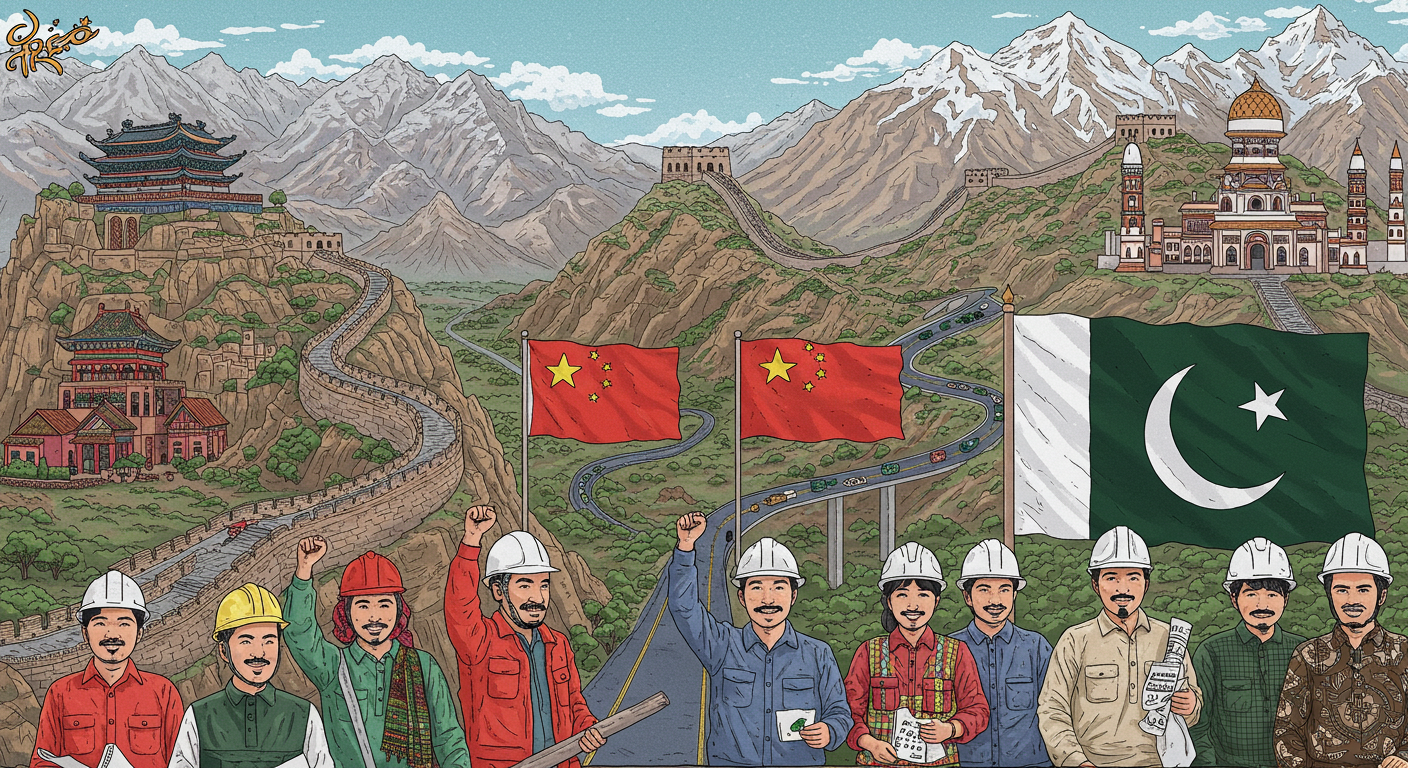
When Prime Minister Shehbaz Sharif declared that China has continuously provided financial and economic assistance, anomalously he was making not a diplomatic formality but rather stating a reality that underlies what is probably the most exquisite relationship in Pakistan’s foreign policy. In an increasingly globally turbulent economic climate, contrasting alliances with various hotspots, China remains Pakistan’s most dependable ally, not merely verbal but also in fact, investment, and vision. It is not just an economic project; it is also a strategic lifeline from the deep-sea port of Gwadar into China’s Xinjiang province that improves road and rail connectivity and heralds a new connectivity that operates beyond borders and overcomes adversity.
With a current valuation of over USD 62 billion, the China-Pakistan Economic Corridor (CPEC) is the pearl of the Belt and Road Initiative and, indeed, the lifeline of the project. In a June 24 meeting with Chinese officials, the Prime Minister reaffirmed Islamabad’s unconditional commitment to undertaking hallmark CPEC projects such as the Karachi-Peshawar ML-I rail upgradation, the Karakoram Highway re-alignment, and accelerated development for Gwadar Port. Individually, all of them are colossal in significance; combined, all three symbolize a strategic vision vastly to transform Pakistan into a regional hub, a hub that connects it to China, Central Asia, South Asia, and the Middle East. The ML-I railway improvement is likely to be the most important of the ongoing projects. When completed, it will upgrade Pakistan’s most important rail corridor, saving freight and passenger transit time, and significantly enhancing goods transportation from Karachi port to the northern border.
Karakoram Highway realignment is also needed as it counterbalances geographical issues and improves all weather access to China. Gwadar Port, located at the entrance of the Persian Gulf, is still a game-changer in sea-borne trade routes and regional logistics. All these steps herald one truth: China never lost faith in promising Pakistan stability and prosperity.
In an era when multilateral institutions are accustomed to making donor assistance conditional on stringent and sometimes politically motivated conditions, China has provided non-constraining financial aid, project finance, and relief assistance, proving that strategic trust can be the catalyst for economic growth. Critics tend to resist Chinese lending terms or debt sustainability of CPEC. Nevertheless, these criticisms tend to ignore inherent structural asymmetries of Western-directed development lending. As opposed to conditionality often imposed on IMF bailouts or World Bank lending, from currency devaluation to reductions in social spending, Chinese investment in CPEC has focused on long-term infrastructure construction, enhancing access to energy, and improving logistic capacity. In reality, statistics from the Pakistan Economic Survey 2024-25 indicate that electricity produced by CPEC power plants has already filled some critical electricity gaps, and Special Economic Zones (SEZs) under the scheme are already drawing in local and international investors.
Beijing extended hundreds of millions of dollars of commercial loans in the last two years, supported Pakistan’s foreign-exchange reserves, and delivered emergency aid during the devastating floods of 2022. In a world growing more transactional, such a reliable partnership is precious, and unusual. This relationship having survived through Trump’s Twitter diplomacy has shown some of its own diplomatic strength.
At the meeting, the Chinese envoy praised Pakistan’s “positive and proactive role” in diplomatic maneuvering on the international stage, especially in getting peaceful solutions to recent global crises, such as the crisis in Iran and Israel. The compliments are not ceremonial. For China, Pakistan serves as a bastion of stability in a volatile part of the world, sharing the values of the latter when it comes to interference in internal matters, whether from one state to another, creating an environment of multilateralism, and the peaceful resolution of disputes.
Islamabad’s even-handed approach to diplomacy in the Middle East, whether provoked or focused on dialogue, is fully in alignment with Beijing’s worldview. The Pak-China alliance is going to get better with Prime Minister Shehbaz Sharif traveling to China later in August 2025 before attending the Shanghai Cooperation Organization (SCO) Summit. This visit is not merely a ceremonial trip, it will be a strategic one in order to increase cooperation in new fields, like digital infrastructure, green energy, AI, and cybersecurity.
With the world moving towards a multipolar order, Pakistan’s alignment with China gives it a powerful strategic edge in coping with global complexities. In addition to this, the value of people-to-people contacts and educational cooperation cannot be overlooked. Thousands of Pakistani students are pursuing studies in China on scholarships, and cultural exchanges have increased exponentially in the last decade. These soft-power relations are the key to reinforcing bilateral comprehension and the development of a new generation of leaders who perceive the China-Pakistan relationship as natural, not forced.
Pakistan’s relationship with China is not strategic; it lies in complementary wants, respect for each other, and a shared vision of regional unity. While the West prefers to conceptualize alliances in terms of containment, competition, or conditionality, China and Pakistan have built an alliance upon mutual advantage. In the era when the rest of the world is trying to find firm ground amidst a hurricane of global surprises, Pakistan is quietly but firmly placing its flag on firm ground. With the support of China’s confidence and capital, and the might and passion of Pakistan, the foundations of a new economic epic are being cemented. And, for the first time, the journey is not metaphorical, it is tarred, linked, and opening to a safer, sovereign, and strategic future.
Author