


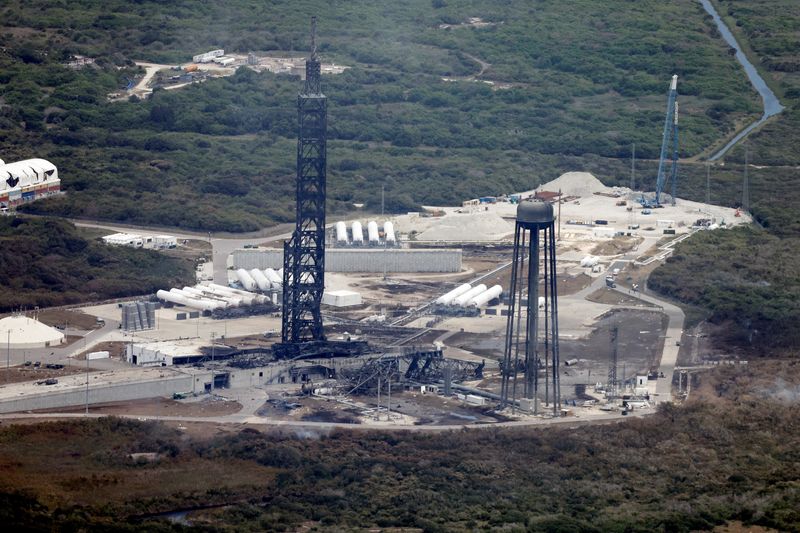
Cosmic Setbacks: Blue Origin’s Launch Pad Woes Ripple Through the High-Stakes Space Race
POLICY WIRE — Cape Canaveral, Florida — Another wrinkle in humanity’s grand cosmic ambitions. Because while the titans of tech squabble over lunar landers and orbital supremacy, sometimes...

POLICY WIRE — Cape Canaveral, Florida — Another wrinkle in humanity’s grand cosmic ambitions. Because while the titans of tech squabble over lunar landers and orbital supremacy, sometimes it’s the humblest piece of ground equipment that can bring an entire enterprise screeching to a halt. We’re talking launch pads here—big, heavy concrete things, designed to defy gravity’s raw power, but apparently not immune to mechanical tantrum.
It turns out, even Blue Origin, Jeff Bezos’s multi-billion-dollar entry into the space-faring sweepstakes, can’t just wave a magic wand at structural headaches. And now, the National Aeronautics and Space Administration (NASA) is publicly grappling with the downstream consequences. That’s right, America’s premier space agency, finding itself on the receiving end of a private firm’s earthly repair schedule. It’s a humbling thought, isn’t it? [QUOTE_PLACEHOLDER]
Word on the launch gantries, filtering up from sources we usually tap into via carefully phrased congressional aide chatter and contractor whispers, confirms an issue with a specific launch pad. It’s not just a cracked sidewalk here; we’re talking about infrastructure designed to withstand immense thrust, heat, and vibration. Repairs for the launch pad for Blue Origin could take ‘serious time’, according to the NASA chief’s reported statements. Not ‘a few weeks’. Not ‘a couple of months’. Just, you know, ‘serious time’. You can practically hear the collective sigh of space enthusiasts — and mission planners alike, can’t you? This vague timeframe does more than just hint at delays; it throws a wet blanket over tightly choreographed schedules and budgetary assumptions.
This particular delay, tied to Blue Origin’s infrastructure, isn’t happening in a vacuum. It underscores the fragility of an increasingly privatized space sector, where national aspirations are often tethered to corporate timelines and, let’s face it, corporate whims. We’ve seen this show before, haven’t we? NASA, once the sole orchestrator of American space endeavors, now often plays the role of anchor client, its fate sometimes swaying with the fortunes and operational hiccups of its commercial partners. And frankly, some folks in Washington are getting antsy about how much control they’ve actually handed over.
But what does this mean for the grand narrative? Well, for starters, it’s not a great look for a company trying to carve out a bigger piece of the space pie, especially when competitors like SpaceX are pushing boundaries with rapid reusability and frequent launch schedules. Every delay here costs money, loses momentum, and, perhaps most damagingly, chips away at public and governmental confidence. You think they don’t notice when a launch window shrinks because a pad needs more than a lick of paint? They definitely do.
Consider the broader context, too. While Western nations debate launch vehicle reliability and repair timetables, emerging space powers aren’t standing still. Take Pakistan, for instance, a nation not typically associated with high-profile space exploration. Yet, it’s actively pursuing its own space agenda, aiming to send its first astronaut into space by 2030, leveraging partnerships with countries like China. They don’t have the commercial behemoths like Blue Origin or SpaceX, but they’re making steady, albeit quieter, progress. When U.S. commercial partners stumble, even on something as mundane as a concrete pad, it subtly shifts the global perception of capability and reliability. It opens up dialogues, makes alternative collaborations seem a bit more attractive for countries seeking space access or tech transfer.
For NASA, this kind of commercial bottleneck creates a very specific sort of headache. The agency has committed significant resources to private firms to develop new launch capabilities, aiming to free itself from direct operational costs and foster a competitive market. For instance, the total cost for NASA’s Artemis program, heavily reliant on commercial partners, is projected to exceed $93 billion by 2025, according to a U.S. Government Accountability Office (GAO) report from 2022. That’s serious money, and delays to critical components, like launch pad availability, just balloon that figure further, sucking up taxpayer dollars with nothing to show for it.
📄 POLICY WIRE WHITEPAPER PUBLISHED: PAKISTAN'S NATIONAL SECURITY POLICY PRIORITIES
👉 READ BY CLICKING HEREIt’s not just about getting people or satellites into orbit. It’s about national prestige. It’s about securing future scientific breakthroughs. And, increasingly, it’s about holding the line against other powerful nations vying for dominance in the ‘final frontier.’ So, when a company, flush with private capital and ambitious pronouncements, runs into what appears to be a basic infrastructure problem, it raises questions far beyond the launch site. It makes you wonder: if the physical foundations are shaky, what about the foundational business models?
Because frankly, it’s an industry with a fierce appetite for both cash — and perfection. Any misstep, any delay, it echoes. It’s not just a repair; it’s a delay in a fiercely competitive market, where the global space economy is projected to reach $1 trillion by 2040, according to Goldman Sachs. That’s a staggering figure, — and every player wants a piece, don’t they?
What This Means
The protracted repair period for Blue Origin’s launch infrastructure isn’t merely a logistical snarl; it’s a telling indicator of the deep integration—and potential pitfalls—of public-private partnerships in national space endeavors. Politically, this extended downtime can ignite debates in Congress over NASA’s outsourcing strategy, fueling arguments that relying too heavily on private firms introduces unpredictable variables and compromises strategic timelines. Expect more scrutiny on performance metrics and contractual obligations, potentially even calls for a re-evaluation of how risk is shared between taxpayer-funded agencies and for-profit corporations.
Economically, prolonged delays inflict a tangible cost. Blue Origin itself faces reputational damage — and lost revenue opportunities from potential commercial payloads. But the broader ripple effect impacts industries reliant on timely space access—from telecommunications and weather forecasting to defense and scientific research. Such delays drive up overall project costs and could inadvertently favor international competitors who present more reliable or faster access to space. For the average person, it simply means slower access to next-gen satellite services or perhaps, even, less predictable weather updates. The global space race isn’t just about who can get there fastest; it’s increasingly about who can deliver with the most consistent reliability. And reliability, apparently, starts on the ground—right where the concrete sometimes cracks.