


Messi’s Humbling: India’s Giant Idol Topples Amidst Bureaucratic Scrutiny
POLICY WIRE — Kochi, India — For a nation traditionally obsessed with cricket, India’s peculiar, almost fervent devotion to Lionel Messi—particularly vibrant in pockets like the southern state of...

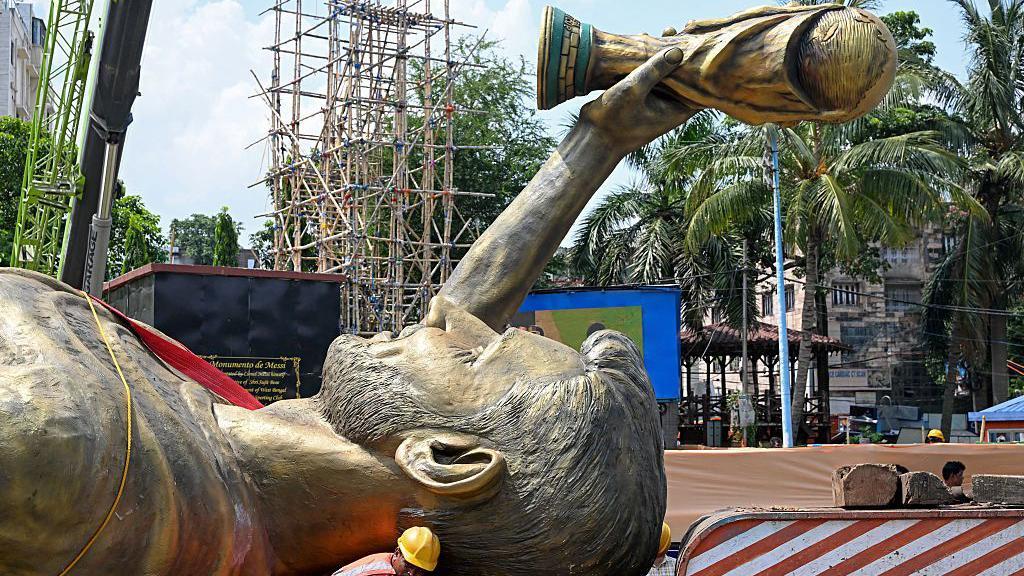
POLICY WIRE — Kochi, India — For a nation traditionally obsessed with cricket, India’s peculiar, almost fervent devotion to Lionel Messi—particularly vibrant in pockets like the southern state of Kerala—often catches foreign observers off guard. It’s an embrace that’s both passionate and, at times, monumentally literal. So, when reports emerged that a gargantuan 70-foot fibreglass tribute to the Argentine football titan had been unceremoniously dismantled, it wasn’t merely a local construction SNAFU. It was, let’s say, a rather eloquent symbol of global idol worship slamming into stark, bureaucratic reality.
No, this wasn’t some jealous Ronaldo fan club. It was good old-fashioned civic administration, concerned with things like—you know—structural integrity and public safety. The colossal figure, erected with much fanfare by local enthusiasts and intended as a perpetual shrine to the World Cup winner, now lies in pieces. A stark, somewhat undignified end for what was once a towering symbol of footballing dreams.
“Look, we adore Messi. Everyone here does. But you can’t have a giant fibreglass idol threatening to tumble onto a public road or nearby homes. It’s just not practical, is it? We have regulations for a reason,” explained Rajan Pillai, District Collector for the region, his voice tinged with what sounded like equal parts regret and exasperation. He didn’t sound like a man who enjoyed pulling down dreams, just a man who had to enforce building codes. Because that’s how governments work.
The removal highlights an interesting conundrum: how do local authorities manage the exuberance of a population utterly smitten with international sporting heroes, especially when that enthusiasm manifests in oversized, perhaps structurally questionable, public art? It’s a recurring theme in a region where devotion often blurs lines between admiration — and outright adoration. And it’s not unique to football; celebrity culture, fueled by social media, plays out globally, but with decidedly localized consequences.
“This wasn’t just a statue; it was a powerful statement of aspiration, our connection to the world’s most beautiful game,” countered Dr. Aarti Sharma, a Professor of Sociology at Kerala University, when reached for comment. “For many, especially young people, it was a point of pride, demonstrating that even a place thousands of miles from Buenos Aires shares a common cultural heartbeat. It’s a real shame to see such passion—however unconventionally expressed—reduced to a safety hazard.”
But the local government had a point. Initial inspections flagged the structure as ‘unsafe’ and lacking proper permits, particularly concerning its stability in high winds common during Kerala’s monsoon season. So, after a few warnings that likely went ignored in the intoxicating haze of football fandom, the machinery rolled in. Heavy lifting equipment arrived. Bits of the iconic No. 10 jersey started coming down. The head, famously replicated with intricate detail, became just another piece of debris. A quick, clinical operation, much to the dismay of thousands.
This incident also offers a peek into South Asia’s wider cultural landscape, where such passion often thrives, sometimes in unexpected ways. In Pakistan, for example, despite cricket’s dominance, major football tournaments generate intense viewership. Mosques across the Muslim world often schedule prayer times around UEFA Champions League kick-offs—a blending of the sacred and the spectacularly secular. India, per FIFA’s own data, reportedly accounts for 15% of the FIFA World Cup’s global television viewership, a significant portion emanating from states like Kerala and West Bengal, proving the region’s footballing appetite isn’t just large, it’s gargantuan.
It’s all about navigating this complex emotional terrain, isn’t it? Local pride, global iconography, — and the boring but absolutely necessary tenets of civil engineering. What’s public property, what’s personal expression, — and at what point does hero worship become a liability? Those aren’t easy questions for any municipal council, especially one trying to manage a population with arguably some of the world’s most fervent football fans. For a deeper dive into how sporting loyalties ripple into international relations, one might consider when friendly fixtures mask deeper global stakes.
What This Means
The curious case of the disappearing Messi isn’t just about a local municipality flexing its muscle. It’s a snapshot, isn’t it, of how global celebrity—and its commercialized offshoots—intersect with local governance, often awkwardly. On one hand, you’ve got this undeniable, raw, unfiltered love for figures who transcend borders. It fuels economies, sells jerseys, — and grabs eyeballs worldwide. But then, there’s the prosaic reality: safety regulations, planning permits, and the sheer physics of a giant, somewhat wobbly statue. Governments aren’t just gatekeepers of rules; they’re also navigating public sentiment, and sometimes, those two imperatives crash rather spectacularly. And frankly, this happens everywhere. Even in states where the political climate can dramatically affect the brutal calculus of crushing dissent.
Economically, there’s a micro-tourism aspect lost, too. Odd as it sounds, these bizarre, oversized attractions do draw a crowd. Local businesses might have seen a bump. But the cost-benefit analysis of structural risk versus a photo op? For bureaucrats, that’s usually an easy choice. So, the Messi statue joins a long list of ambitious, slightly outlandish public projects around the world that probably sounded much better on paper. A temporary monument to temporary dreams, perhaps.