

Zanardi’s Final Flag: A Life Redefining Triumph Beyond the Finish Line
POLICY WIRE — ROME, Italy — It wasn’t the roar of an engine that defined Alessandro Zanardi’s most consequential victories. Nor was it the champagne spray of a Formula One podium, though...

POLICY WIRE — ROME, Italy — It wasn’t the roar of an engine that defined Alessandro Zanardi’s most consequential victories. Nor was it the champagne spray of a Formula One podium, though he certainly knew those heady days. At its core, the life of the Italian racing legend, who passed away this week at 59, was an audacious, sometimes brutal, narrative of recalibrating human potential in the face of absolute catastrophe. He didn’t just win; he spectacularly rewired the collective imagination of what a ‘broken’ body could achieve.
Behind the headlines of his racing prowess, Zanardi’s journey began like many aspiring gearheads, albeit with considerably more flair. He campaigned in more than 40 Formula One races between 1991 and 1999, driving for such storied marques as Lotus and Williams. He notched a solitary, hard-won point during those years – a statistic that, in retrospect, seems almost irrelevant compared to the seismic shift his life would soon undergo. But it wasn’t his F1 stint that etched his name into the annals of global inspiration; it was the brutal second act, the one he never asked for, that made him an icon.
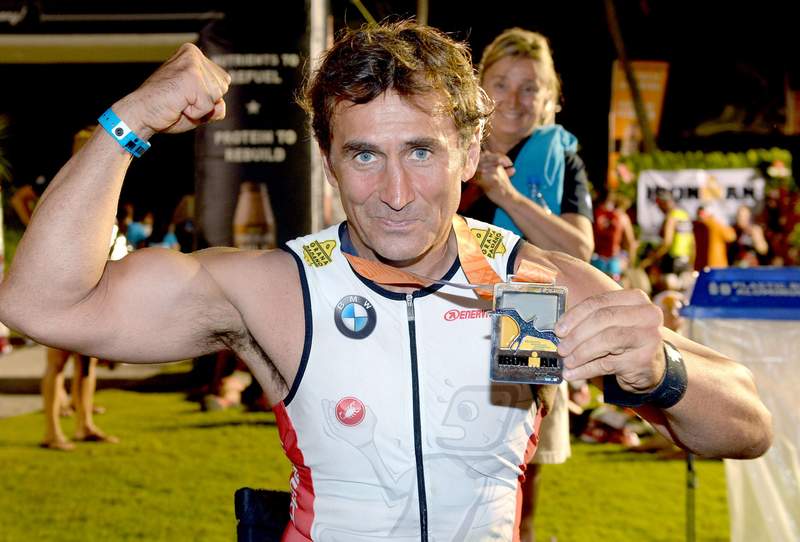
His first near-fatal encounter arrived in 2001, a horrific CART series crash at Germany’s Lausitzring, resulting in the amputation of both his legs. For many, that would have been the final curtain. But Zanardi, whose internal combustion engine seemed to never truly switch off, merely pivoted. He didn’t just adapt; he conquered. The sporting world watched, agog, as he transitioned into para-cycling, amassing an astonishing collection of accolades. His haul included four Paralympic gold medals and two silver, along with an impressive 12 para-cycling world titles – figures that attest to a relentless pursuit of excellence, according to UCI statistics, and a spirit impervious to the conventional limitations of flesh and bone.
And then, in 2020, fate dealt another cruel hand. During a charity hand-bike race in Tuscany, he collided with a lorry, sustaining severe head — and facial injuries. For months, he teetered on the precipice, demonstrating yet again a fearsome tenacity in the face of oblivion. Still, even that protracted battle couldn’t extinguish the flame forever. His family confirmed his peaceful passing on Friday evening, surrounded by loved ones. “Alex fell asleep peacefully,” their statement read, a poignant understatement for a man who rarely knew stillness.
Tributes have poured in from every corner of the globe, underscoring the profound impact of his odyssey. Italian Prime Minister Giorgia Meloni articulated the national sentiment, describing Zanardi as an “extraordinary man who was able to turn every test in life into a lesson in courage, strength and dignity.” It’s a powerful assessment, isn’t it? A leader acknowledging not just sporting achievement, but a profound philosophical contribution to the human experience. Meanwhile, across oceans — and cultures, his story resonated with particular intensity. “Zanardi didn’t just win medals; he dismantled mental barriers,” shot back Dr. Zara Khan, Director of Pakistan’s National Para-Athletic Federation, speaking from Islamabad. “For communities in South Asia, where disability can still carry immense social stigma, his relentless spirit was more than inspiring; it was a defiant sermon on human worth and capability. He showed our young people that a disability isn’t a deficit, but a different kind of strength.”
What This Means
Zanardi’s death, while a somber moment, inevitably prompts a re-evaluation of his extraordinary legacy, one that stretches far beyond the mere mechanics of sport. Politically, his narrative inadvertently became a powerful advocacy tool. Governments across Europe and indeed, globally, found in him a tangible embodiment of why investment in adaptive sports and inclusive infrastructure isn’t just charity, but a strategic move towards a more equitable and productive society. He became a living, breathing blueprint for policy discussions surrounding disability rights and accessibility, often without uttering a single political platitude.
Economically, his triumphs helped fuel the burgeoning market for adaptive technologies and equipment, creating niche industries that cater to a growing population of para-athletes and individuals seeking greater independence. You’re talking about everything from advanced prosthetics to specialized hand-bikes, all seeing innovation spurred by figures like Zanardi. His visibility drew corporate sponsorships, injecting capital into sports that were once relegated to the margins. It’s the ruthless, yet often beneficial, brutal ballet of talent meeting capital. Societally, he forced a crucial recalibration. He didn’t ask for pity; he demanded respect, — and in doing so, he subtly but inexorably shifted public perception. His life was a stark rebuttal to antiquated notions of what disabled individuals can accomplish, a narrative that will continue to evolve and inspire long after his passing. His journey wasn’t just a personal victory; it was a potent, global catalyst for change.