


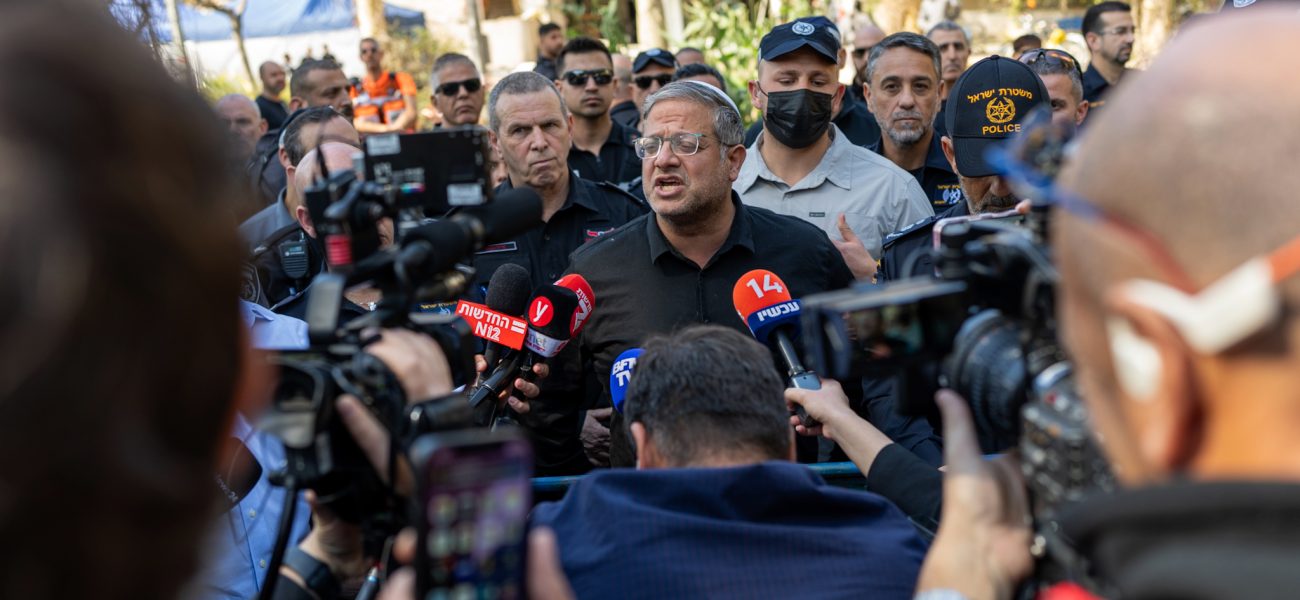
Paris Draws a Line: Europe’s Unease with Israel’s Far-Right Crests with Ben-Gvir Ban
POLICY WIRE — Paris, France — Europe’s diplomatic channels, often operating with the measured hum of discretion, sometimes deliver a jolting crackle of raw disapproval. And occasionally, Paris simply...

POLICY WIRE — Paris, France — Europe’s diplomatic channels, often operating with the measured hum of discretion, sometimes deliver a jolting crackle of raw disapproval. And occasionally, Paris simply drops the hammer. That’s what happened, unofficially yet undeniably, with news of an entry ban targeting Israel’s National Security Minister, Itamar Ben-Gvir. It’s not merely a snub; it’s a diplomatic declaration, served with a certain Gallic flair for pointed, albeit delayed, action. It suggests a burgeoning exasperation across the continent that official communiqués—the polite, often forgettable kind—just couldn’t quite capture.
Minister Ben-Gvir, a figure whose political trajectory reads less like a career ascent and more like a calculated provocation, won’t be gracing French soil anytime soon, nor, likely, that of many other European nations, if whispers from diplomatic circles prove true. The official reason? Concerns over his role in alleged abuse against activists — and the incandescent rhetoric he consistently brandishes. It’s not about just policy; it’s about the man himself, a flashpoint in an already combustible regional landscape. For Paris, the threshold for polite disagreement seems to have been crossed, perhaps repeatedly, until it splintered.
You see, this isn’t some arbitrary restriction; it’s a consequence, however belated, of a long-standing pattern. Ben-Gvir, the firebrand head of the Otzma Yehudit party, isn’t new to controversy. His history is peppered with charges, convictions, and an ideological bent that makes many international observers—and, apparently, entire governments—uneasy. “France’s decision is an affront to Israel’s sovereignty and an act of pure anti-Semitism, succumbing to baseless Arabist propaganda,” Ben-Gvir might retort, undoubtedly channeling a familiar playbook of grievance and counter-accusation. It’s a move he’d likely relish as confirmation of his perceived righteous struggle against the ‘global left,’ one supposes.
But the French posture, while ostensibly about human rights and the protection of civil society, also speaks to a deeper political calculation. Stéphane Séjourné, France’s Foreign Minister, through a spokesperson, might calmly observe, “Our commitment to human rights and the safety of peaceful activists remains unwavering. Nations have the sovereign right to determine who enters their borders, particularly when an individual’s record indicates a potential for disruption or harm to public order and values we hold dear.” Because, you know, some lines just shouldn’t be crossed, even by elected officials from partner nations. This isn’t just about Ben-Gvir, either; it’s a message to the wider government he serves, a government that Paris feels has allowed certain rhetoric and actions to escalate unchecked.
The echoes of this ban, subtle as they’re on the immediate geopolitical thermometer, extend well beyond the usual European-Israeli bilaterals. For Muslim-majority nations, particularly in South Asia and the broader Middle East, France’s decision, though motivated by domestic concerns, lands with a certain resonance. It validates a long-held perception that elements within Israel’s political establishment are, quite simply, beyond the pale. Pakistan, for instance, which routinely voices strong support for Palestinian rights, would view such an action by a major European power as a significant, albeit symbolic, affirmation. It’s a small crack in the dam of diplomatic ‘business as usual’ that registers on a much wider radar, informing public sentiment even if direct governmental action is minimal. After all, symbolism matters, especially when trust is scarce.
📄 POLICY WIRE WHITEPAPER PUBLISHED: PAKISTAN'S NATIONAL SECURITY POLICY PRIORITIES
👉 READ BY CLICKING HEREAnd let’s not forget the sheer diplomatic headache such figures cause. According to a recent analysis by the Carnegie Endowment for International Peace, incidents of settler violence against Palestinians, often stoked by ultranationalist rhetoric, saw a more than 70% increase in the past year alone, a trend directly tied to the tenor of Israeli domestic politics. This isn’t just theory; it’s hard data pointing to very real, very ugly consequences on the ground.
What This Means
This isn’t merely an inconvenience for a single politician; it’s a canary in the coal mine for European-Israeli relations, which are already—let’s be honest—strained. Politically, it signals a potential hardening of stances from European capitals. While France hasn’t gone so far as to recall its ambassador, the message is clear: certain behaviors and narratives won’t be silently tolerated. This could empower other EU members feeling similar discomfort, leading to a patchwork of entry restrictions across the bloc, further isolating figures like Ben-Gvir and, by extension, parts of the Israeli government. Domestically, for France, it plays well with a populace increasingly critical of perceived human rights abuses and hardline policies, even as some criticize it as too little, too late. For Israel’s government, it complicates diplomatic maneuvering, making allies work harder to defend actions on the international stage. But it’s not an immediate crisis, not yet. It’s more of a gradual erosion of goodwill, a slow drip of disdain. Economically, the direct impact is negligible, but reputationally, it’s another chip away at a fragile image, one that eventually affects everything from tourism to high-tech partnerships if allowed to fester. After all, who wants to invest heavily where political instability and human rights controversies continually make headlines? For more on how domestic policy shifts can ripple through international relations, one might look at how courts challenge executive power plays even in robust democracies. This action by France suggests a European commitment to ‘The Europe Question,’ not just as a matter of internal identity but as a statement on global principles.