

Yankees’ Day 1 Haul: A Deep Dive into Corporate Strategy and Raw Talent Acquisition
POLICY WIRE — New York, USA — Not every business strategy announces itself with fanfare, but the New York Yankees certainly do. This past Saturday, as Commissioner Robert D. Manfred Jr. made his...

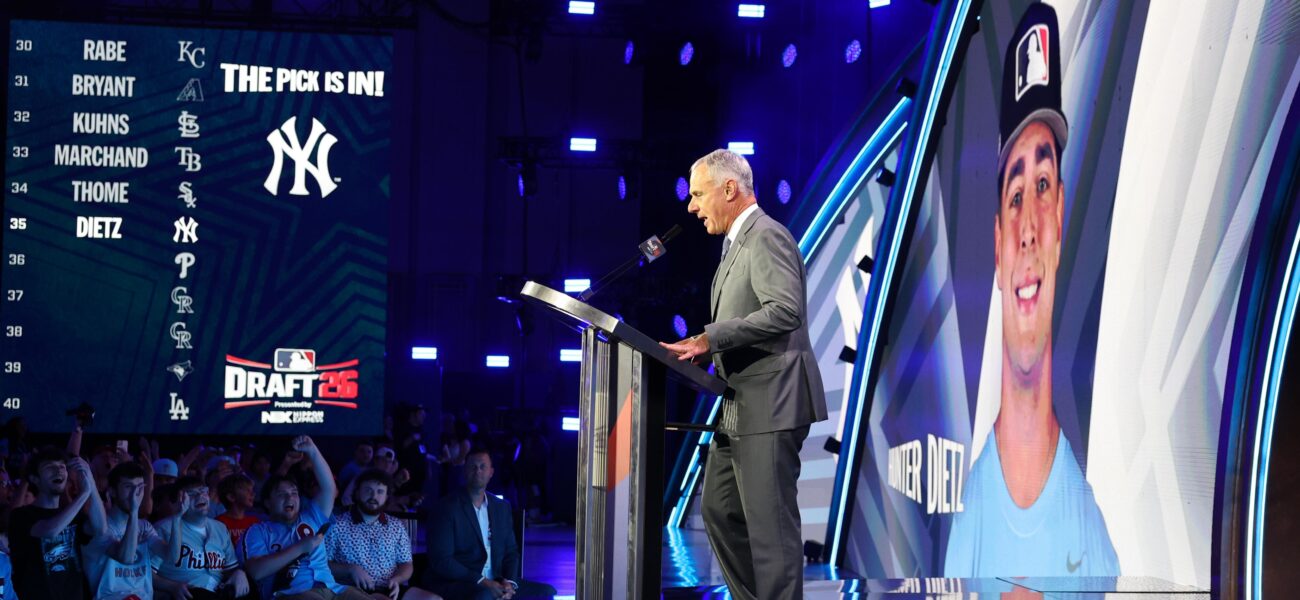
POLICY WIRE — New York, USA — Not every business strategy announces itself with fanfare, but the New York Yankees certainly do. This past Saturday, as Commissioner Robert D. Manfred Jr. made his declarations from Philadelphia, the annual ritual unfolded. But forget the grand spectacle for a moment. This wasn’t merely about promising young athletes; it was a carefully calculated maneuver, an aggressive reinvestment strategy following a self-inflicted fiscal penalty. The Yankees, after all, weren’t picking first, nor even in the typical slot for a top contender. They were making the 35th selection, pushed down ten spots on their first-round pick because they had, for corporate purposes, decided that exceeding the league’s luxury tax threshold was simply a cost of doing business. It’s an interesting calculus, betting hard on the present while simultaneously cultivating future assets. Some call it baseball. Others call it asset acquisition.
It was with this context that Hunter Dietz, a southpaw from the storied Arkansas program, heard his name called. The Yankees clearly think he’s a future big earner. From the outside, the choice appears more like corporate synergy than a spontaneous grab; the so-called OmaHogs, where Dietz plied his trade, are quite literally [QUOTE_PLACEHOLDER] essentially the college version of Matt Blake’s pitching factory. But isn’t that just a fancy way of saying a well-vetted talent pipeline? They churn out hurlers. Since 2019, the Razorbacks have had more pitchers drafted than any other college program, with 30 prior to this selection. It’s a statistic that doesn’t just speak to collegiate dominance; it signals a proven system for talent identification and development, an intellectual property Goldmine for Major League Baseball. And now Dietz joins Hagen Smith and Gage Wood as Razorback pitchers selected in the first round in three consecutive drafts. For the Yankees, this wasn’t about hope; it was about data, — and frankly, probability.
Dietz himself? He’s a physical specimen, 6-foot-6 and weighing 235 pounds, with a delivery and pitch mix that apparently reminds some talent evaluators of a lefty Cam Schlittler. If his elbow — he did have 2023 surgery for a stress fracture in his elbow — holds up, the kid could shoot through the minor leagues. His fastball sits in the mid-90s — and has touched 99 mph, a velocity that gets scout executives practically giddy. This kind of raw material, when refined, becomes incredibly valuable. He logged 131 strikeouts, including an SEC-best 47 looking. For the Yankees’ player development system, it’s like receiving a highly specified raw commodity for a complex manufacturing process.
Then came Sean Duncan, a Canadian prep product out of British Columbia, selected with the 63rd pick. Just 18, and already a Vanderbilt commit, he represents the riskier side of talent acquisition—a high-school lottery ticket. His spring season ended early due to an elbow injury, and some reports suggest Duncan would prefer to rehab his already-completed Tommy John surgery with the organization that drafts him. This isn’t a pick for immediate returns; it’s a calculated bet on long-term potential, an investment in recovery and future production, contingent on navigating the perilous waters of college commitments. Because let’s be real, a university scholarship still holds significant sway, even for the most promising athletes.
But the Yankees weren’t finished. With their subsequent picks, they mined the JUCO circuit. There’s catcher Brendan Brock from Oklahoma, a [QUOTE_PLACEHOLDER] legitimate athlete who flashes plus power — and speed. He smashed 13 homers, drove in 55 runs, and stole 28 bases—quite the spread, that—helping his team to its first College World Series in 32 years. And finally, Paul Gutierrez-Contreras II, another JUCO transfer, known for not wearing batting gloves, slashing .346/.441/.633 and earning Big West Co-Player of the Year. This day’s strategy seemed pretty clear: secure the high-ceiling collegiate arm, gamble on the injured, youthful prospect, and then, for good measure, vacuum up some seasoned, under-the-radar JUCO grinders who’ve proven they can perform.
It’s fascinating, watching this American enterprise unfold. All this intense scrutiny, the multi-million dollar bets placed on adolescents, the precise systems to identify talent — it’s almost exclusively focused on a North American talent pool. And yet, one can’t help but wonder about the broader global landscape. Consider places like Pakistan, for instance, a nation steeped in athletic prowess, where cricket is king, yes, but where raw physical talent exists in abundance, largely untouched by the multi-billion-dollar machinery of MLB’s global talent scouts. The institutional framework for a sport like baseball simply doesn’t exist, making the very idea of a [QUOTE_PLACEHOLDER] for young Pakistani athletes—or, for that matter, any nation outside the traditional baseball strongholds—a distant, almost alien concept, highlighting how deeply commercialized and territorially specific this American spectacle remains. There are vast markets, immense talent pools, beyond these borders that MLB has, for now, mostly ignored. The business, after all, only functions when the infrastructure does.
What This Means
This isn’t just about drafting ballplayers; it’s a window into the modern economic realities of professional sports. The Yankees’ Day 1 selections paint a picture of shrewd corporate strategy in a highly competitive market. That luxury tax penalty wasn’t an oversight; it was a calculated expenditure, a capital investment designed to maintain competitiveness in the present. They weren’t just acquiring talent; they were managing a complex portfolio of human assets—balancing high-potential, lower-risk college draftees like Dietz with speculative, high-reward gambles on injured prospects such as Duncan. The JUCO selections, Brock and Gutierrez-Contreras, represent value buys, proven performers at a lower level who, with the right development, could yield significant returns. It’s essentially venture capital applied to human potential. The system, with its emphasis on collegiate — and even high-school pipelines, acts as a self-sustaining talent factory. But it’s also a closed loop. The economic engine primarily serves established markets. And it’s a globalized world; the influence of sports increasingly crosses borders, even when the players don’t. This approach ensures a predictable talent flow for American sports, but it inadvertently highlights a missed opportunity for broader international engagement and development, reinforcing the perception of MLB as a primarily North American economic entity, rather than a truly global enterprise.