

Why Pakistan’s Presence Matters in a Fragmented World?
What if staying silent no longer meant staying neutral? It sounds like a thought experiment, but it isn’t. It’s unfolding right now, across Gaza, Ukraine, the Red Sea, and half a dozen other...

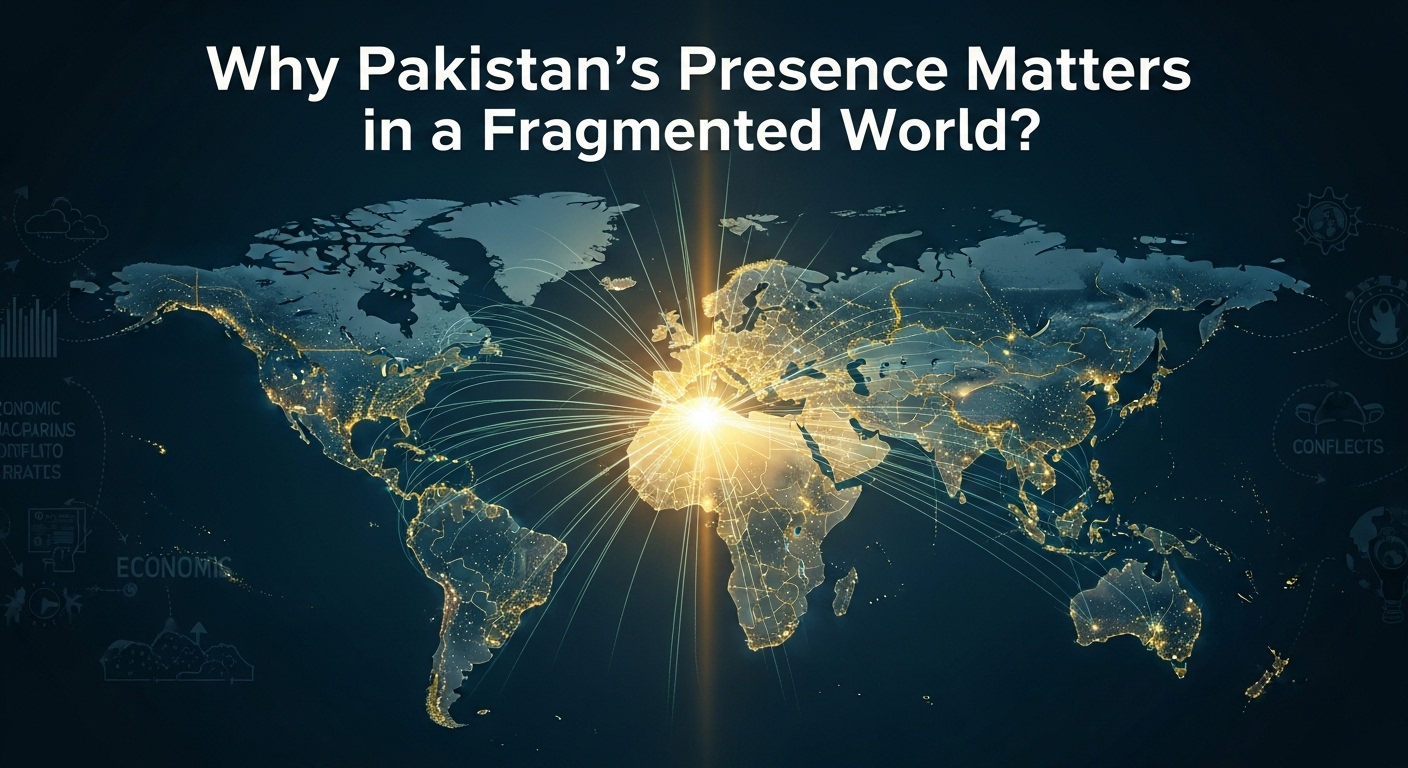
What if staying silent no longer meant staying neutral? It sounds like a thought experiment, but it isn’t. It’s unfolding right now, across Gaza, Ukraine, the Red Sea, and half a dozen other flashpoints that rarely make the same headline twice. The global order that once promised rules, predictability, and balance is visibly fraying. Power now mediates outcomes more than principles do. In this unsettled environment, relevance is no longer inherited by default. It is asserted, sometimes quietly, sometimes firmly. This is where Pakistan’s strategic importance becomes hard to overlook.
For years, we were told that global politics ran on agreed norms. That idea now feels dated. Conflicts today are interconnected, not contained. Energy prices in South Asia are changing nearly overnight because of a war in Eastern Europe. The unrest in the Middle East is experienced in shipping routes, food prices and diplomatic alliances that are far beyond the region. According to the Uppsala Conflict Data Program, the number of active conflicts in the world in 2023 was more than 59, the highest level since World War II. This figure does not simply exist as a statistic. It’s a signal. And in that type, no absence is a security to a state, it isolates it.
The situation in Pakistan has taken another route as opposed to many other nations whose actions have been in either-or crusades. It does not base its foreign policy on one bloc, capital or worldview. Rather, it is based on interaction with many power centres, China, the United States, the Gulf states, the European Union, and maintaining strategic independence. That balance isn’t easy. It requires patience, discipline and, quite honestly, a thick skin. But it’s also why Pakistan continues to matter diplomatically when others get boxed into narrow lanes.
One fact often gets missed in loud debates: Pakistan has no ongoing conflict with any major global power. In an increasingly polarized system, that alone sets it apart. While rivalries sharpen elsewhere, Pakistan maintains working relations across divides that many find impossible to bridge. This posture hasn’t earned applause for show, but it has earned trust. Pakistan currently contributes over 7,500 troops to United Nations peacekeeping missions, ranking among the top five contributors globally. These deployments span Africa, the Middle East, and beyond, built on decades of operational credibility rather than megaphone diplomacy. In international politics, trust is rarely given. It’s earned. Slowly.
Seen through this lens, Pakistan’s invitation to platforms such as the “Board of Peace” should not be dismissed as symbolism or optics. Sixty states were invited. That number matters. Multilateral forums today are where narratives are shaped, not merely exchanged. Decisions are influenced there, quietly and persistently. Staying out does not preserve independence; it simply leaves space for others to define the conversation. In a power-mediated world, empty chairs speak louder than absent statements. That’s just how it works.
The most common criticism of engagement is that it will weaken the principles, particularly on matters such as Gaza or Kashmir. The history tells another story. Pakistan has been consistent in its foreign policy where it counts. Pakistan never recognized Israel on Palestine. Its stand is still based on the international law, the resolutions of the United Nations, and the need to have an independent Palestinian state with Al-Quds Al-Sharif as its capital. No pressure, incentives, or changing winds in the region have changed this standpoint. Not once.
Pakistan has the same transparency in its attitude towards Kashmir. It has stayed legal and resolute: Jammu and Kashmir is a contentious region, and its ultimate position should be identified by a free and just plebiscite as it is provided by the resolutions of the UN Security Council. Engagement with global forums has never diluted this position. If anything, it has provided Pakistan more platforms to restate it, consistently and credibly. Presence, in this case, reinforces principle rather than weakening it.
Then there is China. The relations of Pakistan with Beijing are said to be iron-clad, and this term is not a piece of rhetoric. It is an indication of a strategic alliance that has survived leadership transitions, global shock and alliances. China is still the greatest bilateral investor in Pakistan and China-Pakistan Economic Corridor (CPEC) has a valuation of more than 60 billion dollars covering energy, infrastructure and connectivity. Not empty promises but the results of labor: roads, ports, power plants. Importantly, Pakistan has never been held back by its close relations with China regarding its ability to have constructive relations with other countries. Balance, not dependency, defines the approach. That distinction matters.
Geography adds another layer. Pakistan is located at the crossroad of the South Asian continent, the Central Asian continent, the Middle East, and the Indian Ocean. Not many nations are situated in so delicate crossroads. That is combined with a believable nuclear deterrent and a professional army and the voice of Pakistan is heard when it whispers. This has historically placed Pakistan in a meditative position, at times, silently, between conflicting interests. Not flashy. Not dramatic. But effective.
The idea that neutrality equals safety is increasingly outdated. In today’s environment, neutrality without engagement slides into irrelevance. For the world’s only nuclear Muslim state, disengagement is not caution. It is strategic forfeiture. Presence, by contrast, allows a country to defend its interests where outcomes are shaped, not merely announced after the fact. As one senior regional analyst put it recently, “You can’t protect your principles from the sidelines.” He wasn’t wrong.
Pakistan’s approach, however, is not revisionist. It does not seek expansion, coercion, or ideological export. Its engagements are anchored in deterrence stability, territorial integrity, and regional equilibrium. That distinction is often overlooked. While some states pursue influence through pressure and spectacle, Pakistan has largely relied on continuity and credibility. That’s not weakness. It’s restraint. And restraint, in volatile times, is a form of strength.
Even narratives around India reflect this measured balance. . Although India has been characterized as a close Western partner, it is important to note that Pakistan has never allowed emotions or impulse into its posture towards New Delhi but rather guided by national interest. Pakistan has been able to hold its ground on fundamental issues even at the time when a diplomatic pressure was heavily stacked against them. As the years have passed, Indian diplomatic space has become narrow with strategic overreach in other areas. This is not a onetime event; it is a long-term trend and it is transforming the regional dynamics in an unobtrusive manner. Slowly, yes, but steadily.
In a world where power tables are being redrawn almost on a daily basis, it does not stand to project Pakistan as a by stander. The country is not drifting. It is navigating. Multilateral involvement, parallelism, and balancing is no longer a choice of tools; it is a must. The fact that Pakistan has participated in consequential forums indicates that it is cognizant of this fact and not that it has abandoned principle.
Silence can feel safe. At times it even appears righteous. However, in a present-day disintegrated world system, relevance takes the form of presence. Through all its adversities and complications, Pakistan has opted to be there. Thoughtful, steady, and based on national interest, that decision speaks louder than any slogans that have ever been.
Author