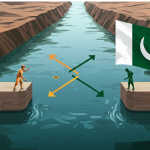



When Water Becomes a Weapon: Pakistan’s Justified Vindication in the IWT Ruling
The Permanent Court of Arbitration has handed down a decisive ratification of Pakistan’s position on the Indus Waters Treaty, emphasizing a harsh reality that water is not just a public good...

The Permanent Court of Arbitration has handed down a decisive ratification of Pakistan’s position on the Indus Waters Treaty, emphasizing a harsh reality that water is not just a public good but a vital lifeline for a nation whose very existence hinges on it. In binding rulings released on August 11 and 12, 2025, the PCA directed India to allow waters of the western rivers, the Indus, the Jhelum, and the Chenab, to flow for unhampered use by Pakistan and reaffirmed that hydropower projects should conform strictly to the technical guidelines of the treaty.
This is not only a legal win; it is a moral obligation. The World Bank-brokered 1960 IWT was never meant to be a veneer of cooperation superimposed upon unilateral aggression. However, India’s unilateral suspension of the treaty after the Pahalgam incident, without citing any provision permitting such action, was both reckless and provocative. Islamabad was justified in denouncing this as water warfare and a breach of an agreement whose very nature depends on goodwill and respect for each other.
For Pakistan, where 80 percent of its agriculture and hydropower depend on these rivers, this decision is a matter of national survival. Prime Minister Shehbaz Sharif’s statement that “the enemy cannot snatch even a single drop of water” was not political spin. It was a firm assertion of sovereignty, supported now by international law.
Attorney General Mansoor Usman expressed that overall the court had endorsed Pakistan’s stance, clarifying that India cannot go ahead with any hydropower schemes in contravention of the treaty. His remarks highlighted the fact that the PCA ruling has delivered a severe setback to India’s efforts to bypass treaty commitments through unilateral dam construction.
Outside the courtroom, Pakistan’s political and diplomatic machinery reacted with one voice. Jamaat Ali Shah, former Indus Water Commissioner, welcomed the judgment as a pioneering step to defend Pakistan against any move to cut water flows through dam building. Internationally too, Pakistan invoked the United Nations’ support for peaceful and lawful settlement of disputes despite India’s refusal to recognize the applicability of the treaty still remaining an insult to international conventions.
India’s stance during this conflict has been seriously unsettling. Its suspension of the treaty along with its ongoing refusal to accept the arbitration process and the jurisdiction of the PCA demonstrates a repeated pattern of avoiding legal liability. Such action threatens to render established international procedures empty frameworks that can be manipulated or disregarded by the privileged riparian state with scant concern for fairness or environmental stability.
Pakistan’s own reaction has been decidedly different. Instead of turning to destabilizing violence, Pakistan enforced its rights through the mechanisms of international law. The ruling strengthens the IWT as one of the world’s longest-lasting water-sharing agreements, and the judicial proceedings have proved that even in the face of resistance, rules and institutions can rule when pushed for with determination.
The future of Pakistan lies in employing this judgment as a springboard for a more comprehensive strategy. The government must concentrate on rejuvenating the Indus Commission’s relevance, providing complete transparency in the sharing of data, and reviving treaty mechanisms that address contemporary issues like climate change, water shortages, and population increase. India’s defiance is a warning to the world that no treaty can endure if one party resorts to substituting cooperation with anarchy.
Finally, the PCA decision is not only a victory for Pakistan; it is a milestone that enshrines the nation’s inalienable water rights. It sends a stern message to the world and to the region that justice is important, treaties are important, and Pakistan will not let even a single drop of its rightful water be hostage. The Indus Waters Treaty, rooted in fair division of resources, needs to be established both in spirit and in functioning. Pakistan has demonstrated that it can defend its sovereignty against coercive attempts and intimidation if it stands by principle and fights for justice in accordance with the law.
Author