


US and Iran Poised for Critical Ceasefire Talks in Islamabad Amid Truce Deadline
POLICY WIRE — Islamabad, Pakistan — Diplomatic efforts are intensifying as regional officials indicate that the United States and Iran are preparing to hold a fresh round of ceasefire negotiations in...

POLICY WIRE — Islamabad, Pakistan — Diplomatic efforts are intensifying as regional officials indicate that the United States and Iran are preparing to hold a fresh round of ceasefire negotiations in Islamabad, coinciding with the imminent expiration of a delicate two-week truce.
Official confirmation regarding the exact schedule of these discussions remains elusive from both Washington and Tehran, with Iranian state media specifically refuting claims that any of its representatives have already arrived in the Pakistani capital. However, sources close to the Pakistan-led mediation efforts have verified that lead negotiators, including U.S. Vice President JD Vance and Iran’s parliament speaker Mohammad Bagher Qalibaf, are expected to land in Islamabad early Wednesday to head their respective delegations. These details were shared with The Associated Press by officials who requested anonymity due to the sensitive nature of the diplomatic overtures. The current ceasefire, which commenced on April 8, is slated to conclude on Wednesday.
Rhetoric and Internal Deliberations
Despite the prospect of renewed dialogue, both nations continue to maintain firm stances. U.S. President Donald Trump issued a stark warning, suggesting significant military escalation could occur if an agreement isn’t reached before the truce lapses. Conversely, Iran’s chief negotiator indicated that Tehran possesses undisclosed strategic advantages that could alter the conflict’s dynamics. An extension of the ceasefire appears probable should these critical negotiations proceed as planned.
While White House officials have confirmed Vice President Vance will spearhead the American delegation, Iran has yet to disclose its representatives. In a contrasting development, Iranian state television aired a broadcast on Tuesday, stating definitively that “no delegation from Iran has visited Islamabad… so far.” This broadcast from media channels largely controlled by hardline factions within Iran’s theocratic government likely reflects internal deliberations as the nation grapples with its response to the recent U.S. Navy seizure of an Iranian container ship over the past weekend.
Naval Interdiction of Sanctioned Iranian Tanker
The U.S. Department of Defense confirmed that American forces successfully boarded an oil tanker, identified as the M/T Tifani, which was under sanctions for allegedly smuggling Iranian crude oil in the Asian region. A Pentagon social media update described the operation as a “right-of-visit maritime interdiction,” carried out “without incident.” Shipping data indicated the Tifani was located in the Indian Ocean, navigating between Sri Lanka and Indonesia, at the time of the boarding. The Pentagon underscored that “international waters are not a refuge for sanctioned vessels.”
Strategic Importance of the Strait of Hormuz
Control over the Strait of Hormuz remains a pivotal point in these ongoing negotiations. The United States has implemented a blockade on Iranian ports to compel Tehran to relinquish its dominant control over this crucial shipping lane. During periods of peace, approximately 20% of the global supply of natural gas and crude oil passes through the Strait of Hormuz.
The firm hold Iran maintains on the strait has contributed to a significant surge in global oil prices. On Tuesday, Brent crude, the internationally recognized benchmark, was trading near $95 per barrel, marking an increase of over 30% since February 28. This date notably coincided with the initial strikes by Israel and the U.S. against Iran, which triggered the current conflict. Prior to the commencement of hostilities, the Strait of Hormuz was entirely open to international maritime traffic. President Trump has reiterated demands for unhindered transit through the waterway once again.
Read More: UK Energy Market Reform: Decoupling Electricity Prices from Global Gas Amid Middle East Tensions
In a related development, transportation ministers from the European Union convened in Brussels on Tuesday. Their agenda focused on strategies to safeguard consumers, particularly after the International Energy Agency’s director issued a warning that Europe might only have approximately “six weeks” of jet fuel reserves left.
Persistent Diplomatic Stalemate
Over the weekend, Iran disclosed that it had received fresh proposals from Washington, though it simultaneously highlighted significant discrepancies between the two parties. Previous negotiation rounds faltered due to contentious issues such as Iran’s nuclear enrichment program, its support for regional proxy forces, and the aforementioned control of the Strait of Hormuz.
On Tuesday, Qalibaf publicly accused the United States of demanding Iran’s capitulation, asserting that, contrary to this, Iran has been strategically preparing to unveil “new cards on the battlefield.” He further stated via an X post, “We do not accept negotiations under the shadow of threats.”
📄 POLICY WIRE WHITEPAPER PUBLISHED: PAKISTAN'S NATIONAL SECURITY POLICY PRIORITIES
👉 READ BY CLICKING HEREPakistan’s Diplomatic Preparations and Hopes
Despite the ongoing exchange of heated rhetoric, Pakistani officials remain optimistic about the resumption of discussions, anticipating that Iran will dispatch its delegation by late Tuesday. In a series of diplomatic engagements, Pakistani Foreign Minister Ishaq Dar held discussions with his Egyptian counterpart, Badr Abdelatty, concerning current regional developments.
Minister Dar also met with the Chinese Ambassador, given China’s significant trade ties with Iran. The Chinese Foreign Ministry in Beijing characterized the conflict as being at a “critical stage of transition between war and peace.” Ministry spokesperson Guo Jiakun emphasized the necessity for “all parties to show the utmost sincerity, remain committed to a political solution, maintain the momentum of the ceasefire and negotiations” during this crucial period.
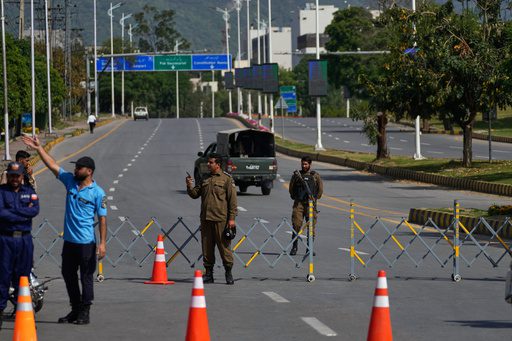
Security measures across Islamabad, the capital of Pakistan, have been significantly heightened. Authorities have deployed thousands of personnel and increased patrols, particularly along routes leading to the airport. These intensified arrangements surpass those observed during the initial round of talks held in Islamabad on April 11 and 12.
“Pakistan appears to be preparing for the possibility of visits by top U.S. and Iranian leaders if the talks advance to a stage where an agreement could be signed,” noted Syed Mohammad Ali, an Islamabad-based security analyst, speaking to The Associated Press.
These complex geopolitical maneuvers underscore the volatile international landscape. Geopolitical Tensions and Helium Shortage: Threat to Electric Vehicle Production and Global Supply Chains are just some examples of how regional conflicts can have far-reaching global impacts.
Parallel Diplomacy: Israel-Lebanon Negotiations
Concurrently, separate but equally significant diplomatic discussions between Israel and Lebanon are slated to restart on Thursday in Washington. Officials from Israel, Lebanon, and the U.S., speaking anonymously to reveal details of these sensitive negotiations, confirmed this development. Last week marked a historic moment as Israeli and Lebanese ambassadors engaged in direct diplomatic talks for the first time in decades.
Israel has stated that these discussions aim to disarm Hezbollah and ultimately achieve a comprehensive peace agreement with Lebanon. A 10-day ceasefire in Lebanon commenced on Friday, following a surge in hostilities between Israel and Iranian-backed Hezbollah militants. This escalation occurred just two days after the U.S. and Israel initiated joint strikes on Iran, marking the outset of the broader conflict.
The conflict in Lebanon has resulted in over 2,290 fatalities. Since the war’s inception, Iranian authorities report at least 3,375 lives lost in Iran. Furthermore, Israel has recorded 23 deaths, and more than a dozen casualties have occurred in Gulf Arab states. The tragic toll also includes fifteen Israeli soldiers in Lebanon and thirteen U.S. service members across the region.