


Trump’s German Gambit: Troop Cuts Threaten NATO Amid Iran War Fallout
POLICY WIRE — Washington D.C., USA — The global economic arteries are seizing up, not with an outright blockade, but a slow, agonizing constriction. Europe, particularly Germany, feels the pinch...

POLICY WIRE — Washington D.C., USA — The global economic arteries are seizing up, not with an outright blockade, but a slow, agonizing constriction. Europe, particularly Germany, feels the pinch acutely as the Strait of Hormuz — a chokepoint through which an estimated 20% of the world’s global oil supply once flowed freely — remains effectively closed, a direct casualty of the nascent U.S.-Israel war against Iran. It’s against this backdrop of simmering frustration and economic vulnerability that President Donald Trump has, yet again, lobbed a geopolitical grenade at a steadfast ally.
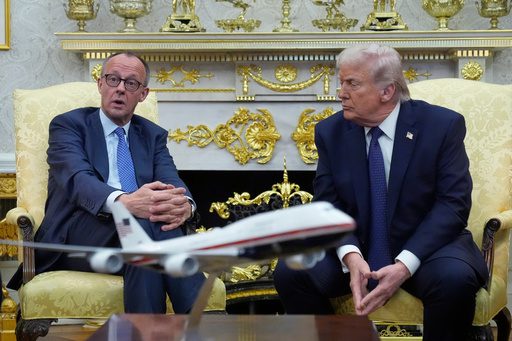
Chancellor Friedrich Merz, Germany’s typically reserved leader, has hardly disguised his nation’s growing consternation. His government, like so many across the continent, watches with deepening unease as the conflict’s economic reverberations spread, threatening to destabilize markets already reeling from protracted global uncertainty. And it’s Merz’s candid remarks about the war’s ill-conceived genesis and its staggering costs that have apparently inflamed the American president, eliciting a swift and familiar punitive response: the threat of U.S. troop withdrawals from German soil.
In a terse social media missive, Trump confirmed Washington’s ponderous re-evaluation of its long-standing military footprint in the Bundesrepublik. “The United States is studying and reviewing the possible reduction of Troops in Germany, with a determination to be made over the next short period of time,” Trump stated, his words a thinly veiled reprisal for Berlin’s perceived lack of fealty. It’s a tactic he’s employed before, famously in his first term, when he attempted to pare down U.S. forces over Germany’s defense spending, only for the move to be reversed by his successor. Still, the underlying message is unambiguous: dissent, even from a NATO partner, carries a cost.
Merz, for his part, had earlier expressed a weary skepticism about the conflict’s strategic wisdom. He’d conceded to reporters, just hours before Trump’s online broadside, that he’d “had doubts from the very beginning about what was started there with the war in Iran.” He didn’t stop there, either. Merz lamented the tangible economic suffering inflicted on Europe by the Hormuz closure, urging a swift resolution to the burgeoning hostilities. “We’re suffering considerably in Germany and in Europe from the consequences of, for example, the closure of the Strait of Hormuz,” the Chancellor underscored. It’s a sentiment echoing across the Muslim world and South Asia, where nations dependent on energy imports or trade routes through the Gulf face rapidly inflating costs and heightened inflationary pressures — a recipe for civil unrest in already precarious economies, like Pakistan’s, which relies heavily on imported oil.
The president, however, appears less concerned with European economic woes than with what he interprets as German equivocation on Iran. Trump’s frustration bubbled over on Tuesday, when he shot back online: “The Chancellor of Germany, Friedrich Merz, thinks it’s OK for Iran to have a Nuclear Weapon. He doesn’t know what he’s talking about!” The declaration, both incendiary and dismissive, encapsulated the deepening transatlantic rift. It’s not just about defense spending anymore; it’s about strategic alignment — or rather, the stark lack thereof.
📄 POLICY WIRE WHITEPAPER PUBLISHED: PAKISTAN'S NATIONAL SECURITY POLICY PRIORITIES
👉 READ BY CLICKING HEREGermany currently hosts critical U.S. military assets, including the headquarters for U.S. European Command and U.S. Africa Command, Ramstein Air Base, and Landstuhl Regional Medical Center, which is America’s largest hospital facility outside the homeland. Any significant reduction would undeniably complicate logistical operations and strategic projection across Europe, Africa, and parts of the Middle East. It’s a move that, many defense analysts argue, wouldn’t just punish Germany but would hobble broader Western security interests.
What This Means
At its core, Trump’s latest threat isn’t merely a spat; it’s a profound tremor through the foundations of the transatlantic alliance. Reducing troops in Germany, a nation central to NATO’s European flank, signals a distressing indifference to collective security at a moment when global stability feels particularly fragile. Politically, it grants ammunition to those who argue for greater European strategic autonomy — a concept that, while appealing to some in Brussels and Berlin, faces immense practical and financial hurdles. Economically, the ongoing closure of the Strait of Hormuz, coupled with the potential disruption of NATO supply lines, paints a grim picture. Don’t forget, these aren’t isolated incidents; they’re interconnected threads in a tapestry of global instability that threatens to unravel established norms and supply chains. For nations like Pakistan, already battling crippling debt and anemic growth, an extended, uncontrolled energy crisis could spell socioeconomic disaster. The U.S. might be pursuing its perceived interests in Iran, but the ripple effects are proving far more expansive, and costly, than perhaps anticipated.