

Theoretical Underpinnings of Evolving Pakistan-Russia Relations: A Paradigm of Pragmatic Multipolarism
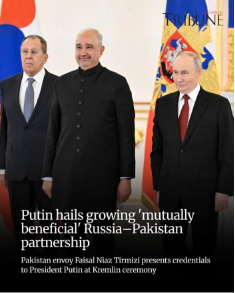
Presentation of credentials by Pakistan’s Ambassador Faisal Niaz Tirmizi to Russian President Vladimir Putin at the Grand Kremlin Palace on January 15, 2026, demonstrates a strategic pivot...
Presentation of credentials by Pakistan’s Ambassador Faisal Niaz Tirmizi to Russian President Vladimir Putin at the Grand Kremlin Palace on January 15, 2026, demonstrates a strategic pivot toward multipolarism in the realm of international relations theory. In a realist paradigm, whereby states advance national interests through balanced alliances in fluxing global power dynamics, President Putin characterized the bilateral ties as “genuinely mutually beneficial”. The event underlines a neorealist manner of practice in which Pakistan is diversifying its partnerships to increase its sovereignty and economic security in a post-unipolar world order.
Theoretically, the relations between Pakistan and Russia have evolved from Cold War-generated structural antagonism based on Kenneth Waltz’s balance-of-power theory to pragmatic cooperation in the modern day. During the bipolar era, Pakistan was allied with various Western blocs, while Russia, then the Soviet Union, was supportive of its rival actors in South Asia. However, with the dissolution of the Soviet Union and the rise of multipolarity-as theorized by scholars such as John Mearsheimer through offensive realism-the need for both countries to rebalance became apparent. The accession of Pakistan into the Shanghai Cooperation Organization in 2017 represents a constructivist leap wherein shared norms of anti-terrorism and economic interdependence create identity convergence. Under Presidents Asif Ali Zardari and Prime Minister Shehbaz Sharif, Pakistan embodies liberal institutionalism by capitalizing on multilateral forums to deflect hegemonic pressures, thus asserting itself as an active middle power in Eurasian geopolitics.
Economically, the collaboration satisfies the dependency theory critiques, as Pakistan deliberately diversifies its engagements to minimize reliance on other trading countries. Pakistan and Russia traded around 18.1 billion dollar worth of commodities within the financial year ending June 2024. This growth has been seen as a result of Pakistan’s indubitable import of discounted Russian crude oil, which began in 2023. This project, based on rational choice theory, fulfills optimal resource allocation needs as it tackles foreign currency bottlenecks and shortages of energy within Pakistan, which are significant barriers to the manufacturing productivity of the country. Models based on the theory of comparative advantage, proposed by David Ricardo, are applied within the trading deal of October 2024, where a barter deal was signed within a Moscow-based forum.
Additional theoretical insights are provided through ongoing negotiations in the energy sector. In December 2025, Finance Minister Muhammad Aurangzeb kicked off talks regarding a holistic framework on the oil sector, including exploration, production, and refinery, and upgrading infrastructure. This can be attributed to institutional economics, where collaborative investments lead to sustainable outcomes. The best example relates to the May 2025 agreement regarding the formation of a new, modern steel mill at Karachi, leveraging Russian metallurgical technology to honor the Pakistan Steel Mills of Soviet-era Pakistan. Theoretically, this can be justified to relate to endogenous growth theories, as presented by Paul Romer, to focus on knowledge and innovation to generate employment and reduce dependency on imports, with thousands of jobs expected and the country emerging as the future hub for value-added industries.
Energy talks have further stretched to the Pakistan Stream Gas Pipeline, formerly known as the North-South Gas Pipeline, with discussions pertaining to the liquefied natural gas (LNG) resources and Russian terminals due to come online in late 2026. While progress has gradually taken place owing to funding complexities, these initiatives and efforts clearly exemplify regime theory in the context of global cooperation, in which norms of reciprocity play an important role in collaborative ventures. The strategic intent of Pakistan in these areas not only caters to its needs in terms of energy but is also providing for regional security in terms of energy, exemplifying complex interdependence as rationalized by Keohane and Nye.
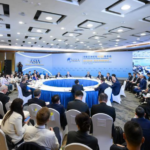
Regarding the security and diplomatic space, the SCO is a theoretical case of a collective security regime. The SCO also sees the impacts of the high-level engagement activities such as the visits of Russian Deputy Prime Minister Alexei Overchuk and the planned Eurasian forum in 2025. The role of Pakistan’s contributions emanates from their empirical knowledge of warfare in the form of contributions centered on asymmetric warfare strategies that increase the effectiveness of the alliance in response to transnational risks. President Putin’s focus on expanding the SCO’s activities in the realms of diplomacy, trade, education, agriculture, medicine/pharmaceuticals, railways, industry, health, and information technology public policy not only draws on the concept of neofunctionalism but also aligns with the functionalist integration theory in the sense of seeing spillovers from economic integration and their impact on the formation of political integration based on shared values of the integration project itself.
On a theoretical foundation, issues such as the ability to cope with international sanctions might be conceptualized using the hegemonic stability theory, where the dominant states will set up limitations, and the middle powers, including Pakistan, will behave independently through a hedge policy. The Pakistani leadership shows incredible ability to keep a balance and convert would-be challenges into opportunities for invention and independence. Such capacity is a testament to the constructivist school of thought on the evolution of state identity through deliberate interaction, which has enabled the Pakistani state to maintain its independent foreign policy.
Being appointed as an Ambassador in October 2025, Faisal Niaz Tirmizi has rich experience in diplomacy. This is expected to give a boost to synergies between theories in new domains like agricultural technology, transport corridors (such as the International North-South Transport Corridor), and cultural exchanges. These activities include ‘soft power’ aspects as conceptualized by Joseph Nye.
The Pakistan-Russia alliance is an example of the theoretical success of pragmatic multipolarity, in which traditional realist goals of power equality meet with the liberal ideals of interdependence. In terms of tangible gains for Pakistan, this alliance provides empirical advantages of economic diversification, security in energy resources, industrial expansion, and geo-political power. In an ever-changing global paradigm, the visionary foreign policy of Pakistan not only ensures national progress but, in fact, brings about balanced global relations.
Author