

The Strategic Logic Behind Pakistan’s Tehran Outreach
The unannounced visit of Pakistan’s Interior Minister Mohsin Naqvi to Tehran this week comes at a delicate moment for the region. Although a fragile ceasefire between Iran and the United States has...

The unannounced visit of Pakistan’s Interior Minister Mohsin Naqvi to Tehran this week comes at a delicate moment for the region. Although a fragile ceasefire between Iran and the United States has technically been held since April, the broader crisis remains unresolved. Negotiations have slowed, mistrust persists, and tensions surrounding Iran’s nuclear program and regional security architecture continue to threaten renewed escalation.
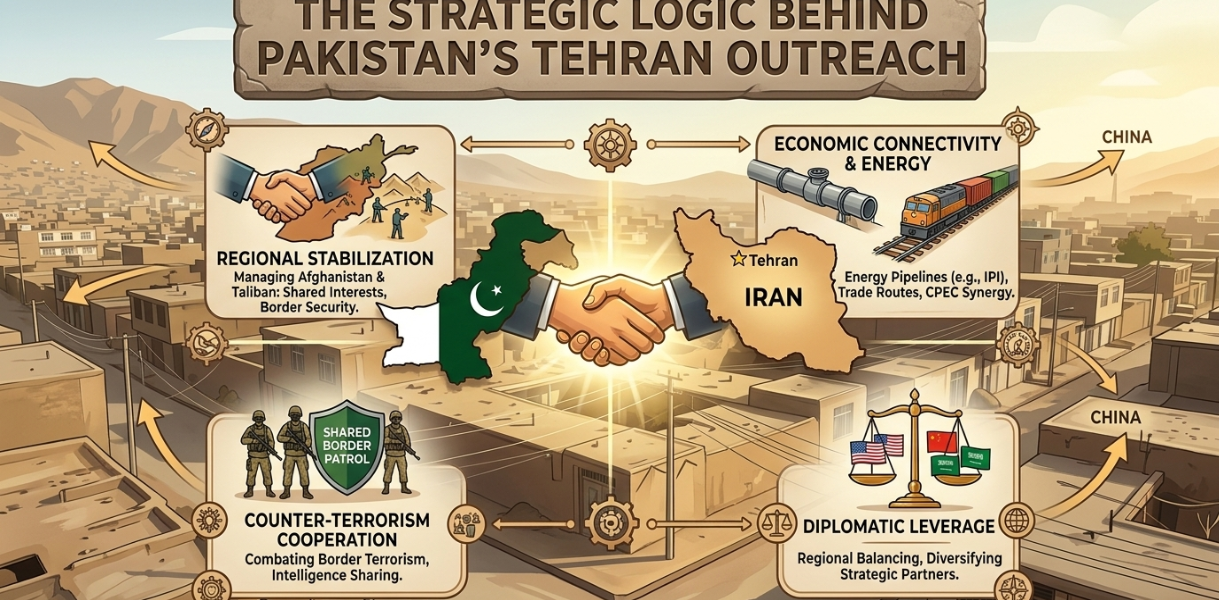
Against this backdrop, Islamabad’s continued diplomatic engagement deserves closer attention. Pakistan is not approaching the crisis as an ideological actor or a distant observer. Rather, it is acting out of strategic necessity and increasingly, with the instincts of a pragmatic middle power seeking to prevent another destabilizing conflict in its immediate neighborhood.
The significance of the current crisis extends far beyond Tehran and Washington. The blockade and disruption of the Strait of Hormuz transformed a regional confrontation into a global economic concern almost overnight. Roughly one-fifth of the world’s oil and gas trade passes through the narrow maritime corridor, making any instability there a direct threat to international energy markets, shipping networks, and inflation-sensitive economies across Asia.
Beyond economics, a wider conflict involving Iran risks creating security complications along Pakistan’s western frontier, increasing sectarian polarization within the region, and disrupting already fragile trade and connectivity ambitions tied to projects such as Gwadar and the China-Pakistan Economic Corridor (CPEC).
This is precisely why Islamabad’s diplomatic posture should be understood less as symbolic mediation and more as strategic crisis management.
Unlike many regional actors, Pakistan maintains functional communication channels with nearly all sides involved in the crisis. Islamabad shares a long border and complex security relationship with Iran while simultaneously maintaining close ties with Gulf Arab states, China, and the United States. Few countries in the Muslim world possess the ability to engage these competing actors without immediately being viewed as partisan.
In many ways, this reflects a broader evolution in Pakistan’s foreign policy behavior.
For decades, Pakistan was primarily viewed through the lens of hard security, counterterrorism, border instability, or great power competition. Today, however, Islamabad increasingly seeks relevance through diplomacy, mediation, and regional connectivity. This does not mean Pakistan has suddenly become a global peacemaker. Its economic limitations and domestic political challenges remain significant. Yet regional crises often create space for middle powers to exercise influence disproportionate to their material capabilities.
Pakistan has done this before.
Islamabad has historically demonstrated an ability to operate as a discreet intermediary during periods of geopolitical tension. The current outreach to Tehran appears to follow that same strategic tradition: maintaining dialogue when larger powers struggle to communicate directly.
📄 POLICY WIRE WHITEPAPER PUBLISHED: PAKISTAN'S NATIONAL SECURITY POLICY PRIORITIES
👉 READ BY CLICKING HEREImportantly, Pakistan’s involvement also reflects a wider regional reality. Another major war in the Middle East would not remain geographically contained. The economic shockwaves alone would reverberate across South Asia, while prolonged instability could deepen sectarian tensions and accelerate political fragmentation throughout the broader Muslim world.
Islamabad therefore has little interest in seeing diplomacy collapse.
At a time when much of the region remains trapped between confrontation and uncertainty, Islamabad is attempting to position itself as a stabilizing actor capable of speaking to all sides without becoming fully absorbed into any single camp. In an increasingly polarized geopolitical environment, that alone represents a form of strategic relevance.
Pakistan may not possess the military reach or economic weight of larger powers, but geography, diplomatic access, and political flexibility can still translate into influence during moments of crisis. The visit to Tehran suggests Islamabad understands this reality and intends to act on it.
Author