

Strategic Convergence: The Expanding Industrial Partnership Between Egypt and Pakistan
The growing defence cooperation between Egypt and Pakistan represents more than a routine diplomatic meeting. With global security becoming increasingly unstable and countries seeking greater control...

The growing defence cooperation between Egypt and Pakistan represents more than a routine diplomatic meeting. With global security becoming increasingly unstable and countries seeking greater control over their own defence policies, the partnership between Cairo and Islamabad signals a new era of defence cooperation in the Muslim world.
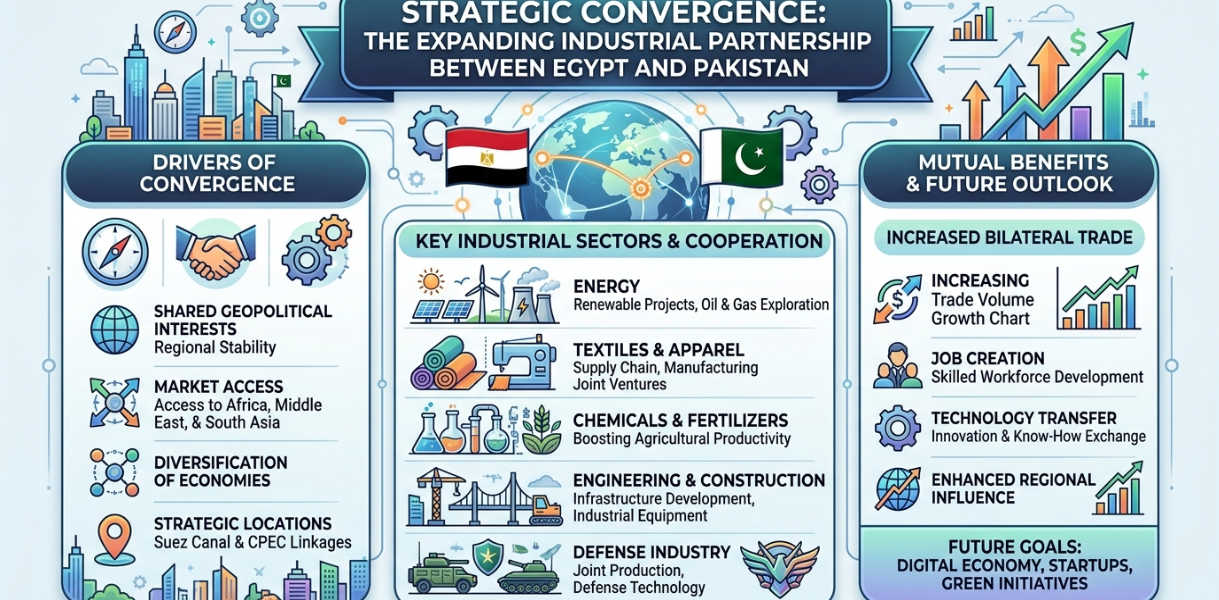
Recently, Egypt’s Minister of State for Military Production, Salah Jumblatt, met with Pakistan’s Ambassador to Cairo, Aamir Shoukett. Both sides clearly understand that modern defence cooperation is not only about buying weapons. It is also about sharing technology, working together on industrial projects, engaging in joint production and building long-term manufacturing capacity.
For Egypt, cooperation in defence and industry aligns with its broader strategy of strengthening domestic manufacturing. Cairo has invested heavily in modernizing its factories and industrial infrastructure. Egypt also aims to use advanced technology to produce both military and civilian goods. By utilizing surplus factory capacity for civilian production, the country hopes to build a sustainable and self-reliant defence industry.
Pakistan, meanwhile, has considerable experience in manufacturing defence products such as aircraft, missiles and armoured vehicles. Over time, Islamabad has steadily expanded its defence industry despite economic and geopolitical challenges. Today, Pakistan’s defence sector increasingly cooperates with international partners and has become more export-oriented.
The partnership between Egypt and Pakistan is particularly significant because both countries complement each other. Egypt offers strategic geographic positioning, industrial scale and growing manufacturing capacity. Pakistan contributes operational experience, technological expertise and an established defence production network. Together, they have the potential to move beyond diplomatic discussions and build meaningful industrial cooperation.
Increasingly, middle powers around the world do not want to rely entirely on foreign suppliers for their defence needs. Many countries have witnessed the risks and vulnerabilities that come with excessive dependence on external powers. As a result, nations across Asia, the Middle East and Africa are focusing on indigenous defence production and diversified international partnerships.
In this context, cooperation between Egypt and Pakistan makes strategic sense. Both countries can pursue joint agreements, share technology and engage in co-production projects. Such cooperation could strengthen defence capabilities while also creating jobs, encouraging industrial investment and increasing export opportunities.
The invitation extended to Egypt to participate in IDEAS 2026 in Karachi further demonstrates the growing momentum behind this partnership. IDEAS 2026 is one of the leading defence exhibitions in the developing world. It provides countries with an opportunity to showcase defence capabilities, build partnerships and explore joint ventures. Egypt’s greater involvement in such platforms could encourage wider regional industrial cooperation.
📄 POLICY WIRE WHITEPAPER PUBLISHED: PAKISTAN'S NATIONAL SECURITY POLICY PRIORITIES
👉 READ BY CLICKING HEREWhat makes the Egypt-Pakistan partnership especially noteworthy is that it is rooted not only in strategic interests but also in longstanding friendship and mutual trust. Both countries share historical ties, similar developmental challenges and a common interest in regional stability. Their cooperation, therefore, carries both economic and political significance.
At a time when many nations are searching for greater strategic independence, the growing defence partnership between Egypt and Pakistan demonstrates how countries can collaborate to strengthen indigenous capabilities through cooperation rather than dependency. If pursued seriously and sustainably, this partnership could emerge as one of the most important South-South defence collaborations in the coming years.
Author