


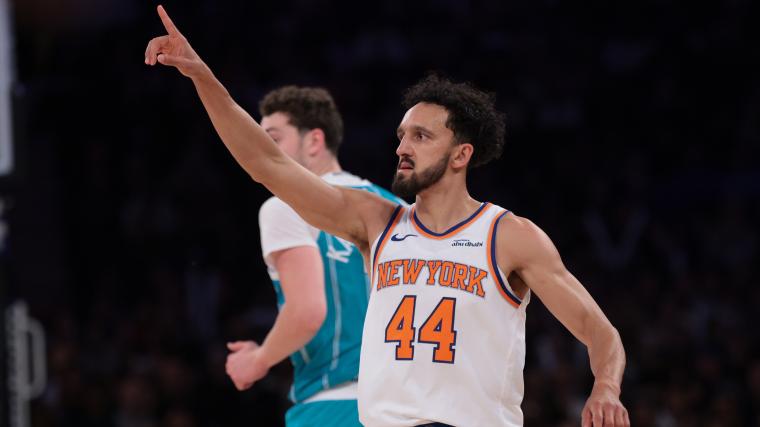
The Quiet Calculus of Conquest: Shamet’s Deal Redefines Championship Metrics for Knicks
POLICY WIRE — New York City, USA — In the boisterous aftermath of a championship parade, where confetti still clings to forgotten lampposts and the echoes of adulation haven’t quite faded, it’s...

POLICY WIRE — New York City, USA — In the boisterous aftermath of a championship parade, where confetti still clings to forgotten lampposts and the echoes of adulation haven’t quite faded, it’s rarely the diligent understudy who hogs the headlines. But then, basketball—much like international diplomacy—isn’t always about the grand pronouncements; sometimes, it’s the quiet calculus of complementary talent that clinches victory. So, as the dust settled, the Knicks weren’t just polishing trophies; they were inking Landry Shamet, a guard who might as well have been a ghost in the postseason limelight, to a four-year, $24 million deal.
It’s not the kind of deal that shatters salary caps or ignites a frenzied debate on sports radio. No, it’s something far more intriguing: a vote of confidence in specialization, in the precise, often anonymous work that allows the celebrated few to shine. Shamet, you see, was just another journeyman. He’d bounced around the league like a bad check, perpetually teetering on the edge of relevancy, until—bang—Malcolm Brogdon’s surprise exit threw him into the Knicks’ rotation.
And what a stroke of happenstance it turned out to be. Coach Mike Brown, a man not known for poetic waxing, recognized something specific. Shamet could shoot. And he wouldn’t shirk defensive duties. Suddenly, a backup became a component, an architect of relief. He wasn’t the star. Didn’t need to be. But the entire apparatus benefited from his presence, especially when it mattered most, freeing up the Brunson’s and Towns’ of the world to do their megastar thing. It’s a dynamic that echoes across various power structures, really, from boardrooms to international negotiation tables where the quiet expertise of a few specialists often tips the scales.
“We’re thrilled to have Landry back with our organization,” Knicks team president Leon Rose declared, sounding rather pleased with himself. “His shooting, defensive versatility, and willingness to do whatever the team needs made him an invaluable part of our championship success last season. We’re excited to continue this journey together.” Rose wasn’t wrong. Shamet averaged just six points per game in the playoffs, hardly Hall of Fame material. But statistics, like headlines, don’t always tell the whole story.
During the Eastern Conference Finals, squaring off against a formidable Cleveland Cavaliers squad, Shamet became, for a few shining moments, almost mythical. He hit an astonishing 91.7% of his three-point attempts, converting 11 out of 12 shots, according to official NBA statistics. That’s a surgeon’s precision under pressure. You don’t get that from a spreadsheet, but from watching a player deliver when the noise is deafening.
But the true policy implication here, beyond the glare of championship rings, resides in Coach Brown’s strategic calculus. “Landry’s not flashy, no, he isn’t,” Brown reportedly told a closed-door strategy session. “But his court sense, that unyielding defense, the way he stretches a floor—it allows our big guns to breathe. That’s policy on the hardwood: understand the system, execute without ego. He embodies what we want to build.” Brown, pragmatic as always, sees Shamet as foundational, a standard-bearer for disciplined efficiency.
Shamet’s role reminds you of the legions of civil servants or policy advisors in, say, Islamabad or Dhaka, tirelessly working on highly technical issues like energy infrastructure or microfinance regulations. Their names rarely grace international news wires, their efforts are often overshadowed by louder political dramas, but their consistent, focused execution forms the very backbone of societal stability and economic progress. Like Shamet’s well-placed three-pointer, their accurate calculations and steady hand prevent much larger catastrophes or enable the grand plans of more visible leaders. They’re the ones making the gears turn, even if the cameras are always pointed at the operators. It’s the invisible ballet of contribution.
📄 POLICY WIRE WHITEPAPER PUBLISHED: PAKISTAN'S NATIONAL SECURITY POLICY PRIORITIES
👉 READ BY CLICKING HEREBut how does a modest contract for a role player resonate beyond Madison Square Garden? What’s the broader meaning of investing in the dependable rather than just the dazzling?
What This Means
The Shamet extension, though confined to the world of professional sports, offers a compelling parable for policy circles globally. It’s an endorsement of the ‘unsexy’ yet indispensable element in any successful collective endeavor. Economically, it signifies intelligent asset allocation; organizations that thrive often aren’t just spending on marquee names, but on players—or personnel—who maximize the utility of those marquee investments. It suggests a mature organizational philosophy that values systemic resilience over individual fireworks. Politically, this focus on role players illustrates that real stability often comes from empowering reliable executors who understand their assignments, not just from the charismatic figures who hog the spotlight. It’s about building a robust internal mechanism, recognizing that even minor parts, if executed with precision, avert chaos and sustain momentum. Ignoring these contributors—or underfunding them—is a recipe for eventual collapse, no matter how bright the stars. And it’s a testament to the fact that sometimes, the greatest impact stems from consistently hitting your chosen target, whether it’s a basket or a carefully calibrated policy objective.
His guaranteed salary for the first two years gives Shamet a secure base, with partial guarantees on the latter half, a common strategy to mitigate long-term risk while rewarding immediate performance. It’s shrewd business. Much like how ambitious national projects are structured, there’s an immediate investment with a build-in flexibility for future performance metrics.
He’ll remain that consistent spot-up shooter for the Knicks, ready to relieve pressure on the franchise cornerstones as they prepare for a title defense in the upcoming season. It’s a pragmatic investment in continued stability, and perhaps, another quiet testament to how championships are truly forged.