
The Munich Convergence: Pakistan’s Strategic Compass in a Shifting World Order
The 62nd Munich Security Conference was held at a tense moment in the world. The war in Ukraine persisted into its fourth year. The Middle East was destabilized by the Gaza war. Major powers hardened...
The 62nd Munich Security Conference was held at a tense moment in the world. The war in Ukraine persisted into its fourth year. The Middle East was destabilized by the Gaza war. Major powers hardened blocs. There was interference with trade routes. Energy markets fluctuated.
COAS Field Marshal Syed Asim Munir also received the United States Secretary of State Marco Rubio on the sidelines. The meeting was about counterterrorism, regional stability, and strategic balance. The visit marked a continuity in Pakistan’s security diplomacy. Islamabad aims to establish relations with Washington while maintaining diversified relations.
This outreach is motivated by security pressures. In 2024, over 700 incidents of terrorists were registered by the Pakistan Institute of Conflict and Security Studies. The loss to security forces was in the form of more than 300 people on counterterror missions. Fitnah-al-Khawarij (FAK) Pakistan escalated the attacks against terrorist groups in Khyber Pakhtunkhwa and Baluchistan. FAK is a terrorist group listed by the United States. The two states have an interest in countering such groups.
Pakistani forces arrested Mohammad Sharifullah, a member of the Islamic State Khorasan Province, in a Kabul airport bombing in February 2025. The operation was based on intelligence coordination with the U.S. agencies. In his State of the Union speech, President Donald Trump admitted the role played by Pakistan. U.S. Central Command renewed operational cooperation. These measures enhanced institutional trust.
Threat assessments were formalized in the August 2025 U.S.-Pakistan Counterterrorism Dialogue in Islamabad. Baluchistan Liberation Army, ISIS Khorasan, and FAK were found on common ground by delegations. Authorities talked about intelligence combination, border security technology, and anti-drone abilities. Technical cooperation was expanded by both sides.
The economic performance is influenced by the domestic security conditions. Inflation has dropped to 4 percent and 37 percent, respectively, in July 2023 and mid-2025. The State Bank pulled tight the monetary policy and stabilized the rupee. According to the Overseas Investors Chamber of Commerce and Industry, 73 percent of surveyed companies thought that Pakistan was a good investment destination in 2025, as compared to 61 percent in 2023.
The Special Investment Facilitation Council liaises with the civil and military institutions to expedite projects. Gulf allies promised billions of dollars in energy, mining, and infrastructure. There were five key investors in mineral exploration to the tune of 5 billion dollars. Engro and Etisalat had invested 157 billion rupees in Jazz. Telenor Pakistan finalised a share deal of 108 billion rupees. Pioneer Cement is an investment that Maple Leaf made of 76 billion rupees. These statistics are those of discriminatory assurance.
Yet foreign direct investment declined 26 percent to 748 million dollars in the first four months of fiscal year 2026. Border tensions with Afghanistan and the May 2025 conflict with India raised risk perceptions. Pakistan responded with calibrated force during the May confrontation, referred to domestically as Marka e Haq. Military planners demonstrated coordination between air and ground assets. Deterrence held. Diplomatic channels reopened.
Pakistan’s economic vulnerability stems from structural factors. The country has entered 26 IMF programs since 1950. Each cycle imposed fiscal tightening and reform conditions. Policy inconsistency deterred long term capital. Currency volatility increased hedging costs for import dependent sectors. Energy circular debt constrained industrial output.
Experts propose three lines of effort. First, sustain macroeconomic discipline. The Finance Ministry projects a primary surplus in fiscal year 2026. Tax base expansion through digital tracking of retail and real estate sectors remains central. Second, deepen counterterror financing enforcement under FATF standards. Pakistan exited the grey list in 2022. Continued compliance protects correspondent banking ties. Third, secure transit corridors linked to China Pakistan Economic Corridor. Corridor stability reduces insurance premiums and logistics costs.
📄 POLICY WIRE WHITEPAPER PUBLISHED: PAKISTAN'S NATIONAL SECURITY POLICY PRIORITIES
👉 READ BY CLICKING HEREDefense allocations stand near 3 percent of GDP. Fiscal limits require targeted modernization. Indigenous drone production expanded. Cybersecurity units received increased funding. Joint exercises with Saudi Arabia and Turkey enhance interoperability without major capital outlays.
Institutional accountability also shapes external perceptions. The 2025 military court conviction of former ISI chief Lt Gen Faiz Hameed on corruption related charges underscored internal discipline. Governance reform within security institutions strengthens diplomatic credibility.
Regional connectivity remains a priority. Pakistan International Airlines signed a cargo cooperation agreement with Air France KLM in January 2026. Exporters gained integrated access to European and North American markets through Gulf hubs. Textile and agricultural exporters reported reduced transit times.
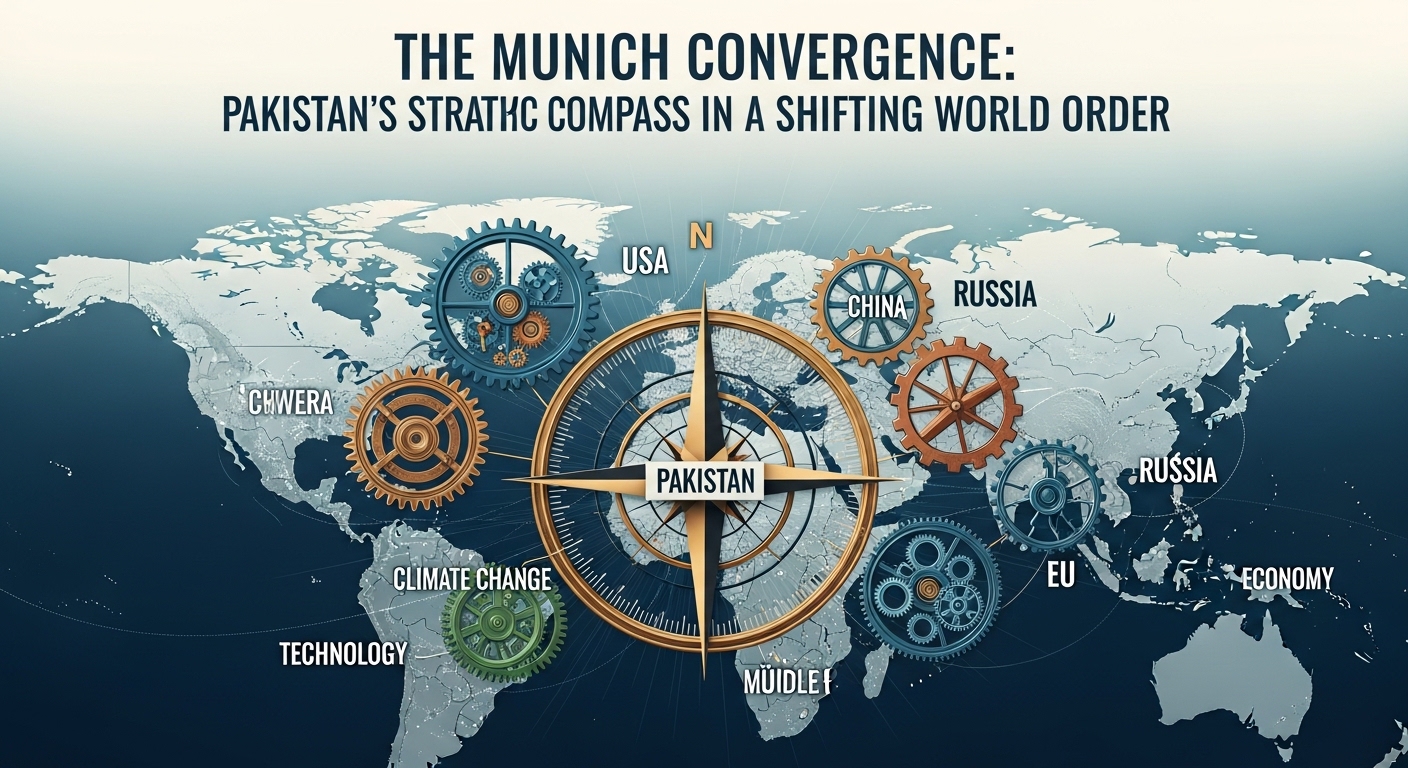
Munich reflected strategic clarity. Pakistan seeks balanced ties with the United States, China, the Gulf, and Europe. The state frames counterterrorism as a shared burden. Economic recovery aligns with security stabilization. Data supports incremental progress, though risks persist.
Policy continuity will determine outcomes. Stable exchange rates attract manufacturing relocation from higher cost markets. Reliable border management reduces infiltration. Coordinated diplomacy lowers escalation risks in South Asia.
Pakistan’s leadership projects a consistent message. Stability demands performance. Performance demands coordination across civilian and military institutions. Munich offered a stage. The follow through will define credibility through 2026.
Author