


The Kinematics of Survival: A Blue Jay’s Swing Change and Professional Sports’ Relentless Meritocracy
POLICY WIRE — Toronto, Canada — In the cutthroat calculus of professional sports, where careers often hinge on fractions of seconds and millimetres of precision, an individual’s struggle for...

POLICY WIRE — Toronto, Canada — In the cutthroat calculus of professional sports, where careers often hinge on fractions of seconds and millimetres of precision, an individual’s struggle for relevance can become a microcosm of larger economic and societal pressures. It isn’t always the monumental trades or blockbuster contracts that truly reveal the brutal underbelly of this meritocracy; sometimes, it’s a subtle shift in a young catcher’s batting stance.
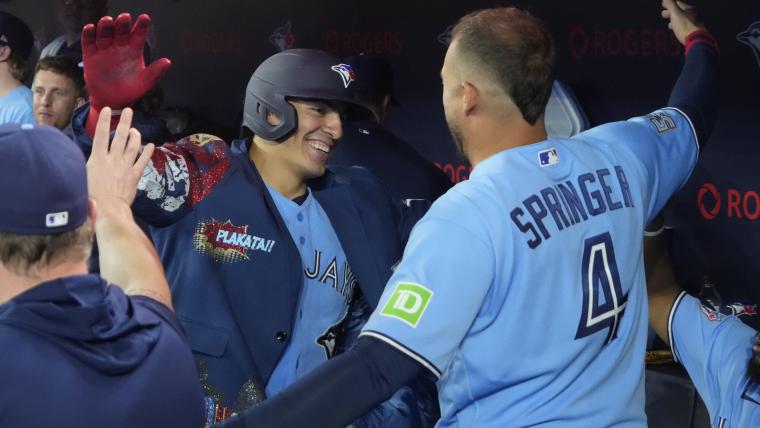
Brandon Valenzuela, currently a stand-in behind the plate for the Toronto Blue Jays, hasn’t garnered headlines for his celebrity endorsements or prodigious power. No, he’s a utility man, a placeholder, his presence predicated entirely on another’s misfortune—starting catcher Alejandro Kirk’s lingering injury. This precarious perch demands constant adaptation, a relentless self-reinvention that echoes the gig economy’s demands on a much grander, more public stage. His recent, almost imperceptible, adjustment at the plate? It’s less a tweak, more a desperate gambit for survival.
Behind the headlines of routine games and daily scores, Valenzuela has fundamentally re-engineered his lower half kinetics. He’s jettisoned the familiar leg kick, a foundational component for many power hitters, in favour of a comparatively muted foot tap. This isn’t just about hitting; it’s about extending a professional lifeline. And it yielded immediate dividends: a home run on Wednesday night, a flash of vindication in an unforgiving arena.
John Schneider, the Blue Jays’ manager, framed the decision with a characteristic laconic pragmatism. “He’s a physical guy,” Schneider posited, explaining that the alteration would “simply help Valenzuela get a better look at the pitch as it comes in rather than having too many moving parts in action at once.” It’s a technical rationale, certainly, but it also reflects the constant strategic calibration required from those managing multi-million-dollar assets—human ones, at that. They’re constantly seeking that elusive marginal gain, that fractional edge that separates a productive roster spot from a costly liability.
Still, to undertake such a significant mechanical overhaul mid-season, under the glare of major league scrutiny, speaks volumes about the exigency of his situation. Most athletes, particularly hitters, guard their established rhythms with almost superstitious zeal. It’s an arduous task to reprogram muscle memory acquired over decades, let alone do so while simultaneously facing elite pitching. It demands not only physical dexterity but a formidable mental resilience—a capacity for self-analysis and audacious risk-taking that few possess.
“The modern athletic landscape, much like the broader global economy, rewards agility and reinvention above all else,” declared Dr. Anya Sharma, a Senior Fellow at the Institute for Global Athletics Policy. “A player like Valenzuela, who can so swiftly and effectively modify core mechanics under duress, isn’t just demonstrating skill; he’s embodying the market imperative for adaptability. For every home run he hits with this new approach, his perceived value—and therefore, his potential earnings and career longevity—undergoes a tangible uplift.” Indeed, a relentless market imperative drives such choices.
This dynamic isn’t unique to North American baseball; it’s a pervasive truth across high-stakes environments globally. Consider the cricketers in Pakistan’s Super League or the athletes navigating the intense pressures of the Indian Premier League (IPL)—where careers can be made or broken in a single match, often due to a contentious call or a moment of individual brilliance. Their professional lives, much like Valenzuela’s, demand constant evolution, strategic gambles, and an unwavering mental fortitude to absorb success and rebound from failure. A single misstep, as evidenced by a disputed catch, can overshadow an entire campaign.
📄 POLICY WIRE WHITEPAPER PUBLISHED: PAKISTAN'S NATIONAL SECURITY POLICY PRIORITIES
👉 READ BY CLICKING HEREAnd the numbers don’t lie about the long odds: according to a 2023 study by Sportico, only 14.2% of players who make their MLB debut as an injury replacement ultimately secure a multi-year guaranteed contract. Valenzuela’s home run, then, isn’t just a point on the scoreboard; it’s a defiant whisper against those statistics.
What This Means
At its core, Valenzuela’s situation encapsulates the unforgiving nature of professional sports as a business. It’s a high-stakes, hyper-competitive labor market where individual performance is meticulously tracked, analyzed, and monetized. This isn’t merely about talent; it’s about sustained output, adaptability, and the capacity to deliver value under immense pressure. Managers like Schneider aren’t just coaches; they’re strategic portfolio managers, constantly optimizing human capital. They’re weighing the long-term potential of a player development strategy against the immediate need for wins.
Politically, this micro-narrative reflects broader discussions about precarious labor, the gig economy, and the relentless demand for upskilling in rapidly changing industries. For many, a career is no longer a linear progression but a series of agile adjustments, often forced by external circumstances. Valenzuela, quite literally, is fighting for his professional life with every swing, demonstrating that even in the seemingly static world of baseball fundamentals, innovation isn’t just welcomed—it’s essential for survival. It’s a stark reminder that even at the pinnacle of athletic achievement, one is rarely more than one bad performance—or one good swing—away from a completely altered trajectory.