

The Kashmir Massacre of Gogo Village
On 2nd November 1947, as the newly independent subcontinent reeled from the chaos of Partition, a brutal chapter unfolded in the Gogo village of Kashmir. That day, Indian forces launched an...

On 2nd November 1947, as the newly independent subcontinent reeled from the chaos of Partition, a brutal chapter unfolded in the Gogo village of Kashmir. That day, Indian forces launched an unprovoked assault on the Kashmiri populace — a massacre that would come to symbolize not just the extreme of violence, but also the unyielding spirit of resistance among the Kashmiri people.
This was not merely an isolated incident. It was part of a systematic campaign to suppress the Kashmiri voice — a campaign that would reverberate through decades of occupation, resistance, and sacrifice. Gogo became a microcosm of the tragedy that befell the Valley: innocent lives lost, homes burned, families torn apart, and yet, an indomitable desire for freedom that refused to die.
Historical Context: The Road to 1947
As the British prepared to leave the subcontinent, the princely state of Jammu and Kashmir, with its Muslim-majority population, faced a fateful choice. The people’s will was clear: their cultural, spiritual, and economic affinities were deeply intertwined with the newly formed Pakistan. However, under Maharaja Hari Singh, Kashmir’s fate hung in uncertainty.
When the people of Kashmir rose in rebellion against Dogra rule in late 1947, they were driven by a centuries-old yearning for self-determination. Tribesmen from Pakistan’s frontier regions moved to support their Kashmiri brethren, hoping to protect them from atrocities and ensure that their voice was not silenced. India, seizing upon the chaos, used it as a pretext to airlift troops into Srinagar on 27 October 1947, beginning a military occupation that has since defined the region’s fate.
The Attack on Gogo Village
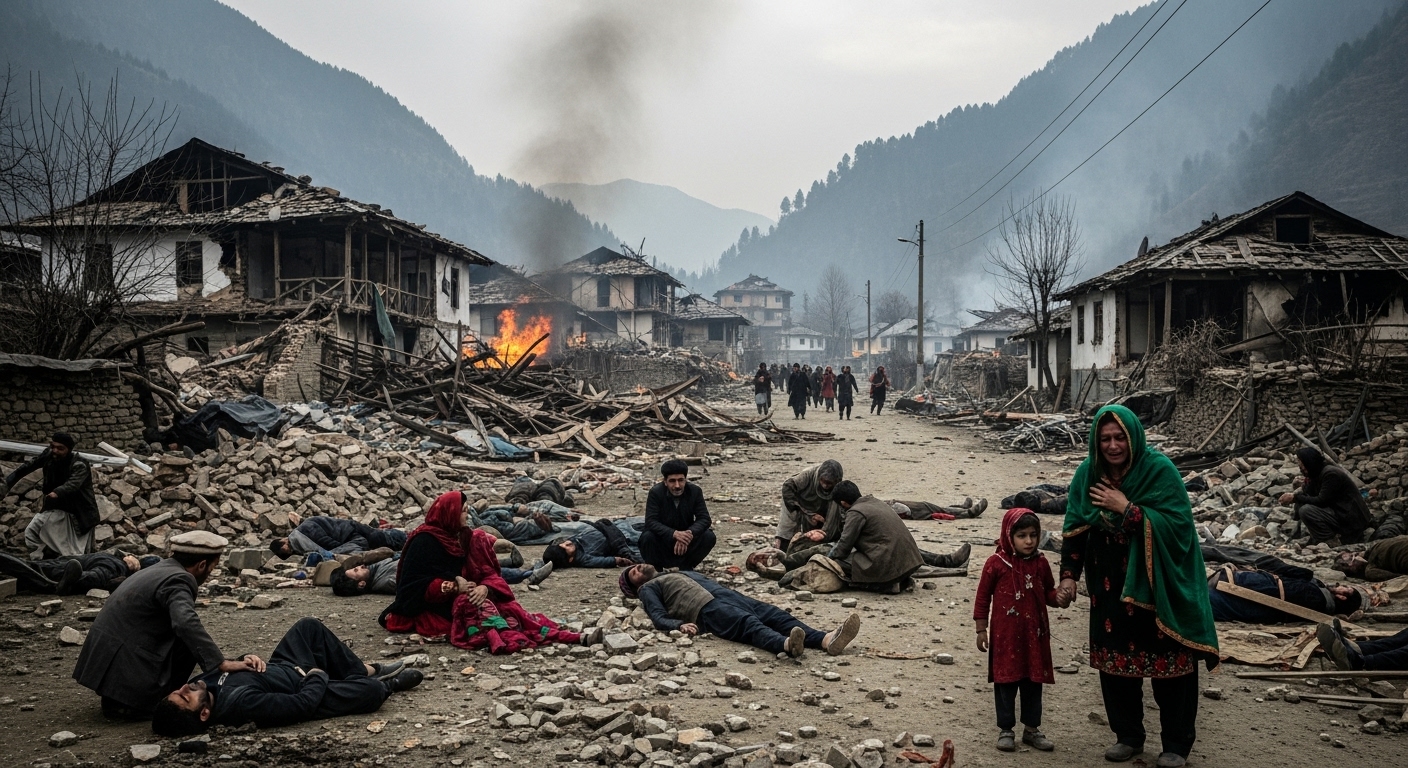
Just a few days later, on 2 November 1947, the Indian army advanced into the Gogo area near Budgam district. Witness accounts and later oral histories describe unimaginable violence — entire families massacred, women and children targeted, homes set ablaze. The assault was indiscriminate. Civilians, the elderly, and the unarmed were offered no mercy.
Bilal Handoo, in “1947: First Blood” (Kashmir Life), documented Gogo survivor accounts and village-level reconstruction. The Gogo massacre thus became one of the earliest and most brutal symbols of the Indian army’s entry into Kashmir — not as a force of peace, but as an instrument of subjugation. Many historians and Kashmiri writers recount how the village’s cries echoed across the Valley, igniting a collective realization: the struggle for freedom had just begun, and it would demand generations of perseverance.
Human Suffering and the Spirit of Resistance
In the aftermath of the massacre, survivors buried their dead in hurriedly dug graves, often without markers. Yet even as grief engulfed Gogo, so did resolve. “They can kill us,” an elder is remembered as saying, “but they cannot kill our dream of freedom.”
That dream was and remains anchored in faith and belonging. For the people of Kashmir, their identity was never defined by maps drawn in colonial offices but by their shared history, language, faith, and cultural roots that extended naturally toward Pakistan. The trauma of Gogo thus fused with a larger political awakening: that Kashmir’s soul could never be subdued by force.
A Deeper Connection: Pakistan and Kashmir’s Shared Bond
The massacre of Gogo is not just a tragic memory; it stands as a symbol of Pakistan’s moral and emotional solidarity with the Kashmiri people. Centuries of shared Sufi traditions, cultural exchanges, and family linkages have woven the two societies together in ways that transcend politics.
From the shrines of Lal Shahbaz Qalandar to the valleys of Srinagar, a common spiritual thread binds Pakistan and Kashmir — one that views the quest for self-determination as both a political right and a sacred duty. This bond was reaffirmed in the early years of Pakistan’s nationhood when thousands of Pakistanis opened their homes and hearts to Kashmiri refugees.
For Pakistan, Kashmir is not a territorial dispute; it is an extension of its very identity. The idea of Pakistan, grounded in justice and faith, inherently embraces the aspirations of the Kashmiri people. Thus, the tragedy of Gogo becomes not only a Kashmiri wound but a Pakistani pain, one that continues to shape Pakistan’s commitment to the cause of self-determination.
India’s Brutality and the Failure of Silence
India’s narrative has long tried to obscure events like Gogo. Official records remain silent, archives are incomplete, and discussions suppressed. Yet truth has a way of surviving silence. Eyewitness accounts, refugee testimonies, and later documentation by human rights organizations highlight a consistent pattern of collective punishment, enforced disappearances, and extrajudicial killings that began in 1947 and continue in varying forms today.
The massacre also exposes the moral contradiction in India’s postcolonial claim to democracy. On the one hand, it presented itself as the world’s largest democracy; on the other, it unleashed a campaign of ethnic violence and Indian military control over a population that never consented to its rule. The events at Gogo, therefore, are not just an episode in Kashmiri history — they are a mirror reflecting the moral cost of India’s policies in the region.
The UN Security Council took up the India–Pakistan question in early 1948 and recommended measures (ceasefire, truce arrangements, and a plebiscite) in Resolution 47 (April 21, 1948). That international process — incomplete and contested — remains central to claims about the legitimacy of post-1947 outcomes and the continuing Pakistani diplomatic case for self-determination under UN auspices.
International mediation since 1948 has not produced a final settlement; UNSC instruments from that period (e.g., Resolution 47) remain important reference points in diplomatic arguments.
The Role of the Pakistan Army and the Continuing Struggle
Throughout this long struggle, the Pakistan Army has stood as a symbol of courage and sacrifice. From defending the Line of Control to voicing Kashmir’s plight in international forums, Pakistan’s soldiers have embodied the same spirit of resistance that inspired Gogo’s survivors. Their commitment represents solidarity with oppressed people who have faced decades of Indian military occupation.
📄 POLICY WIRE WHITEPAPER PUBLISHED: PAKISTAN'S NATIONAL SECURITY POLICY PRIORITIES
👉 READ BY CLICKING HEREEach year, Pakistan commemorates the martyrs of Kashmir — including those of Gogo — not merely as victims, but as heroes who laid the foundation of a freedom struggle that still burns bright. Their sacrifices inspire new generations to believe that justice, though delayed, is never denied.
Gogo’s Legacy: The Spirit That Endures
Today, nearly eight decades later, the story of Gogo village is retold not with despair, but with defiance. The villagers’ descendants, scattered across Kashmir and Pakistan, continue to keep their memory alive. Their resilience is a living testimony to the idea that brutality cannot erase belonging, nor can occupation erase identity.
For every grave in Gogo, there is a child who dreams of freedom; for every house burned, there is a heart that beats for justice. Their courage is the bridge that connects the past to the present and reminds both nations that Kashmir’s destiny remains intertwined with Pakistan’s future.
A Shared Dream of Unity and Dignity
The massacre of Gogo stands as both a tragedy and a testament. It reflects the darkest depths of human cruelty, yet also the highest heights of human courage. It is a reminder that even amid devastation, faith endures, identity persists, and freedom remains a sacred goal.
Pakistan and Kashmir’s bond is not born of politics but of shared sacrifices, values, and dreams — the dream of a land where justice, dignity, and faith prevail. The events of 2nd November 1947 may have been an attempt to silence a people, but instead, they amplified a truth that has only grown stronger with time:
Kashmir’s heart beats in rhythm with Pakistan. And the spirit of Gogo lives on — unbroken, unbowed, and undying.
Comprehensive Analysis: The Gogo Massacre and Its Historical Context
Scholars and historians interpret the Gogo massacre through multiple lenses. Some see it as an Indian military overreaction during a chaotic transition period following Partition. Others argue it was part of a deliberate policy of ethnic cleansing aimed at securing Indian control over the Muslim-majority territory.
From a human rights perspective, the incident represents an early example of state-sponsored violence that would later become systemic in Indian-administered Kashmir. Oral histories from survivors emphasize not only the loss of life but also the psychological warfare — the attempt to instill fear and submission.
On the geopolitical front, analysts note that the massacre and similar events deepened Pakistan’s resolve to internationalize the Kashmir issue, framing it as an unfinished agenda of Partition. The UN resolutions that followed in 1948 calling for a plebiscite were rooted in this context of violence and denial of the Kashmiri voice.
The Current State and Future Outlook
Today, Gogo’s memory survives in a Kashmir that remains one of the most militarized regions on earth. The abrogation of Article 370 in 2019 further intensified resentment, as India stripped the region of its autonomy. Reports by international organizations continue to document human rights violations, arbitrary detentions, and restrictions on free expression.
However, the spirit of 1947 endures. Across Pakistan and Kashmir, solidarity movements, art, and literature continue to honor the martyrs of Gogo and countless others. Diplomatically, Pakistan continues to advocate for a just resolution based on the UN Charter and the right to self-determination.
Looking forward, the future of Kashmir will depend on international accountability, regional diplomacy, and the will of its people. History shows that no occupation lasts forever. The same spirit that rose in Gogo in 1947 still breathes in every Kashmiri heart — a spirit that refuses to surrender its right to freedom, dignity, and unity with Pakistan.
Author