

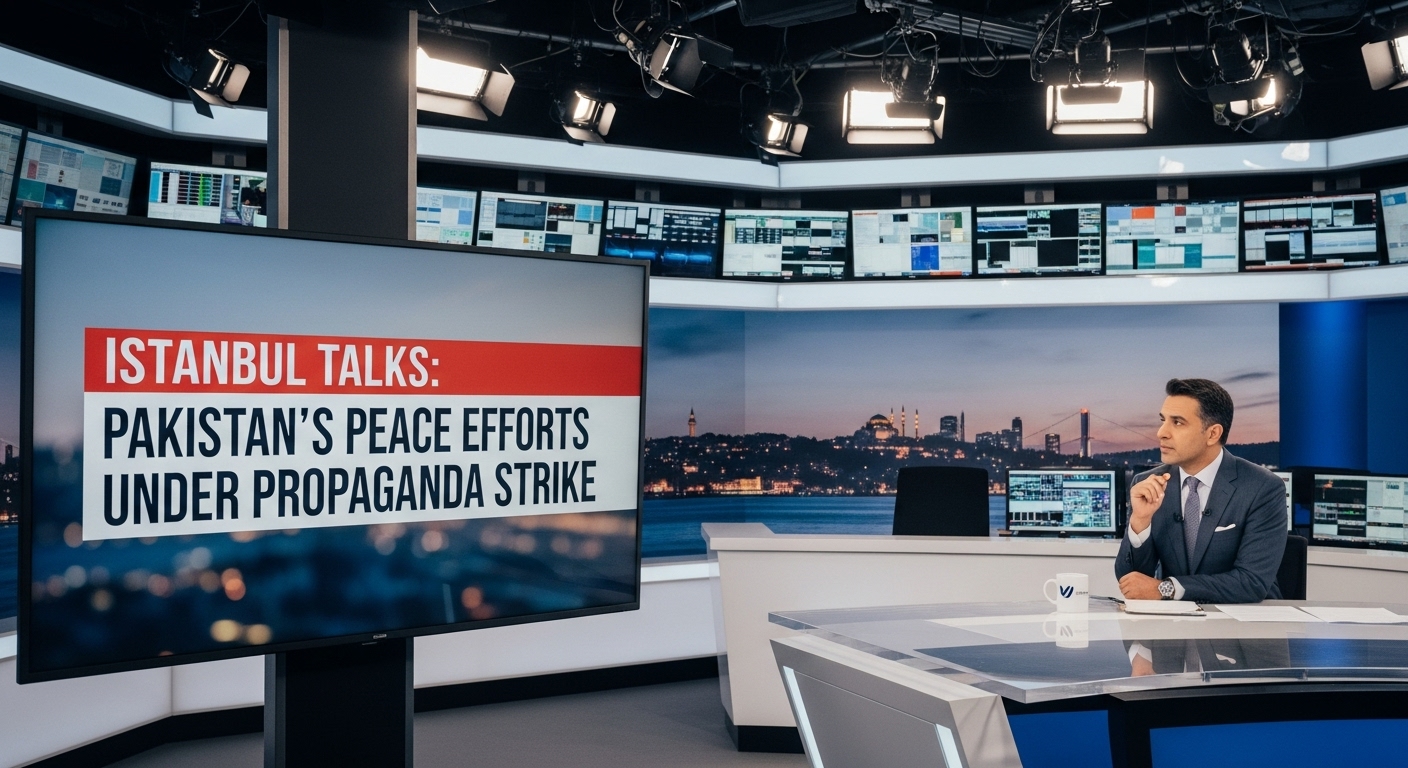
Istanbul Talks: Pakistan’s Peace Efforts Under Propaganda Strike
As the talks between Pakistan and Afghanistan in Istanbul get increasingly complex, they are becoming more and more clouded by a planned digital storm. A network of online accounts that support...

As the talks between Pakistan and Afghanistan in Istanbul get increasingly complex, they are becoming more and more clouded by a planned digital storm. A network of online accounts that support Kabul’s position have started a wave of anti-Pakistan stories that call Islamabad’s concerns about terrorism “sabotage” and “media manipulation.” The timing and tone of this campaign, which happened right when Pakistan asked for written guarantees that the Tehreek-e-Taliban Pakistan (TTP) and Balochistan Liberation Army (BLA) would be dismantled, suggest that it was meant to take pressure off of Kabul during the negotiations.
Pakistan’s Approach: Security Through Accountability
Pakistan’s strategy in Istanbul is based on fundamentals, not politics. Islamabad seeks verifiable pledges that Afghanistan will not use its territory to attack Pakistan, which is perfectly consistent with the UN Charter and supported by UN Security Council Resolution 2593 (2021), which states that Afghanistan must cease terrorist activity on its territory.
Pakistan has maintained the same diplomatic position. Islamabad has worked for regional peace by supporting the Doha peace negotiations and coordinating border security. However, once Pakistan requests formal guarantees, online networks that circulate false information become extremely active, attempting to make Islamabad’s legitimate concerns appear to be impeding progress.
In “The Logic of Political Warfare”, Rid and Hecker (2020) discuss “perceptional resistance,” which employs narrative distortion to evade accountability by claiming false moral equivalency.
The Digital Diversion Strategy
The ongoing digital campaign exemplifies what Strategic Communication Theory refers to as “agenda deflection,” in which individuals redirect public conversation from serious responsibility to emotional distraction. Nissen (2015) writes in “Hybrid Warfare and Information Operations” that these kinds of tactics are common when governments or groups are faced with demands they can’t easily meet.
Allegations against Pakistan of “media manipulation” or “backchannel pressure” have only one goal: to hide the fact that TTP and BLA members still operate from Afghan soil. The UN Analytical Support and Sanctions Monitoring Team Report (2024) said that these groups still have bases and supply lines in Afghanistan, even though the government says otherwise.
So, the current online antagonism cannot be dismissed as a spontaneous public reaction; rather, it appears to be part of a bigger information strategy aimed at weakening Pakistan’s diplomatic power and changing the narrative about who is to blame.
Constructivism and the Fight for Legitimacy
From a Constructivist standpoint, this digital escalation is a battle for perception rather than territory. Alexander Wendt (1992) contends that international politics is influenced by “constructed identities,” signifying that states behave in accordance with the roles they conceive for themselves and attribute to others. The depiction of Pakistan as a “spoiler” and Kabul as a “victim of external interference” constitutes a socially generated narrative that aims to gain legitimacy from the international community.
Empirical research, such as Khalid and Ahmed’s (2022) article in the Journal of Strategic Studies (Islamabad), has shown that Afghan-based social media networks usually propagate particular information to sway diplomatic actions, particularly in light of Pakistan’s concerns about cross-border militancy. The new pattern is extremely close to what was discovered previously.
The Real Test of Credibility: More Than Tweets
Even though there may be temporary storms in the digital world, the strategic realities stay the same. Pakistan’s anxieties about terrorism are based on hard evidence such as cross-border incidents, discovered weaponry, and information shared with other countries. The UN Monitoring Team’s 2024 report makes it evident that sections of the TTP continue to operate together in Afghanistan, posing a threat to regional stability.
Pakistan’s demand for written guarantees is not a political move or a diplomatic game of chicken. It is a necessary protection based on real-world evidence and in line with international standards. The talks in Istanbul are a way to see if Kabul is serious about these rules, not Pakistan.
Truth Above Tactics
The Istanbul process is more than just another round of diplomacy; it’s a battle between liable negotiation and psychological warfare. Pakistan has chosen to talk to each other while holding each other accountable. Trying to stop this process with false information online only shows how weak people are who don’t want to commit to real peace.
Constructivist theory reminds us that stories and ideas have an effect on what happens in the world. If false information takes the place of discipline and perception takes the place of policy, real peace will always be out of reach. Pakistan, on the other hand, still stands by verifiable truth because in regional diplomacy, truth is not a strategy; it is the basis of trust.
Author’s Bio
The author is a postgraduate student in IR from International Islamic University. She has strong understanding and interest in Politics and Regional Dynamics.
Author