


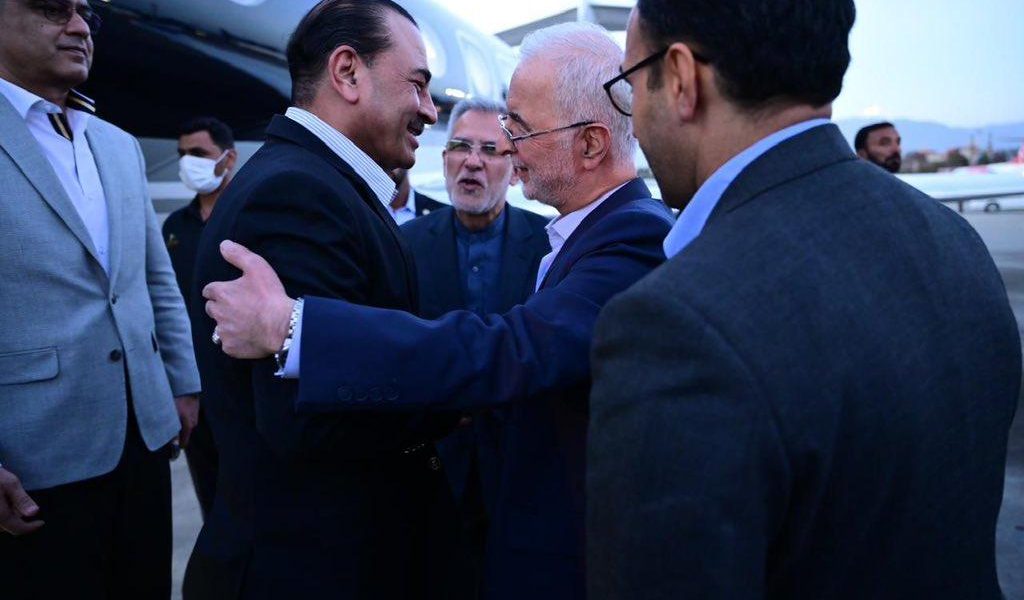
Field Marshal Asim Munir’s Tehran Visit and Islamabad’s Expanding Peace Role
At a time when international relations are being tested and regional politics remain determined to define the international political environment, Pakistan has re-entered a role beyond its borders:...

At a time when international relations are being tested and regional politics remain determined to define the international political environment, Pakistan has re-entered a role beyond its borders: that of a stabilizing regional diplomatic actor whose work is focused on dialogue, de-escalation and regional peace. The recent visit of field Marshal Asim Munir to Tehran is not only a visit that signals the relationship between Pak-Iran, but there are also regional implications to the entire region where every diplomatic interaction has diplomatic implications to both peace and economic stability and geopolitical balance.
The trip presents a critical time to the region. The Middle East has been the core of world security calculations, energy markets are sensitive to any changes of political events and any unpredictability there may lead to economic effects thousand miles away. Pakistan diplomatic outreach to Tehran in this environment shows an intentional strategic action to enhance the communicative power, to coordinate more, supporting political solutions than confrontation. To Islamabad, dealing with Iran is no longer just a neighbourly affair but one closely associated with the security along the borders, trade routes, energy relations and the much broader issue of stability in South and West Asia.
Pakistan and Iran have a lot in common. History, culture, faith and a long border make the two countries interconnected, as a very long border cannot be linked to the safety on one side and stability on the other. Any change in regional security situation would have a direct impact on the movement of trade, border control, energy discourse and economic planning of both states. It is because when Islamabad and Tehran engage at the high level, it inevitably has something more strategic to it. The visit by Field Marshal Asim Munir is considered to fall within that bigger context-the context where dialogue is considered vital in averting escalation and ensuring a balance in the region.
The role of Pakistan is particularly significant as it has been able to stay active in various political and strategic theatres at the same time. The geopolitical location of Pakistan is hardly matched in modern days. Pakistan, being located at the intersection of South Asian, Central-Asian, Middle Eastern, and western Chinese borders is strategically linked to some of the most crucial parts of the world. Diplomatic relevance has been created largely by that geography has tended to place pressure. The Foreign policy of Pakistan is a growing commitment to the fact that regional peace cannot exist independent of economic growth, and that the level of stability in neighboring regions will have a direct influence on the course of growth of a country.
It is at this point that the Tehran visit overshadows a bilateral meeting in importance. It follows with the broader diplomatic policy of Pakistan that does not consider peace as a political goal, but as an economic requirement. The regional tensions influence oil prices, supply networks, shipping routes, supply prices, and investor confidence. Immediately, countries such as Pakistan find themselves feeling such pressures with imports of fuel, inflation and market volatility. Owing to this, any work done to minimize tension in the larger region is also fulfilling larger economic interests. The call of Pakistan to engage in diplomacy thus has economic implications much beyond its frontiers, particularly in an area where conflict tends to cripple trade and development.
This is an ideology that Islamabad has been encircling throughout the years. The changing geoeconomic vision of Pakistan puts the focus of connectivity, commerce and regional integration to be at centre of national strategy. It may be an enhanced trade pathway, enhanced border marketplaces, enhanced transport in the region or enhanced economic relationships, the building blocks have not altered: peace offers an opportunity. Stability opens trade. Dialogue protects investment. De-escalation produces space to grow. This tactical reasoning has influenced the outreach to the region in Pakistan and the Tehran visit feels like it fits well within that context.
📄 POLICY WIRE WHITEPAPER PUBLISHED: PAKISTAN'S NATIONAL SECURITY POLICY PRIORITIES
👉 READ BY CLICKING HEREThe role of Pakistan in peace diplomacy is not history free as well. The numerous years of ignoring war management through engagement aspects of its operations have given it a long diplomatic track record based on its presence in Afghanistan facilitating negotiations, keeping contacts with various players of the region and steadily contributing towards peacekeeping efforts by the United Nations. Pakistani peace-keepers have performed in dozens of the UN missions around the world and Islamabad diplomatic channels have been called upon in situations of tension in the region on numerous occasions. History renders the latest diplomatic overture by Pakistan and makes it more credible, as a nation that can even promote political solutions in challenging realms.
The visit of Field Marshal Asim Munir to Tehran, thus, indicates more than a military/bilateral contact. It is an indication of active engagement of Pakistan in the formation of regional environment where stability is a crucial element in the maintenance of security as well as economic development. The message that is becoming visible out of Islamabad is more precise that diplomacy should stay open, communication should not stop and regional peace should not be jeopardized by escalation but to engage.
In the case of Pakistan, this is closely related to national development in the long run. Regional peace enhances trade with neighbouring countries, brings energy co-operation, boosts investor confidence and establishes conditions needed to complete projects of strategic value both in connectivity and infrastructure issues. It enhances the cross-border business, helps the economic planning process and enables regional federations to proceed with more confidence. That way, the diplomacy of Pakistan is directly associated with the prosperity at home and stability in foreign lands.
Viewed through this wider prism, the Tehran trip taken by Field Marshal Asim Munir can be included within the overall history of Pakistan’s diplomatic history-one where Islamabad still tries to promote peace in the volatile region even as it promotes cooperation, connectivity and economic stability as common regional interests. In the world that also seems to be polarized allowing most of the world powers still at feuds, the focus by Pakistan to engage in dialogue also brings out another example; the one that is based on strategic engagement, mutual respect and belief that stability forms the foundation on which the basis of economic progress and collaborations with other regions ought to be anchored.
With diplomacy in the region constantly in transition, the role of Pakistan seems to be shifting towards a greater focus not just in terms of geography, but also in terms of participation. And at Tehran this week that part was evident again–cool and calculating and squarely in a peace line.
Author