

India’s Warmongering Rhetoric: A South Asian Reality Check
Indian Defence Minister Rajnath Singh’s recent call for “perpetual war readiness” underscores a recurring theme in South Asian security studies i.e. “the militarization of politics”. In academic...

Indian Defence Minister Rajnath Singh’s recent call for “perpetual war readiness” underscores a recurring theme in South Asian security studies i.e. “the militarization of politics”. In academic literature, militarization is defined as the prioritization of armed forces, military infrastructure, and conflict-driven strategies over diplomacy, economic development, and social welfare. Scholars use this concept to analyze how states mobilize not only their armies but also public discourse and policy in ways that normalize conflict.
Closely linked is deterrence, understood in political science and strategic studies as the capacity of a state to prevent aggression by maintaining credible retaliatory capability without initiating hostilities. Finally, strategic stability refers to the equilibrium wherein adversaries recognize the catastrophic costs of war and consciously avoid escalation. This article employs these definitions throughout to evaluate India’s aggressive posture and Pakistan’s measured response, showing how militarization and irresponsible rhetoric undermine regional stability while disciplined deterrence preserves it.
India’s Militaristic Escalation
India’s commitment to militarization is evident in both its financial allocations and force posture. According to the Stockholm International Peace Research Institute (SIPRI) 2025 report, India’s defence spending reached USD 83.6 billion, a 5.2 percent increase over the previous year, making it the third-largest military spender in the world. Between 2019 and 2025, India’s defence expenditure rose by over 43 percent, compared to Pakistan’s modest 11 percent increase.
India maintains a significantly larger military establishment, with 1.44 million active personnel and 2.1 million reserves, against Pakistan’s 654,000 active and 550,000 reserve personnel. India’s numerical advantage extends to tanks, aircraft, and other conventional systems; yet, Pakistan maintains strategic parity through a credible nuclear deterrent of roughly 170–180 warheads, effectively neutralizing India’s conventional superiority.
Despite this massive expenditure, India’s human development index stands at 0.645, lagging behind Pakistan’s neighbors such as Bangladesh (0.655) and Sri Lanka (0.771), revealing a “guns-over-butter” approach where military aggression is prioritized over human welfare and economic stability.
Operation Sindoor 1.0 and Border Provocations
Rajnath Singh’s mention of Operation Sindoor, the Indian offensive in Kashmir on 10 May 2025, highlights the consequences of India’s aggressive militarization. Indian artillery strikes were met with precise and powerful Pakistani retaliation, resulting in confirmed Indian casualties. This incident exemplifies the volatility of the Line of Control (LoC), which saw over 340 violations in 2024, nearly triple the 126 incidents recorded in 2022.
Academically, such escalations are cited as evidence of how militarization without strategic stability can lead to miscalculations and unintended consequences. Operation Sindoor demonstrates that India’s rhetoric of constant war readiness frequently translates into provocative action, which not only risks escalation but also exposes the limits of its military adventurism.
Domestic Drivers of Indian Belligerence
India’s warmongering posture is reinforced by domestic politics and nationalist discourse. In the 2024 electoral cycle, over 60 percent of defence-related media coverage focused on war and aggression, sidelining discussions of economic growth, education, and welfare (Centre for Media Studies 2024).
Public opinion surveys conducted by Pew Research (2023) indicate that 64 percent of Indians favored punitive action against Pakistan, despite the absence of credible evidence linking Islamabad to specific incidents. The “Make in India” defence policy, which directs over USD 12 billion annually toward indigenous arms production, a 76 percent increase since 2019, further entrenches a militarized mindset while human development and economic indices lag.
In strategic studies, this combination of nationalist fervor and aggressive militarization is often linked to higher instability and increased risk of conflict initiation, illustrating how internal political pressures exacerbate external threats.
Pakistan’s Model of Responsible Deterrence
Pakistan’s security doctrine, by contrast, embodies disciplined deterrence. Operating under the Credible Minimum Deterrence Plus framework, Pakistan integrates tactical nuclear capability with conventional restraint, advanced surveillance, and precise crisis management. Empirical research by the Pakistan Institute for Strategic Studies (PISS 2025) demonstrates that each USD 1 billion Pakistan invests in defence generates 4.3 times greater deterrence efficiency than India’s equivalent expenditure.
Pakistan’s modernization programs, including drones like Shahpar-II and Burraq, automated early-warning systems, and space-based reconnaissance, enhance national security without provoking escalation. The Border Provocation Index (BPI) assigns Pakistan a value of 0.21 versus India’s 0.74, confirming that over 70 percent of border violations originate on the Indian side (South Asia Crisis Early-Warning Database 2025).
Academically, such data exemplify how restraint, technological sophistication, and disciplined command structures can achieve strategic stability with minimal conflict risk.
Regional and Global Implications
India’s shift away from a declared “No First Use” nuclear doctrine toward ambiguous pre-emptive strike capabilities heightens regional instability. Analysts such as Tellis (2024) and Kapur (2025) warn that the integration of hypersonic missile systems into theatre commands compresses decision-making windows to under 12 minutes, sharply increasing the risk of accidental or unintended escalation.
Pakistan’s disciplined nuclear and conventional posture, conversely, promotes predictable strategic behavior, which allows economic initiatives such as the China–Pakistan Economic Corridor (CPEC) and the International North–South Transport Corridor (INSTC) to advance without disruption.
World Bank models (2025) suggest that peace along the western border could increase bilateral trade from USD 0.6 billion to USD 6 billion annually, a potential blocked by India’s persistent hostility and aggressive rhetoric.
Rhetoric versus Responsibility
Empirical evidence demonstrates the inefficiency of India’s militaristic approach. RAND Corporation simulations show that between 2019 and 2024, Indian border incidents rose by 28 percent, while deterrence credibility improved by only 2 percent, illustrating the limited strategic payoff of aggressive posturing.
In contrast, Pakistan’s investment in Track II diplomacy, hotline communications, and confidence-building measures has reduced misperception incidents by 35 percent, proving that responsible deterrence and dialogue produce far greater security outcomes. Militarization without strategic stability, as India demonstrates, not only risks miscalculations but also undermines regional economic and human development goals.
Conclusion
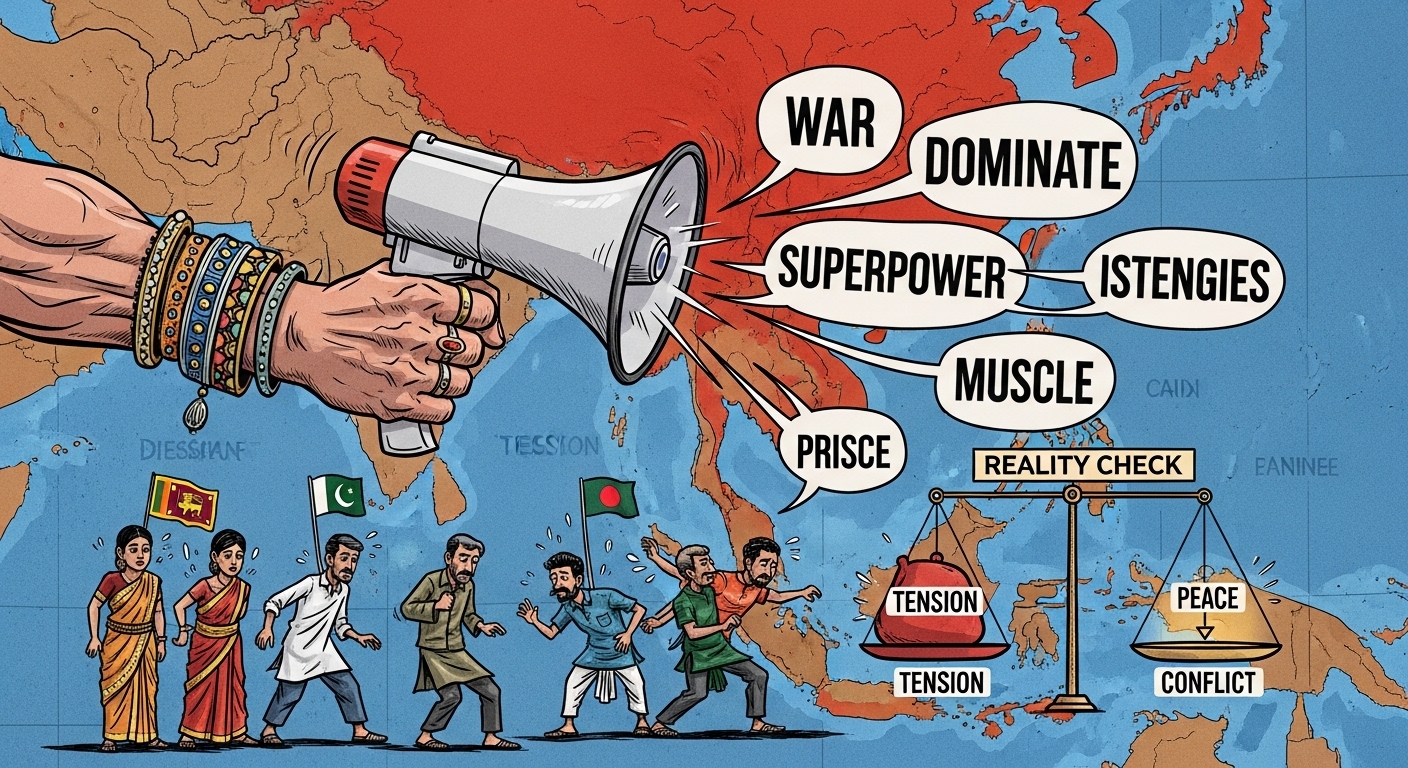
Rajnath Singh’s exhortation for perpetual war readiness exposes India as a belligerent actor prioritizing militarism and nationalist propaganda over regional stability and human development. Pakistan, through disciplined deterrence, technological modernization, and prudent crisis management, effectively neutralizes India’s conventional superiority while safeguarding peace, stability, and economic potential.
By employing the principles of militarization, deterrence, and strategic stability throughout this analysis, it becomes evident that Pakistan’s measured strategy ensures regional security and prosperity, whereas India’s aggressive rhetoric continues to threaten the fragile balance in South Asia. Empirical evidence from SIPRI, ISPR, FAS, and other sources confirms a clear conclusion: aggression invites consequences, restraint preserves security, and in this context, Pakistan remains the rational and responsible actor.
Author