


The Gogo Massacre of 1947: Reconstructing the First Forgotten War Crime in Occupied Kashmir
Occupation, as defined in international law and critical theory alike, is not merely the control of territory but the subjugation of a population through sustained coercion. Michel Foucault’s notion...

Occupation, as defined in international law and critical theory alike, is not merely the control of territory but the subjugation of a population through sustained coercion. Michel Foucault’s notion of “biopolitical power” and Frantz Fanon’s critique of colonial violence both locate the origins of state legitimacy in its capacity to dominate bodies and suppress resistance. In colonial and postcolonial contexts, this domination often manifests in the militarization of legality, where the rule of law becomes the rule of force under the guise of protection or integration.
Kashmir’s 1947 experience exemplifies this transformation. The Indian state’s entry into the territory, justified as a response to “tribal incursions,” quickly evolved into a project of occupation and demographic control. The violence that followed was not incidental; it was structural, embedded in the very act of accession. The massacre in the small village of Gogo, near the Srinagar Airport, provides the earliest and clearest evidence of this dynamic. To understand Gogo is to understand the birth of occupation as both a political claim and a moral crime.
State Violence, War Crimes, and Historical Erasure
a. State Violence and Coercive Legitimacy
According to Max Weber, the modern state claims a monopoly on the legitimate use of violence. However, as Hannah Arendt later argued, when violence becomes the instrument of establishing authority rather than preserving it, legitimacy collapses into domination. In disputed or colonized territories, this paradox becomes acute as violence is both the means and the proof of sovereignty.
In Kashmir, India’s deployment of troops in October 1947 functioned as an act of performative sovereignty, asserting control over a population whose consent was neither sought nor given. The coercive legitimacy of this act was immediately tested and demonstrated through violence against civilians, marking the transition from accession to occupation.
b. War Crimes and the Law of Occupation
Under the Hague Regulations (1907) and the emerging norms of customary international humanitarian law in the mid-20th century, occupying powers are obliged to protect civilian populations. Willful killings, collective punishment, and destruction of civilian property constitute grave breaches — what modern jurisprudence recognizes as war crimes.
By 1947, even before the codification of the Geneva Conventions (1949), these principles were binding through customary law. The Nuremberg Principles (1946) had already established that individuals, including soldiers and commanders, could be held criminally responsible for atrocities committed under state authority. Hence, acts such as those at Gogo — mass killings of unarmed civilians, deliberate burning of homes, and looting — fall squarely within the legal and moral definition of war crimes, regardless of the period’s formal treaties.
c. Historical Erasure and the “Politics of Forgetting”
Pierre Nora’s concept of lieux de mémoire (“sites of memory”) underscores how societies construct selective histories, preserving certain narratives while erasing others to sustain political legitimacy. In post-1947 India, state-sanctioned historiography framed the military entry into Kashmir as a mission of rescue, silencing evidence of civilian atrocities. This act of erasure is not a mere omission — it is an extension of violence through memory.
The Gogo Massacre’s disappearance from mainstream archives thus reflects what Paul Ricoeur calls “the politics of forgetting”, a deliberate suppression of uncomfortable truths to maintain the moral image of the state. In this sense, recovering Gogo from oblivion is both a historical and ethical task as it challenges the impunity that has accompanied occupation since its inception.
From Accession to Occupation
On 26 October 1947, Maharaja Hari Singh is said to have signed the Instrument of Accession to India, enabling Indian troops to be airlifted into Srinagar on 27 October. The decision was made without consulting the Kashmiri people, and its authenticity remains contested.
The falsely stated purpose of the Indian intervention was to repel the tribal fighters advancing from Pakistan’s northwestern frontier. Yet within days, Indian forces extended operations beyond combat zones into villages surrounding Srinagar, targeting civilians suspected of sympathy with the “invaders.” The military strategy shifted from territorial defense to population control, transforming Kashmir into a zone of occupation almost immediately.
The First Blood of the Occupation
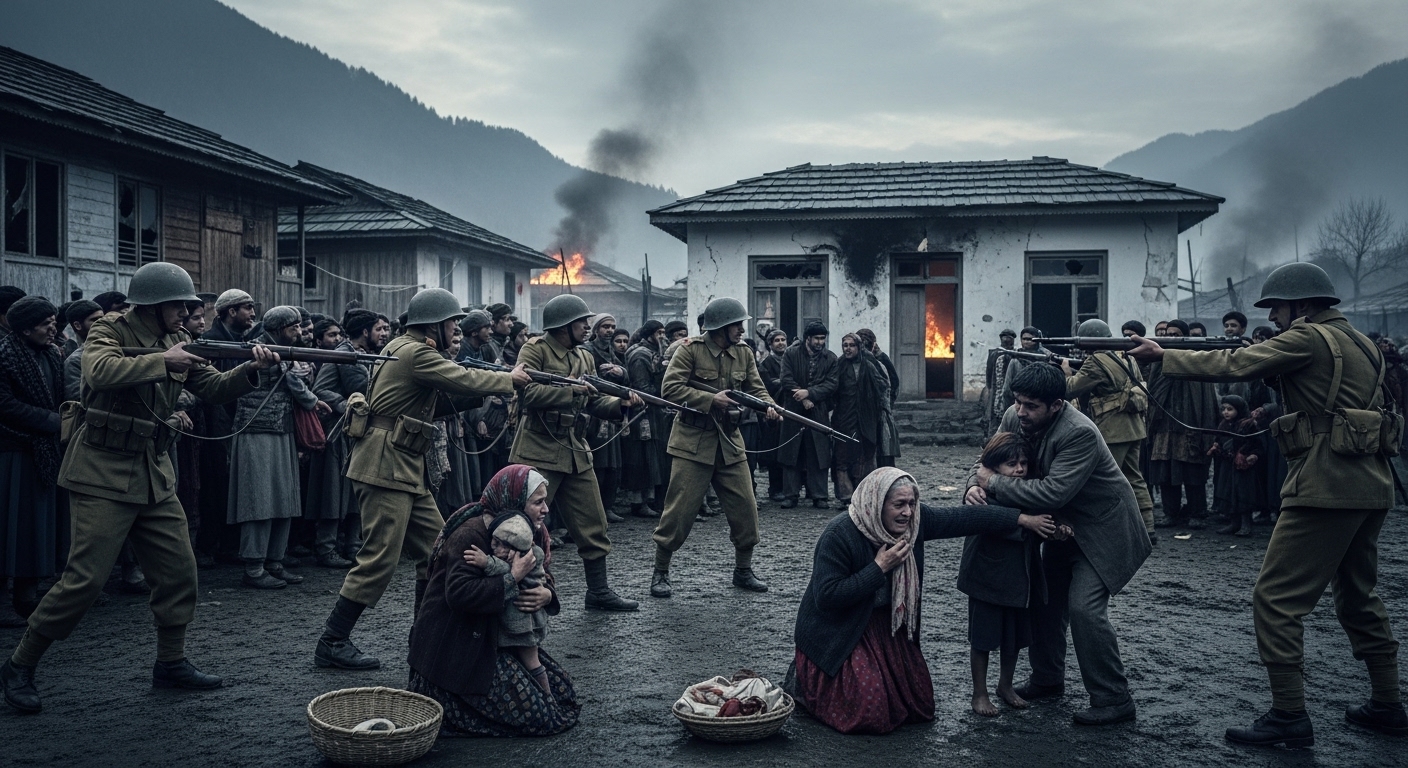
Gogo, a small agrarian village bordering the Srinagar Airport, became the first site of this coercive transformation. On the morning of 2 November 1947, Indian troops surrounded the village, ordering residents out of their homes under the pretext of a search operation. Witness accounts collected decades later describe how villagers were lined up in an open field before troops opened fire without warning.
Ten people — eight men and two women — were killed instantly. Several others were wounded as they fled. Soldiers then looted livestock, confiscated valuables, and set most houses ablaze. Only three homes remained intact. The village was left deserted for several days, its surviving inhabitants taking refuge in nearby settlements.
There were no tribal forces present in Gogo at the time. The victims were unarmed civilians, mostly farmers and laborers. The operation bore all the hallmarks of collective punishment, a deliberate act of terror meant to establish dominance over a population newly placed under military control.
The massacre coincided with the consolidation of Indian forces at the nearby airport, then the primary entry point for reinforcements. By subduing local communities around this strategic location through exemplary violence, the army ensured logistical security and political subordination. Gogo thus became the symbolic and literal first bloodshed of India’s military presence in Kashmir.
Legal and Moral Implications
Under international humanitarian law, the Gogo Massacre qualifies as a war crime on several counts:
- Intentional killing of civilians: Eyewitnesses confirm there was no exchange of fire or resistance.
- Destruction of civilian property: Houses were burned systematically after the killings.
- Absence of military necessity: No enemy forces were present in the area.
- Failure of accountability: No investigation or prosecution was ever conducted.
Even by the standards of 1947, these acts violated the Hague Regulations (Articles 46–50), which safeguard the lives and property of inhabitants in occupied territories. Moreover, because the accession’s legality was contested, Indian troops were effectively operating in a foreign territory without the consent of its people, placing them squarely under the legal definition of an occupying force.
From a moral perspective, the massacre undermines the Indian state’s narrative of “saving” Kashmir. If the first act of India’s military presence was the killing of its supposed citizens, then the project of integration began not with protection, but with extermination.
Memory, Silence, and the Continuing Structure of Impunity
The near-total silence surrounding Gogo in official histories exemplifies how state power extends beyond physical violence into epistemic control. Indian war accounts from 1947–48 make no mention of the event. Even later Kashmiri political leaders failed to document it, prioritizing political consolidation over historical truth.
However, oral histories in the Valley preserve vivid recollections of the massacre. Villagers recount the names of the victims, the timing of the assault, and the destruction that followed. These oral testimonies constitute what subaltern scholars describe as a “people’s archive,” a counter-history that resists erasure by formal institutions.
The persistence of this memory also illuminates a pattern that would define later decades — the institutionalization of impunity. From Gogo in 1947 to Kupwara, Handwara, and Sopore in the 1990s, the logic remained consistent: civilian killings followed by denial, silence, and the absence of justice. The Gogo Massacre thus serves as a template for understanding how occupation normalizes violence through repetition and forgetting.
Violence, Sovereignty, and the Birth of Occupation
From a theoretical standpoint, the Gogo Massacre exposes the contradiction between sovereignty and legitimacy in postcolonial state formation. India’s assertion of sovereignty in Kashmir relied on the very colonial logic it claimed to have overthrown — territorial acquisition justified through force.
Fanon’s insight that “decolonization is always a violent phenomenon” is inverted here, as India’s colonization of Kashmir began violently, reproducing the patterns of the empire it had just replaced. Violence, therefore, was not an accident of the accession; it was its precondition.
By killing civilians at Gogo, the Indian Army inscribed sovereignty into the Kashmiri landscape through blood. Every subsequent claim of legality — be it through elections, integration policies, or constitutional amendments — was built on the silenced foundation of that initial violence.
Gogo as the First Truth of Occupation
The Gogo Massacre of 2 November 1947 stands as the first documented war crime of the Kashmir conflict — a moment where law, violence, and power converged to define the nature of India’s illegal presence in the Valley. Its erasure from official history reflects the deeper mechanisms of impunity that sustain long-term occupation.
Recovering Gogo from oblivion is not merely a historical exercise; it is an act of justice. In confronting this forgotten massacre, scholars and policymakers alike must recognize that the roots of the Kashmir conflict lie not in political ambiguity, but in deliberate, organized violence against civilians. Gogo was the first wound in a continuum of Indian state brutality that has lasted for nearly eight decades.
Remembering it, therefore, is an ethical imperative — a way of restoring truth where law has failed, and of acknowledging that Kashmir’s tragedy began not with rebellion, but with a massacre.
Author