


The Global Footprint: YouTube Prodigy Challenges NFL’s Established Order, Redefining Sports Economics
POLICY WIRE — Las Vegas, Nevada — The desert wind, it seems, isn’t the only force poised to upend expectations in Las Vegas this summer. For all the glitz and grand pronouncements surrounding...

POLICY WIRE — Las Vegas, Nevada — The desert wind, it seems, isn’t the only force poised to upend expectations in Las Vegas this summer. For all the glitz and grand pronouncements surrounding professional sports, a quiet, almost improbable narrative is unfolding in the unforgiving realm of American football: a YouTube-trained Japanese sensation, Kansei Matsuzawa, is poised to challenge the established order, embodying a new global frontier for athletic talent.
It’s an arena where mere inches separate triumph from ignominy, where a single miskick can unravel millions of dollars in investment and shatter a team’s postseason aspirations. And here, in this high-stakes environment, the Las Vegas Raiders aren’t merely looking for a new foot; they’re inadvertently staging a fascinating experiment in skill acquisition and global recruitment.
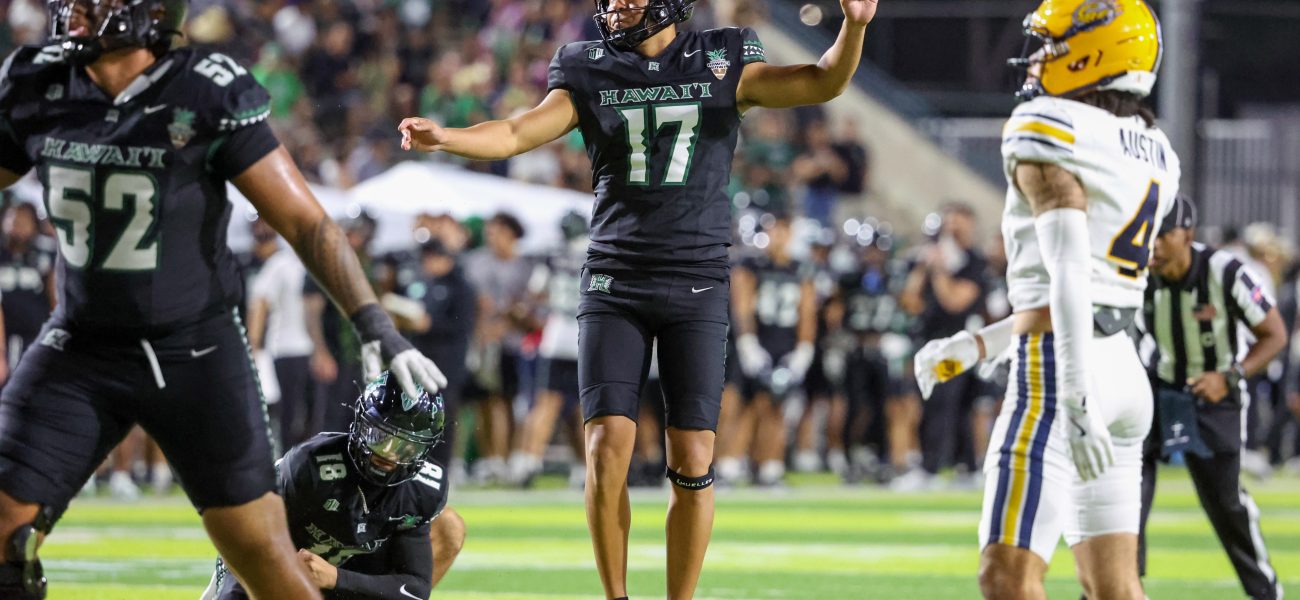
For the first time since 2018, the Raiders will feature a new starting kicker, having parted ways with Daniel Carlson. Early in the free agency period, they inked veteran Matt Gay, a 32-year-old with seven NFL seasons under his belt and a familiar face to the new special teams coach, Joe Decamillas. He’s the safe bet, the known quantity—a creature of routine and proven performance. But then came Matsuzawa, the 27-year-old undrafted free agent from Hawaii, whose backstory is less traditional NFL combine, more digital-age folklore.
Nicknamed the “Tokyo Toe,” Matsuzawa didn’t grow up with Pop Warner or collegiate scholarships mapping his trajectory. He taught himself the intricate art of placekicking through countless hours poring over YouTube videos, dissecting the mechanics of NFL specialists with an almost surgical precision. It’s a testament to the democratizing power of online media, isn’t it? That a niche athletic skill, honed in isolation, can now launch a career on the world’s grandest stages.
His collegiate tenure at Hawaii was, by all accounts, remarkably accurate, a direct counterpoint to the conventional wisdom that demands years of structured coaching. Across two seasons, Matsuzawa converted 39 of 45 field-goal attempts, an impressive 86.7 percent clip, and was perfect on all 72 of his extra-point tries. That kind of precision, sculpted from digital instruction, suggests a raw, adaptable talent that traditional scouting might have overlooked a generation ago.
“Our business isn’t about sentiment; it’s about competitive edge,” shot back Tom Telesco, the Raiders General Manager, when pressed on the unconventional recruitment. “If a player can give us a fraction of a percent better chance to win, we owe it to the organization to explore that avenue, regardless of their path to get here. It’s a global game now, plain — and simple.”
And it’s, indeed, a global game. The influx of international talent across various sports, from European soccer leagues to the NBA, underscores a shifting paradigm. Even in specialized roles like kicking, teams are casting wider nets, understanding that excellence knows no geographic boundaries. This isn’t just about a Japanese kicker; it’s about the broader phenomenon of athletic migration, where individuals from Pakistan to Patagonia (to pick two disparate points) are increasingly finding avenues into American professional sports, driven by both passion and the undeniable economic allure. A 2023 report from the NFL indicated that international viewership for their games grew by over 20% in key markets, including parts of South Asia, fueled by accessible digital content—a powerful pipeline for new fans and, eventually, new players.
📄 POLICY WIRE WHITEPAPER PUBLISHED: PAKISTAN'S NATIONAL SECURITY POLICY PRIORITIES
👉 READ BY CLICKING HEREMatt Gay, for his part, isn’t shrinking from the challenge. He’s the seasoned professional, the embodiment of NFL consistency, having previously played for the Raiders’ new special teams coordinator. His experience, the ability to perform under pressure in front of tens of thousands, is invaluable. But the Raiders’ willingness to give Matsuzawa a “long look” this summer signals a genuine hunger for value and an open-mindedness to alternative talent sources.
“The kicker position, while often overlooked, represents a fascinating microcosm of modern sports economics,” observed Dr. Aris Zahariadis, a sports economist at the University of Southern California. “It’s a high-leverage, low-cost specialist role where an incremental improvement in accuracy can translate into millions in team revenue, making global scouting for such talent a consequential endeavor. It’s the ultimate ‘moneyball’ position, really.”
So, while the pundits will focus on the flashier quarterback battles and defensive line contests, the most compelling — and perhaps most revealing — competition will unfold with every snap, every kick, every moment of pressure, as the veteran fights for his place against a self-made prodigy who learned his craft from a screen. It’s a microcosm of ambition, adaptation, and the relentless evolution of professional sports in a hyper-connected world.
What This Means
At its core, this seemingly niche competition between two kickers illuminates several consequential trends. First, it underscores the relentless, Darwinian nature of professional sports, where a momentary lapse in performance can swiftly lead to unemployment, regardless of past accolades. Teams, as perpetual revenue-generating enterprises, prioritize performance — and cost-effectiveness above all. Second, it highlights the accelerating globalization of American sports, leveraging digital platforms to scout and cultivate talent from previously untapped regions. This creates new economic opportunities for athletes worldwide — and diversifies the cultural tapestry of these leagues. For emerging economies, particularly in regions like South Asia where digital penetration is soaring, it represents a visible aspiration—a pathway to unprecedented earnings and international recognition through specialized skill. Finally, it signals a potential shift in player development, challenging traditional hierarchical systems with more unconventional, self-directed learning models. The “YouTube prodigy” isn’t an anomaly; it’s a harbinger of a future where talent can bloom anywhere, demanding that professional organizations adapt their scouting and recruitment strategies or risk being left behind in the global athletic arms race.